
Most American businesses are spending nearly a third of their operating budget on energy costs each year. For Florida companies aiming to boost profitability and sustainability, traditional power bills can feel like a constant drain. Exploring solar panel installation not only curbs expenses but also opens doors to valuable tax credits and financing options. This guide walks through the key steps for owners who want to take control of energy usage and future-proof their business.
Table of Contents
- Step 1: Assess Current Energy Usage And Site Conditions
- Step 2: Research Solar Options And Select Providers
- Step 3: Review Financing, Incentives, And ROI Projections
- Step 4: Plan Installation Logistics And Set Project Timelines
- Step 5: Verify Compliance And Finalize Solar Activation
Quick Summary
| Key Insight | Explanation |
|---|---|
| 1. Assess Energy Usage Thoroughly | Collect detailed energy consumption data and site characteristics to evaluate solar potential. |
| 2. Research Solar Options Carefully | Understand different solar technologies and choose an experienced provider that matches your needs. |
| 3. Analyze Financing and Incentives | Explore financing options and incentives to reduce upfront costs and project potential ROI. |
| 4. Plan Installation Timeline Well | Create a comprehensive project timeline to manage installation phases and anticipate challenges. |
| 5. Verify Compliance Before Activation | Ensure all regulatory requirements are met prior to system activation for grid connection. |
Step 1: Assess current energy usage and site conditions
Preparing your business for solar requires a comprehensive analysis of your current energy consumption and physical site characteristics. The first crucial step involves gathering detailed data about your energy profile and evaluating your property’s solar readiness.
Start by collecting 12 months of electricity bills to understand your total annual energy usage and identify peak consumption periods. Review photovoltaic system performance data to benchmark potential solar array output against your specific energy needs. During this assessment, examine critical factors like roof orientation, available unshaded space, structural integrity, and potential obstructions that might impact solar panel placement. Professional solar site evaluators typically conduct two levels of analysis: a high-level screening to assess initial viability and a more rigorous feasibility study that provides detailed system design recommendations.
Your site assessment should include measuring roof pitch, checking structural load capacity, and analyzing potential shading from nearby trees or buildings. This detailed investigation helps determine optimal solar panel positioning and projected energy generation potential.
Pro Tip: Request a professional solar site assessment to get the most accurate evaluation of your business’s solar potential and uncover any hidden installation challenges.
Step 2: Research solar options and select providers
Researching solar options and selecting the right provider is a critical step in your business solar journey. This process involves understanding different solar technologies, evaluating potential providers, and matching your specific energy needs with the most suitable solar solution.
Begin by exploring solar photovoltaic technologies to understand the various system types available. Different solar panel materials and configurations offer unique performance characteristics, so consider factors like efficiency, durability, and compatibility with your business infrastructure. Look for providers with extensive experience in commercial solar installations who can demonstrate proven track records through certifications, customer testimonials, and comprehensive warranties. Your research should encompass grid-tied, off-grid, and hybrid solar systems to determine which best matches your energy consumption patterns and business goals.
Evaluate potential solar providers by requesting detailed proposals that outline system design, estimated energy production, installation timelines, maintenance plans, and financial projections. Pay close attention to their expertise in handling commercial solar projects similar to your business’s scale and industry. Compare multiple quotes, review financing options, and assess the long-term return on investment for each proposed solar solution.
Pro Tip: Request references from past commercial clients and conduct site visits to existing installations to gain firsthand insights into a solar provider’s quality of work and system performance.
Step 3: Review financing, incentives, and ROI projections
Reviewing financing options, understanding available incentives, and accurately projecting your return on investment are critical steps in making a sound solar energy decision for your business. This comprehensive analysis will help you determine the financial feasibility and long-term benefits of your solar investment.
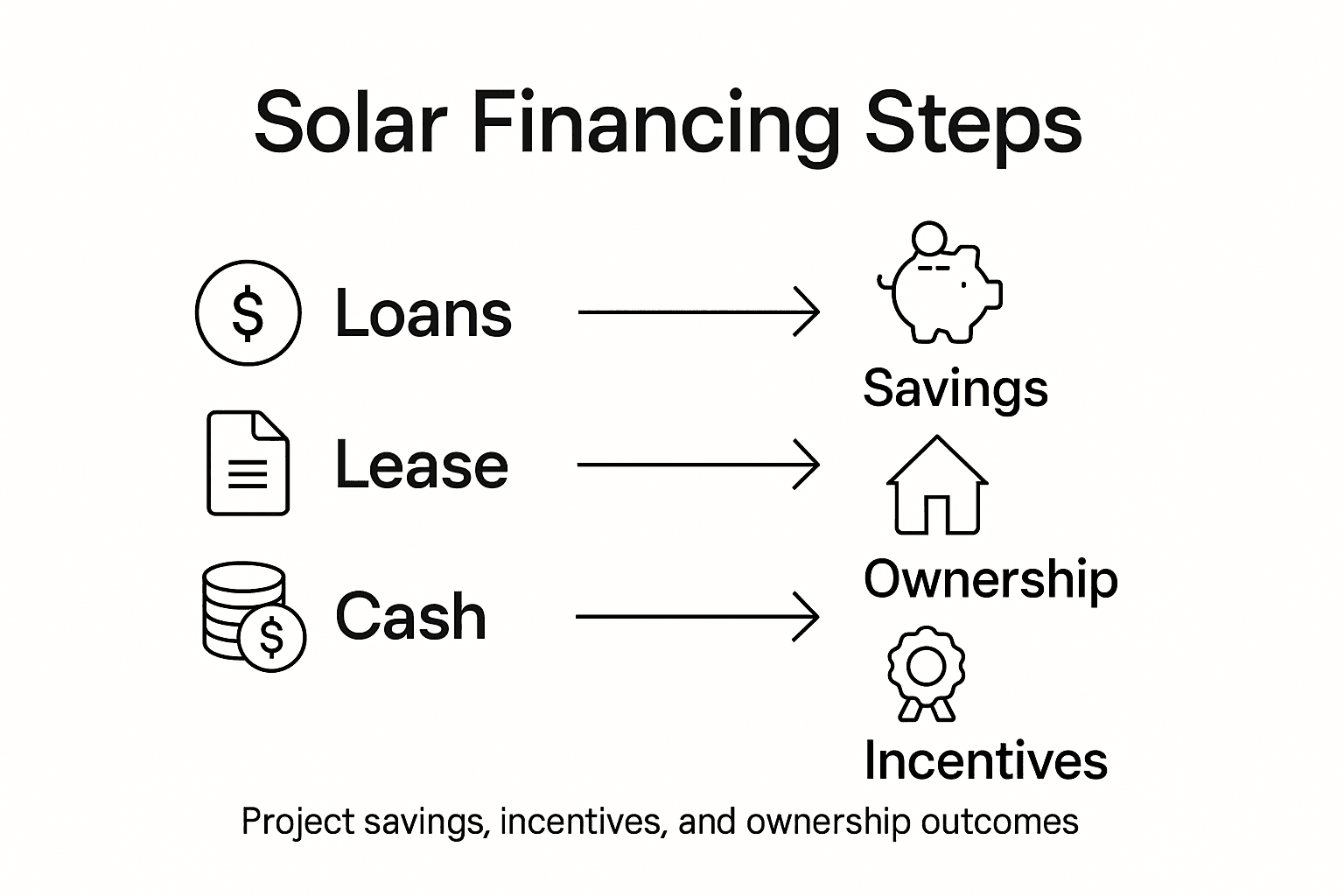
Begin by exploring targeted investment promotion policies and financial incentives that can significantly reduce your upfront solar installation costs. These may include investment subsidies, tax credits, grants, and renewable energy auctions that can substantially lower your initial financial burden. Carefully examine federal, state, and local incentive programs specific to commercial solar installations. Some key financial mechanisms to investigate include accelerated depreciation benefits, investment tax credits, and performance-based incentives that reward energy production.
Comprehensively analyze the financing landscape by reviewing the cost of capital and potential financing structures. Consider working with financial advisors who specialize in renewable energy investments to develop accurate ROI projections. Calculate potential energy savings, compare different financing options like solar loans, power purchase agreements, and lease arrangements, and model your expected financial returns over the system’s lifetime. Pay close attention to factors like electricity rate escalation, maintenance costs, and potential revenue from excess energy production.
Pro Tip: Create detailed financial models that project solar savings over 10 to 25 years, accounting for potential energy price increases and maintenance expenses to get a true picture of your investment’s long-term value.
Here is a summary of common solar financing options and their business impacts:
| Financing Option | Upfront Cost Impact | Ownership Outcome | Typical Benefits |
|---|---|---|---|
| Cash Purchase | High initial outlay | Business fully owns system | Maximum savings, tax benefits |
| Solar Loan | Low to moderate upfront cost | Business owns after loan | Maintains incentives, spreads cost |
| Power Purchase Agreement | Minimal upfront investment | Third party owns system | Fixed energy price, no maintenance |
| Solar Lease | Minimal upfront investment | Third party retains ownership | Lower energy bills, simple process |
Step 4: Plan installation logistics and set project timelines
Successful solar installation requires meticulous planning and strategic timeline management. Your goal is to create a comprehensive project roadmap that anticipates potential challenges and ensures smooth implementation from initial design to final commissioning.
Begin by understanding National Environmental Policy Act (NEPA) review process timelines for solar projects, which typically span one to two years. These regulatory timelines will significantly impact your overall installation schedule. Develop a detailed project timeline that includes critical milestones such as site assessment, permitting, equipment procurement, structural modifications, electrical system integration, and final inspection. Coordinate closely with your chosen solar provider to establish realistic deadlines and build in buffer periods for potential unexpected delays.
Carefully map out each phase of the installation process, including electrical upgrades, roof reinforcement if necessary, equipment delivery schedules, and installation windows. Engage multiple stakeholders including your facility management team, electrical contractors, solar installers, and local permitting authorities to synchronize efforts. Consider seasonal variations, potential weather impacts, and your business operations when scheduling installation to minimize disruption to your daily workflow.
Pro Tip: Create a color-coded project management timeline that visually tracks each installation phase, allowing you to quickly identify potential bottlenecks and maintain clear communication with all project stakeholders.
The table below highlights key steps and responsible parties in solar installation project management:
| Project Phase | Responsible Party | Key Milestone |
|---|---|---|
| Site Assessment | Solar consultant, facility mgr | Site survey completed |
| Permitting | Solar provider, local authority | All permits received |
| Installation | Solar contractor, electrician | Panels, wiring installed |
| Inspection & Commissioning | Inspector, utility rep | System approved, grid connected |
Step 5: Verify compliance and finalize solar activation
The final stage of your solar installation journey involves meticulously verifying regulatory compliance and preparing for system activation. This critical step ensures your solar investment meets all safety, technical, and legal requirements for successful grid interconnection.
Begin by reviewing the comprehensive solar licensing and regulatory requirements specific to your state and local jurisdiction. Work closely with your solar installation provider to compile and validate all necessary documentation, including electrical permits, building code compliance certificates, and system interconnection agreements. Carefully examine technical specifications to confirm your solar system meets all safety standards, electrical codes, and grid compatibility protocols. This process typically involves scheduling multiple inspections with local building authorities and utility representatives who will thoroughly evaluate your system’s design, installation quality, and electrical integration.
Prepare for the final activation by conducting a comprehensive system walkthrough with your solar installer. Verify all electrical connections, mounting hardware, inverter settings, and monitoring systems are correctly configured. Obtain and carefully review all final inspection reports, interconnection approvals, and system documentation. Schedule the official grid connection with your local utility company, ensuring all paperwork is completed accurately and all required certifications are in place.
Pro Tip: Maintain a dedicated digital folder with all solar installation documentation, including permits, inspection reports, and system specifications to streamline future maintenance and potential insurance or property valuation processes.
Get Your Business Solar-Ready with Expert Support From PES Solar
Preparing your business for solar can feel overwhelming. From detailed site assessments and choosing the right solar technology to navigating financing options and regulatory compliance each step requires careful planning and expert guidance. The complexity of evaluating energy usage, planning installation logistics, and verifying compliance might slow down your solar journey but it does not have to.
PES Solar offers comprehensive commercial solar energy solutions designed to ease your transition to clean energy. With proven experience in Florida’s commercial solar installations, PES Solar helps you assess your property’s solar potential, select the ideal system including trusted options like REC solar panels and Tesla Powerwall batteries, and secure financing options that maximize your return on investment. You will benefit from trusted expertise that ensures your project timeline stays on track while fully complying with all state and local regulations.
Take the first step now for a smoother solar installation process by visiting our commercial solar solutions page.
Contact PES Solar today for a free consultation and see how easy and financially smart preparing your business for solar can be. Visit https://proesolar.com to get started and turn your solar goals into reality.
Frequently Asked Questions
How can I assess my business’s current energy usage for solar preparation?
To assess your business’s current energy usage, gather 12 months of your electricity bills to understand total annual consumption and peak usage periods. Analyze this data to identify when solar energy can be most effectively utilized.
What factors should I consider when evaluating my property’s solar readiness?
Consider factors such as roof orientation, available unshaded space, structural integrity, and potential obstructions like trees or nearby buildings. Measuring your roof pitch and checking load capacity will help you determine optimal solar panel placement.
How do I research and compare different solar providers for my business?
Start by investigating various solar technologies and their suitability for your business needs. Request detailed proposals from multiple providers that include system design, projected energy production, and estimated costs to compare options effectively.
What financing options should I explore for my business solar installation?
Explore options such as cash purchases, solar loans, power purchase agreements, and leases. Evaluate their impact on your upfront costs and long-term returns, aiming to select a financing structure that maximizes your investment’s profitability.
What is the typical timeline for planning and installing a solar system?
The timeline for solar installation usually spans 1 to 2 years, including site assessments, permitting, and installation phases. Create a detailed project timeline with milestones to keep the installation process organized and avoid unexpected delays.
How can I ensure my solar installation complies with all regulations?
Review local solar licensing and regulatory requirements with your installation provider. Compile all necessary documentation and schedule inspections to verify that your system meets safety and operational standards before activation.
