
Hearing about solar energy can feel overwhelming when the terms sound unfamiliar and the choices seem endless. Many Florida homeowners want an affordable way to cut electric bills and boost their home’s value, but first need to understand some basics. This guide breaks down the key concepts and common terminology of solar power, giving you the clarity to discuss solar options confidently and make decisions suited to your home and budget.
Table of Contents
- Solar Power Glossary And Key Concepts
- Types Of Solar Power Systems Explained
- Understanding Common Solar Panel Terms
- Net Metering, Incentives, And Florida Specifics
- Critical Safety, Installation, And Finance Terms
Key Takeaways
| Point | Details |
|---|---|
| Understanding Key Components | Familiarize yourself with essential solar terms such as Photovoltaic Cells, Inverter, and Solar Module for informed decisions. |
| Explore System Types | Assess different solar system configurations like Grid-Connected, Off-Grid, and Hybrid to find the best fit for your energy needs. |
| Leverage Florida Incentives | Utilize available financial incentives such as Net Metering and Federal Solar Tax Credit to maximize your investment. |
| Prioritize Safety and Finance | Ensure compliance with safety standards and seek clarity on financial agreements like Power Purchase Agreements before finalizing installations. |
Solar power glossary and key concepts
Solar energy represents an exciting renewable technology transforming how homeowners power their Florida properties. Solar power technologies convert sunlight into usable electricity through sophisticated processes that have dramatically improved in recent years. Understanding the fundamental terminology helps homeowners make informed decisions about their energy investments.
Key solar power concepts include several critical components and processes:
- Photovoltaic (PV) Cells: The fundamental building blocks that directly convert sunlight into electrical current
- Inverter: Equipment that transforms direct current (DC) into alternating current (AC) for home use
- Solar Module: A collection of interconnected photovoltaic cells forming a complete panel
- Grid-Tied System: Solar installation connected to the local electrical utility infrastructure
- Off-Grid System: Solar power setup completely independent from traditional electrical networks
The solar energy generation process involves multiple sophisticated stages. Solar panels capture sunlight through photovoltaic cells, which generate direct current electricity. An inverter then transforms this DC electricity into alternating current suitable for household appliances and electrical systems. Modern solar technologies have significantly increased efficiency, allowing homeowners to generate substantial electrical power from relatively compact panel installations.
Pro tip: When exploring solar options, always request detailed efficiency ratings and understand how different panel configurations might perform specifically in your Florida property’s unique environmental conditions.
Types of solar power systems explained
Solar power systems come in various configurations designed to meet different energy needs and property characteristics. Photovoltaic systems offer homeowners multiple options for generating clean, renewable electricity tailored to their specific requirements. Understanding these system types helps Florida residents make informed decisions about their solar energy investments.
The primary types of solar power systems include:
- Grid-Connected Systems: Directly linked to the local electrical utility grid
- Off-Grid Systems: Completely independent power generation setups
- Hybrid Systems: Combine solar generation with battery storage capabilities
- Rooftop Installations: Panels mounted directly on residential or commercial building roofs
- Ground-Mounted Systems: Solar panels installed on open land areas
Each solar system type offers unique advantages for different property configurations. Grid-connected systems allow homeowners to send excess electricity back to the utility grid, potentially earning energy credits. Off-grid systems provide complete energy independence but require more sophisticated battery storage solutions. Hybrid systems represent a versatile approach, offering grid connectivity with integrated battery backup to ensure consistent power supply during outages or low sunlight periods.
Here’s a summary of common solar system types and their main benefits:
| System Type | Main Advantage | Key Consideration |
|---|---|---|
| Grid-Connected | Reduces electricity bills | Needs access to utility grid |
| Off-Grid | Complete energy independence | Requires robust battery storage |
| Hybrid | Backup power during outages | Higher upfront cost |
| Rooftop Installation | Space-efficient solution | Roof condition must be suitable |
| Ground-Mounted | Flexible panel orientation | Requires available land area |
Pro tip: Consult with local solar professionals to assess your specific property’s solar potential and determine the most suitable system configuration for your energy needs and budget.
Understanding common solar panel terms
Navigating the world of solar energy requires familiarity with key technical terminology. Photovoltaic terminology helps homeowners understand how solar technology transforms sunlight into usable electricity. Knowing these essential terms empowers Florida residents to make informed decisions about their solar investments.
Critical solar panel terms include:
- Photovoltaic (PV) Cells: Semiconductor devices that convert sunlight directly into electrical current
- Solar Module: A collection of interconnected photovoltaic cells forming a complete panel
- Solar Array: Multiple solar panels grouped together to increase total electricity generation
- Inverter: Equipment that transforms direct current (DC) into alternating current (AC)
- Semiconductor: Special material that enables electrical current generation
Understanding the electrical conversion process is crucial for solar energy comprehension. Direct current (DC) is initially produced by solar panels, which then passes through an inverter to become alternating current (AC) compatible with home electrical systems. This transformation allows solar-generated electricity to power household appliances and feed excess energy back into the electrical grid.
Pro tip: Request a detailed walkthrough of solar panel terminology from your installation professional to ensure you fully understand the technical aspects of your specific solar system.
Net metering, incentives, and Florida specifics
Florida offers a unique and attractive environment for solar energy adoption, with robust policies designed to support homeowners and businesses. Net metering policies provide significant financial advantages for solar panel owners, allowing them to maximize their renewable energy investments.
Key features of Florida’s solar incentives include:
- Net Metering Credit: Full retail rate credit for excess electricity sent back to the grid
- Federal Solar Tax Credit: 30% tax deduction for solar installation costs
- Property Tax Exemption: Solar installations do not increase property tax assessments
- Sales Tax Exemption: No sales tax on solar equipment purchases
- No Statewide Rebate Programs: Relies primarily on federal and utility-based incentives
The net metering mechanism is particularly beneficial for Florida solar customers. When solar panels generate more electricity than a home consumes, the excess power is sent back to the electrical grid, earning credits at the full retail electricity rate. These credits can offset future electricity consumption, effectively reducing overall energy costs and providing a financial incentive for solar adoption.
Refer to this quick guide to Florida solar incentives and ownership benefits:
| Incentive/Policy | What It Means for Homeowners | Current Availability |
|---|---|---|
| Net Metering Credit | Offsets bills with excess solar energy | Statewide, utility funded |
| Federal Solar Tax Credit | Reduces installation cost by 30% | Available through 2032 |
| Property Tax Exemption | No tax increase for solar installation | Statewide |
| Sales Tax Exemption | No sales tax on solar equipment | Statewide |
Pro tip: Consult with a local solar professional to understand the precise net metering terms specific to your utility provider and maximize your potential energy savings.
Critical safety, installation, and finance terms
Solar installations involve complex technical and financial considerations that homeowners must understand before investing. Solar installation standards establish critical guidelines to ensure safety, performance, and long-term reliability of solar energy systems.
Key safety and financial terminology includes:
- Electrical Permit: Official authorization required for solar electrical system connections
- Interconnection Agreement: Contract defining terms for connecting solar system to utility grid
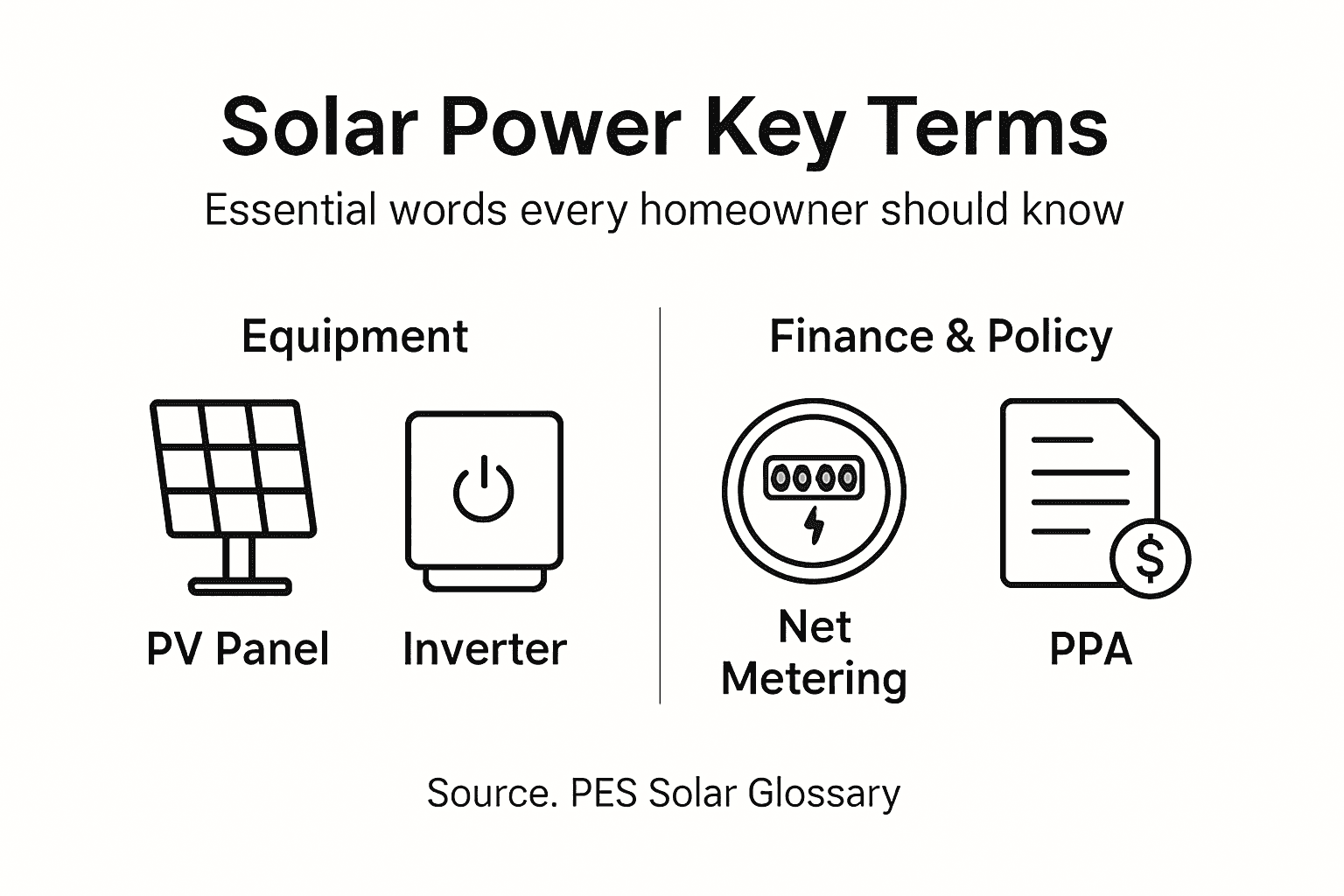
- Power Purchase Agreement (PPA): Financial contract where third party owns and operates solar system
- Performance Guarantee: Manufacturer’s commitment to system output and efficiency levels
- Equipment Certification: Verification of solar components meeting industry safety standards
Financial mechanisms like Power Purchase Agreements provide alternative funding strategies for homeowners. These arrangements allow customers to install solar systems with minimal upfront costs, paying only for the electricity generated. The third-party owner assumes responsibility for installation, maintenance, and system performance, reducing financial risk for the property owner.
Pro tip: Always request detailed documentation of safety certifications and performance guarantees before finalizing any solar installation contract.
Unlock the Full Potential of Your Solar Investment with PES Solar
Understanding essential solar power terms like photovoltaic cells, inverters, and net metering is only the first step toward energy independence and reducing your electricity bills. Many homeowners struggle to navigate these complex concepts while aiming to maximize the financial and environmental benefits of solar technology. If you want clear guidance, expert installation, and customized solutions such as Tesla Powerwall batteries or premium REC solar panels, PES Solar is here to help.
Our team specializes in tailored residential and commercial solar energy solutions across Florida. We take the time to explain every technical detail so you feel confident about your investment and the incentives available to you. With PES Solar, you get trusted local expertise and a seamless process for turning your solar power knowledge into real savings.
Explore our reliable solar energy services and discover how we simplify complex terms like net metering and interconnection agreements.
Ready to make your solar power glossary come to life on your property? Get your free consultation at PES Solar today for a personalized plan that fits your energy goals and budget. There is no better time than now to transform solar knowledge into lasting energy independence.
Frequently Asked Questions
What are photovoltaic (PV) cells and how do they work?
Photovoltaic (PV) cells are the fundamental building blocks of solar panels that convert sunlight directly into electrical current through a semiconductor process.
What is the difference between grid-tied and off-grid solar systems?
Grid-tied systems are connected to the local electrical utility infrastructure, allowing homeowners to send excess electricity back to the grid. Off-grid systems operate independently of the grid, typically requiring battery storage for energy.
How does net metering benefit solar panel owners?
Net metering allows solar panel owners to receive credit for excess electricity they generate and send back to the grid, effectively reducing their energy bills.
What should I consider when choosing a solar panel installation type?
When selecting a solar panel installation type, consider factors like your available space, energy needs, and whether you want a grid connection or complete energy independence.
