
Most Florida homeowners believe solar panels alone guarantee energy independence, but that’s only half the story. Without batteries, your solar system shuts down during power outages, and excess daytime energy flows back to the grid instead of powering your home at night. Solar battery storage in Florida transforms your solar investment by capturing surplus energy for later use, cutting grid dependence by up to 15%, and keeping critical systems running when hurricanes knock out power. This guide breaks down how batteries work with solar panels, how to size them correctly, which types thrive in Florida’s heat, and what savings you can expect.
Table of Contents
- Key takeaways
- How batteries store and deliver solar energy
- Sizing solar batteries for Florida homes: what you need to know
- Choosing the best battery type for Florida’s climate
- Maximizing energy savings and resilience with solar batteries in Florida
- Explore solar battery solutions with Pro Solar
- FAQ
Key Takeaways
| Point | Details |
|---|---|
| Battery storage benefits | Batteries store excess solar energy for self use or backup. |
| Sizing based on daily load | Sizing based on daily load determines the required battery capacity for your autonomy goals. |
| LFP suits Florida heat | Lithium iron phosphate cells handle Florida heat better than other chemistries. |
| Savings up to 15 percent | Adding batteries can raise overall savings by about 15 percent beyond solar alone. |
| Placement for hurricane resilience | Proper placement and hurricane resilience considerations help Florida installations withstand storms and outages. |
How batteries store and deliver solar energy
Solar batteries work through electrochemical processes that capture direct current (DC) electricity from your panels and release it when needed. Inside each battery, lithium iron phosphate (LFP) cells undergo chemical reactions that store electrons during charging and release them during discharge. A battery management system (BMS) monitors cell voltage, temperature, and state of charge to prevent overcharging, overheating, and deep discharge that could damage the battery.
Your hybrid inverter types play a crucial role by converting stored DC energy into alternating current (AC) that powers your home. These inverters manage three distinct operating modes: self-consumption mode uses stored solar energy to power your home instead of drawing from the grid, backup mode provides power during outages by isolating your home from the grid, and charge mode replenishes batteries from either solar panels or grid power during off-peak hours.
Round-trip efficiency (RTE) determines how much stored energy you actually get back. DC-coupled systems achieve about 92-97% efficiency because they skip an extra conversion step, while AC-coupled systems reach about 85-90% efficiency due to converting DC to AC and back to DC before storage. This 7-12% difference might seem small, but over 20 years it represents thousands of kilowatt-hours and hundreds of dollars in lost energy value.
Pro Tip: DC-coupled systems work best for new solar installations, while AC-coupled batteries integrate more easily with existing solar arrays since they connect on the AC side without modifying your current inverter setup.
Modern grid-tied solar batteries communicate with your utility meter, solar panels, and home loads simultaneously. Smart algorithms predict your energy usage patterns and weather forecasts to optimize when batteries charge and discharge. During peak rate periods, batteries automatically supply stored energy to avoid expensive grid power. When storms approach, systems can pre-charge batteries to maximum capacity for extended backup capability.
Sizing solar batteries for Florida homes: what you need to know
Calculating the right battery capacity prevents overspending on unused storage or running out of power when you need it most. Use this formula: Capacity (kWh) = (Daily Load × Autonomy Days) ÷ (DoD × RTE). Each variable represents a critical factor in your battery system’s performance and cost.
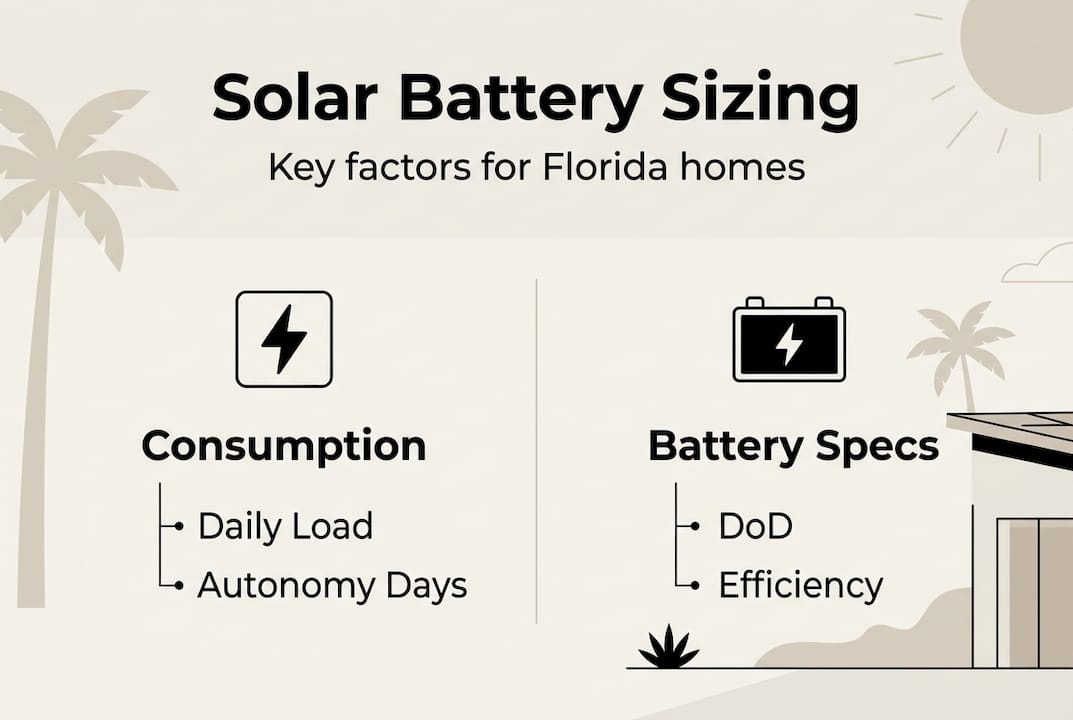
Daily load measures your essential power consumption in kilowatt-hours. Most Florida homes consume 25-35 kWh per day total, but during outages you’ll likely power only critical loads like refrigerators, lights, internet routers, phone chargers, and possibly window air conditioning units. These essentials typically draw 3-5 kW continuously, totaling 8-12 hours of critical operation from 10-13.5 kWh of battery capacity.
Autonomy days reflect how long you want batteries to sustain your home without solar input. One autonomy day suits homeowners who want overnight coverage and expect solar production to resume daily. Two to three autonomy days provide security during extended cloudy periods or multi-day power outages common after major hurricanes. Each additional autonomy day doubles or triples your required battery capacity and cost.
Depth of discharge (DoD) represents the usable portion of total battery capacity. Modern LFP batteries safely discharge 90-100% of their rated capacity without damage, unlike older lead-acid batteries limited to 50% DoD. Higher DoD means you need less total capacity to deliver the same usable energy, reducing system cost.
Round-trip efficiency (RTE) accounts for energy lost during charging and discharging cycles. Quality batteries achieve 90-95% RTE, meaning you lose 5-10% of stored energy to heat and conversion losses. Lower efficiency requires larger batteries to deliver the same usable power.
Here’s how these variables combine for typical Florida scenarios:
| Scenario | Daily Load | Autonomy | DoD | RTE | Required Capacity |
|---|---|---|---|---|---|
| Overnight essentials | 10 kWh | 1 day | 95% | 92% | 11.5 kWh |
| Extended backup | 10 kWh | 2 days | 95% | 92% | 23 kWh |
| Whole-home coverage | 30 kWh | 1 day | 95% | 92% | 34 kWh |
Pro Tip: Start with solar battery sizing tips by monitoring your actual usage during peak summer months when air conditioning drives consumption highest, then size batteries for 80% of that load to balance cost and coverage.
Most Florida installations pair 10-15 kWh batteries with 6-10 kW solar arrays. This ratio ensures batteries fully charge from solar production during typical sunny days while providing meaningful backup during outages. Oversized batteries relative to solar capacity may never fully charge, wasting investment. Undersized batteries fill quickly but leave excess solar production exported to the grid at lower net metering rates.
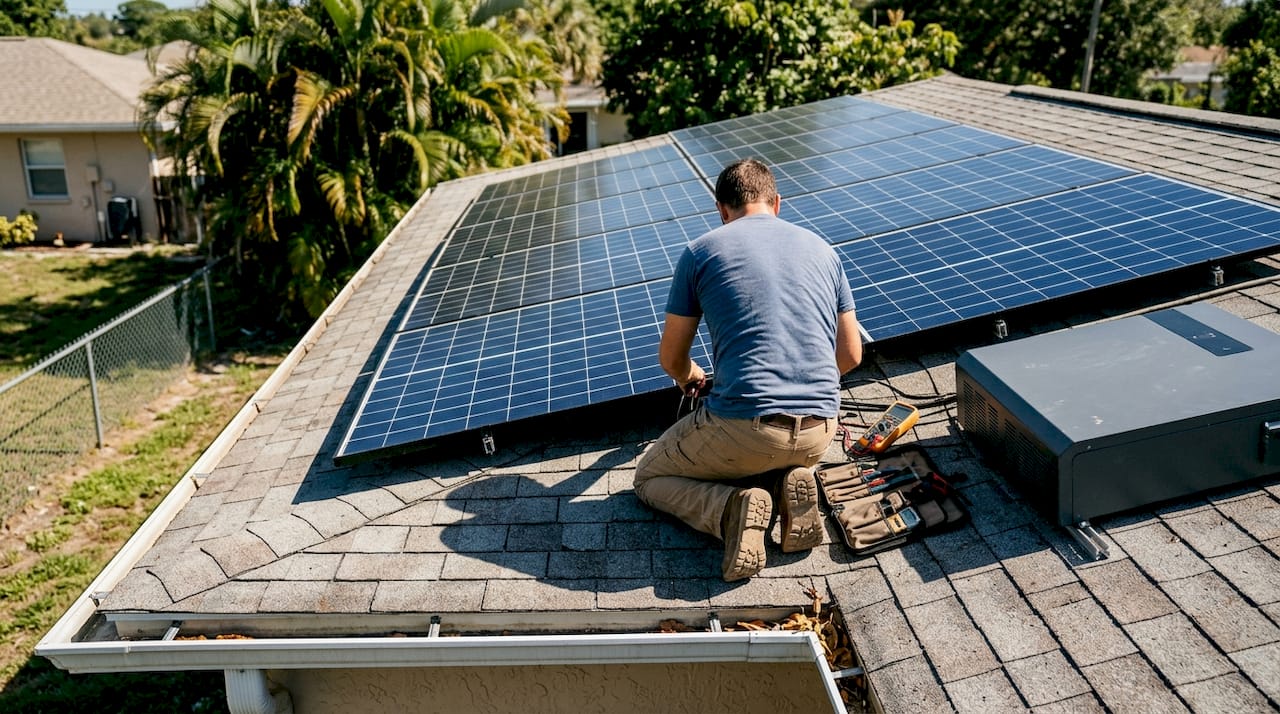
Assessing solar needs Florida requires examining your utility bills for seasonal variation, identifying which circuits power essential loads, and determining realistic backup duration based on local outage history. Hurricane-prone coastal areas justify larger batteries than inland locations with more reliable grid service.
Choosing the best battery type for Florida’s climate
Florida’s combination of intense heat, high humidity, and hurricane risks demands batteries engineered for extreme conditions. Lithium iron phosphate (LFP) batteries resist thermal degradation far better than other chemistries, making them the clear choice for long-term Florida installations.
Temperature directly impacts battery lifespan and capacity retention. High temperatures double capacity fade rates, with LFP batteries losing about 8% capacity versus 14% for nickel manganese cobalt (NMC) lithium-ion batteries when operating continuously at 95°F or higher. Florida’s average summer temperatures regularly exceed this threshold, especially in unshaded garage or outdoor installations.
Loss of lithium inventory (LLI) dominates the degradation mechanism in hot climates. As batteries cycle through charge and discharge in high heat, lithium ions become trapped in electrode structures instead of moving freely between cathode and anode. This irreversible process reduces available capacity over time. LFP chemistry’s stable crystal structure minimizes LLI compared to other lithium-ion variants.
Here’s how common battery types compare for Florida conditions:
| Battery Type | Temp Range | Cycle Life | Capacity Fade at 95°F+ | Typical Cost per kWh | Best For |
|---|---|---|---|---|---|
| LFP (Lithium Iron Phosphate) | 32-110°F | 6,000-10,000 | 8% over 10 years | $400-600 | Florida installations |
| NMC (Nickel Manganese Cobalt) | 50-95°F | 3,000-5,000 | 14% over 10 years | $350-500 | Cooler climates |
| Lead-Acid | 40-80°F | 500-1,200 | 25% over 5 years | $200-300 | Budget backup only |
Pro Tip: Insist on LFP batteries with active thermal management systems that use fans or liquid cooling to maintain optimal operating temperatures, extending lifespan by 3-5 years in Florida’s climate.
LFP batteries typically maintain 80% capacity after 15-20 years in Florida installations with proper thermal management. This longevity translates to better return on investment despite higher upfront costs. A $12,000 LFP system lasting 18 years costs $667 annually, while a $9,000 NMC system lasting 12 years costs $750 annually, plus you face earlier replacement.
Solar battery options Florida include popular models like Tesla Powerwall 3 (13.5 kWh LFP), Enphase IQ Battery 5P (5 kWh LFP), and Generac PWRcell (9-18 kWh modular NMC). While Generac offers flexibility, its NMC chemistry makes it less ideal for Florida heat compared to LFP alternatives. Top home solar batteries consistently feature LFP models for Florida installations.
Placement considerations matter as much as chemistry selection. Batteries installed in direct sunlight or poorly ventilated spaces experience accelerated degradation regardless of chemistry. Coastal installations require corrosion-resistant enclosures rated for salt air exposure. Flood-prone areas need elevated mounting to prevent water damage during storm surge. These environmental factors compound thermal stress, making proper installation critical for achieving rated lifespan.
Maximizing energy savings and resilience with solar batteries in Florida
Batteries transform solar panels from a grid-tied generator into a comprehensive energy system that cuts costs and maintains power during outages. Benchmark data shows 60% of solar-plus-battery homes achieve roughly 15% extra savings compared to solar-only installations by maximizing self-consumption of generated energy.
The savings mechanism works through time-shifting energy use. Florida’s high solar production occurs midday when home consumption typically drops because residents work away from home and air conditioning needs remain moderate. Without batteries, excess solar exports to the grid under net energy metering (NEM) programs that credit you at wholesale rates around $0.03-0.05 per kWh. Batteries capture this excess and discharge it during evening peak hours when you’d otherwise buy grid power at retail rates of $0.12-0.16 per kWh. This $0.09-0.11 per kWh arbitrage opportunity adds up quickly.
A typical 8 kW solar array in Central Florida generates 12,000-14,000 kWh annually. Without batteries, you might export 40% of production (4,800-5,600 kWh) at low NEM rates. Adding batteries lets you store and use 70-80% of that exported energy, keeping an additional 3,360-4,480 kWh at the full retail rate differential. At $0.10 per kWh saved, that’s $336-448 in additional annual savings, or $6,720-8,960 over 20 years.
Florida’s evolving net metering policies make batteries increasingly valuable. Some utilities are transitioning from retail-rate NEM to time-of-use rates or reduced export credits. Batteries hedge against these policy changes by reducing your dependence on favorable net metering terms. You control more of your energy destiny regardless of utility rate structures.
“Homeowners who cut costs with solar and batteries report the peace of mind during hurricane season is worth as much as the monthly savings. Knowing your refrigerator, internet, and essential lighting will work regardless of grid status changes how you experience storm preparation.”
Hurricane resilience represents the most tangible battery benefit for Florida residents. The 2022 hurricane season left over 2.6 million Floridians without power, some for multiple weeks. Battery systems sized for 1-2 days of autonomy kept critical systems running while neighbors relied on generators or evacuation. Medical equipment, refrigerated medications, home security systems, and communication devices remained operational.
Proper installation considers National Fire Protection Association (NFPA) guidelines limiting whole-home battery storage to roughly 20 kWh in residential spaces without special fire suppression systems. Larger systems require outdoor enclosures or detached structures. Florida building codes also mandate hurricane-rated mounting and enclosures for batteries in wind zones.
- Solar energy savings tips Florida emphasize combining batteries with smart thermostats and LED lighting to maximize self-consumption during peak production hours
- Battery monitoring apps let you track real-time energy flows, optimizing usage patterns to increase savings by another 3-5%
- Time-of-use rate programs from utilities like Duke Energy Florida offer even greater arbitrage opportunities when paired with batteries
- Backup capability during outages prevents food spoilage, typically saving $200-400 per major storm event
Explore solar battery solutions with Pro Solar
Now that you understand how batteries amplify your solar investment, the next step is selecting and sizing the right system for your Florida home. Solar battery options Florida homeowners can explore include detailed comparisons of capacity, efficiency, and warranty terms tailored to our state’s unique climate demands.
Professional guidance ensures your battery system integrates seamlessly with your existing solar array or new installation. How to size solar batteries requires analyzing your actual consumption patterns, identifying critical loads, and calculating optimal capacity for your backup needs and savings goals. Expert installers also handle permitting, utility interconnection agreements, and compliance with Florida building codes.
Grid-tied solar battery installation involves electrical work that must meet strict safety standards. Licensed professionals ensure proper grounding, overcurrent protection, and emergency disconnect systems that protect your home and utility workers. They also optimize battery placement for thermal management and accessibility while meeting setback requirements and flood elevation standards.
FAQ
Can solar batteries power my whole home during an outage?
Most residential battery systems power critical loads rather than whole-home consumption due to capacity limits and NFPA safety rules capping indoor storage around 20 kWh. Systems can be designed to automatically prioritize essential circuits like refrigerators, lighting, and internet during outages. Whole-home backup requires larger outdoor battery banks or multiple units, significantly increasing cost.
How long do solar batteries last in Florida’s heat?
LFP batteries maintain about 80% capacity after 15-20 years in Florida’s climate when properly installed with thermal management. High temperatures accelerate capacity fade, but LFP chemistry resists degradation better than other lithium-ion types, losing only 8% capacity versus 14% for NMC batteries at sustained 95°F+ conditions. Proper ventilation and shade extend lifespan by keeping operating temperatures within optimal ranges.
What maintenance do solar batteries require?
Solar batteries need minimal maintenance, primarily software updates and periodic visual inspections for physical damage or corrosion. Battery management systems monitor performance automatically through smartphone apps, alerting you to any issues. Solar panel and battery maintenance involves annual professional inspections to verify electrical connections, check thermal management systems, and ensure mounting hardware remains secure after storms. Clean battery enclosures of debris and vegetation quarterly.
Are there savings advantages beyond solar panels alone?
Batteries increase savings by approximately 15% compared to solar-only systems by enabling greater self-consumption of generated energy. They store excess daytime production for evening use instead of exporting at low net metering rates, capturing the full retail rate value. Batteries also hedge against changing net metering policies and time-of-use rates, protecting your investment as utility rate structures evolve. The combination of increased self-consumption and rate arbitrage delivers measurable financial benefits beyond solar panels alone.
