
Running the air conditioner nonstop each Florida summer quickly reminds homeowners just how much electricity costs can add up. As rising bills and the desire for greater property value make solar panels more attractive, knowing where to begin with your own home’s solar journey can seem confusing. This guide walks you through the five crucial steps for evaluating your energy use and property details, helping you make smarter decisions and maximize the benefits of solar investment.
Table of Contents
- Step 1: Gather Energy Usage Data
- Step 2: Evaluate Roof and Property Conditions
- Step 3: Calculate Solar System Size Requirements
- Step 4: Verify Incentives and Financing Options
- Step 5: Confirm Optimal Solar Placement
Quick Overview
| Main Takeaway | Details |
|---|---|
| 1. Gather Accurate Energy Data | Collect your last 12 months of electricity bills to understand your seasonal energy consumption patterns and avoid system oversizing or undersizing. |
| 2. Evaluate Roof Conditions | Check your roof’s age, slope, and shading to ensure it can support solar panels optimally and avoid future costly repairs. |
| 3. Calculate Required System Size | Determine the solar system size by dividing annual kWh by peak sun hours; account for system losses to ensure efficiency. |
| 4. Research Incentives and Financing | Investigate federal and local incentives that can significantly reduce installation costs, including tax credits and rebates. |
| 5. Confirm Optimal Panel Placement | Identify the best roof location with maximum sun exposure to enhance energy production, considering any potential obstructions. |
Step 1: Gather Energy Usage Data
Your solar system needs to match how much energy you actually use. Gathering accurate energy data is the foundation for everything that follows. Without it, you’ll either oversize your system and waste money or undersizes it and miss savings.
Start by collecting your past 12 months of electricity bills. This gives you the complete picture because energy use varies seasonally in Florida, with higher consumption during summer for cooling and winter for heating.
Here’s what to track from each bill:
- Total kilowatt-hours (kWh) used during that billing period
- Peak usage months (typically June through September)
- Off-peak usage months (usually November through March)
- Average monthly consumption across the year
Once you have these numbers, calculate your average daily energy consumption by dividing your annual kWh total by 365. For example, if your annual usage is 12,000 kWh, you’re consuming about 33 kWh per day.
Notice any patterns in your bills. Did usage spike when you added a pool pump? Did it drop when you replaced an old air conditioner? These clues help you understand whether your current habits are your “normal” baseline or temporary anomalies.
For a deeper analysis, tools like the PVWatts calculator can help you estimate how much solar energy your location receives, which works alongside your usage data. You can also reference energy consumption data analysis tools specifically designed for Florida homes to understand how your usage compares to similar properties.
Your annual electricity bill is the single most reliable document for assessing your solar needs accurately.
If you don’t have 12 months of bills available, most utility companies can provide historical data through your online account portal or by phone request. Getting complete data now prevents underestimating your needs later.
Pro tip: Take photos of your last year’s utility bills and store them in a folder on your phone before your solar consultation, so you have them readily available when discussing system sizing with an installer.
Step 2: Evaluate Roof and Property Conditions
Your roof is the real estate where solar panels live. Before you can design a solar system, you need to understand whether your roof can support panels and if it receives adequate sunlight. This evaluation protects your investment and ensures optimal performance.

Start by examining your roof’s age and condition. Solar panels typically last 25 to 30 years, so if your roof is nearing the end of its lifespan, consider replacing it before installing panels. Replacing a roof after solar installation is expensive and disruptive.
Walk around your property and note these roof characteristics:
- Roof slope and direction (south-facing roofs are ideal in Florida, but east and west facing work too)
- Roof material (asphalt shingles, metal, tile, or flat membrane)
- Visible damage (cracked shingles, missing sections, active leaks)
- Shade patterns throughout the day from trees or structures
- Structural condition (sagging areas, deterioration, or soft spots)
Shadow coverage is critical. Trees that shade your roof in the morning or afternoon reduce solar production significantly. If mature trees block sunlight during peak hours, solar may not be viable on that section of roof.
Check for any homeowner association restrictions on your property. Florida law protects homeowners from unreasonable solar installation restrictions through the Florida Solar Rights Act, which ensures that suitable roof areas remain available for solar equipment without impairing performance.
Take photos of your entire roof from ground level and capture wide shots showing the surrounding landscape. These images help solar installers assess feasibility without needing to climb your roof initially.
A roof facing south with minimal shade is your biggest advantage in Florida’s solar equation.
If you’re uncertain about roof condition or structural capacity, professional inspectors can evaluate roof design considerations specific to solar installations, ensuring your home is properly prepared.
This table summarizes typical Florida roof factors and their impact on solar suitability:
| Roof Factor | Ideal Condition | Negative Impact | Example Solution |
|---|---|---|---|
| Orientation | South-facing | North-facing blocks sun | Use east/west exposures |
| Age/Condition | New and sturdy | Needs repairs or replacement | Upgrade before install |
| Shade | No obstructions | Large trees or structures | Select sunniest roof area |
| Material | Asphalt/metal | Fragile tile or membrane | Specialized mounting kits |
Pro tip: Snap photos of your roof’s exposure to sunlight at different times of day so you can see exactly where shadows fall during peak solar production hours (9 a.m. to 3 p.m.).
Step 3: Calculate Solar System Size Requirements
Now that you understand your energy usage and roof capacity, it’s time to determine how many kilowatts of solar power you actually need. This calculation bridges the gap between your consumption data and your physical system design.
The math is straightforward. Take your annual energy consumption in kilowatt-hours and divide it by the number of productive sun hours your location receives yearly. In Florida, most areas average 4.5 to 5 peak sun hours per day, which equals roughly 1,600 to 1,825 annual hours.
Here’s the basic formula:
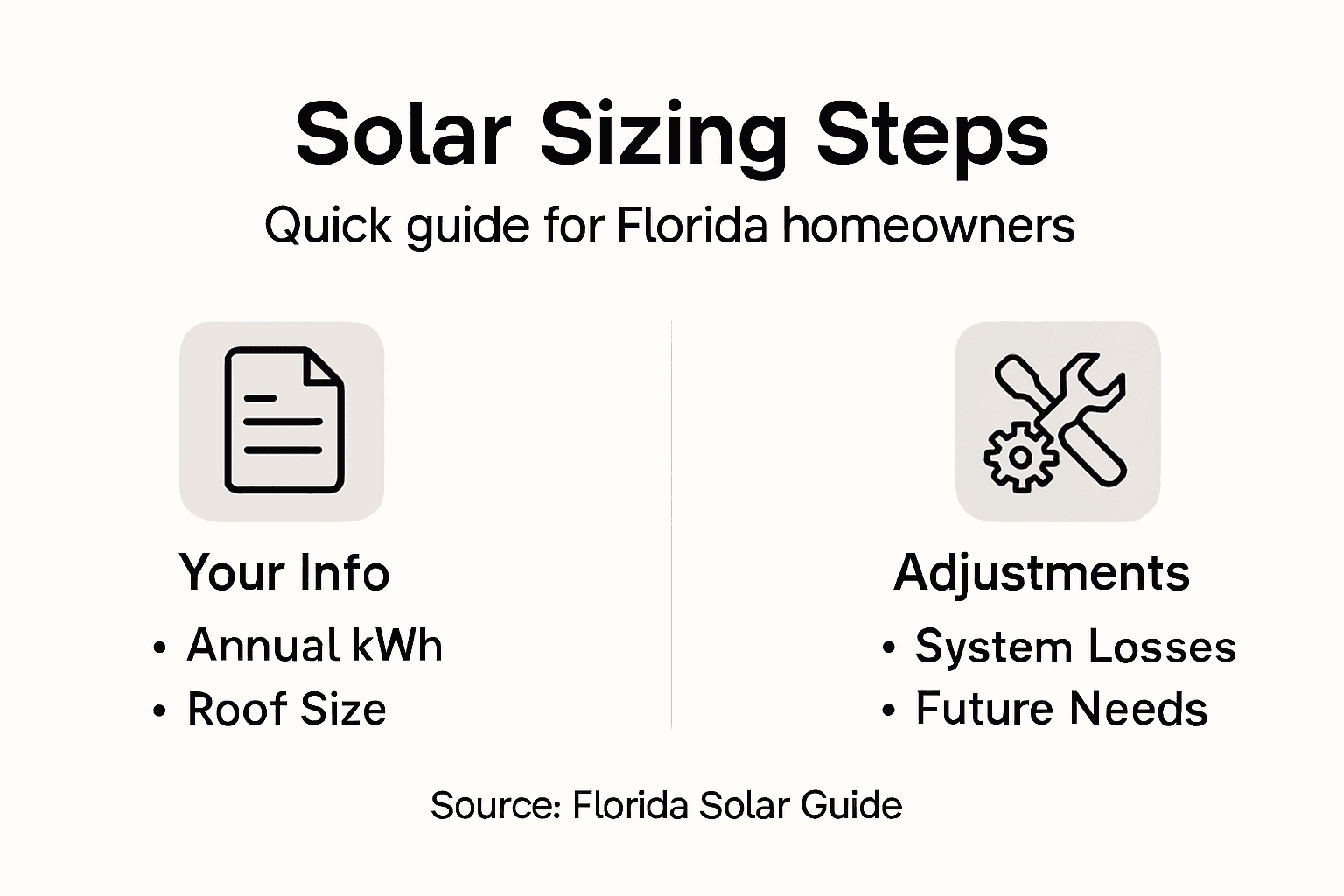
- Annual kWh needed divided by annual peak sun hours equals your required system size in kilowatts
- For example, 12,000 annual kWh divided by 1,600 peak sun hours equals a 7.5 kW system
- Account for system losses (typically 20 to 25 percent) by adding this percentage to your calculated size
System losses happen because of inverter inefficiency, wiring resistance, and temperature effects. A 7.5 kW system might actually need to be sized at 9 to 9.5 kW to account for these real-world factors.
You can use solar production estimation tools to input your location, roof orientation, and tilt angle for more precise calculations that account for weather patterns specific to Florida. These tools factor in seasonal variations and help you right-size your system accurately.
Consider whether you want to offset 100 percent of your energy consumption or just a portion. Some homeowners target 80 to 90 percent offset to keep costs reasonable while still achieving significant savings.
Your system size determines both your upfront cost and your long-term savings, making this calculation the financial pivot point of your solar decision.
Write down your target system size in kilowatts. This number becomes the foundation for your solar installation quote and helps installers recommend specific equipment configurations.
Pro tip: Add 10 to 15 percent extra capacity to your calculated size if you plan to add electric vehicle charging or other high-draw appliances within the next five years, since upgrades after installation are costly.
Step 4: Verify Incentives and Financing Options
Solar installations represent a significant investment, but federal and state incentives can dramatically reduce your upfront costs. Before you commit to a system, research what financial programs you qualify for. These savings are real money back in your pocket.
Start with the federal tax credit. The U.S. government offers a 30% residential clean energy credit on qualified solar installations through 2025, which means you can deduct 30 percent of your total system cost from your federal taxes. For a $25,000 solar installation, that’s a $7,500 tax reduction.
Check Florida-specific incentives next. Your utility company may offer rebates or credits for installing solar. These vary by region and change frequently, so verify current programs with your local utility.
Review available financing options for your situation:
- Cash purchase (no loans, you own everything immediately, highest long-term savings)
- Solar loans (borrow money to buy, maintain ownership and tax credits)
- Leases (lower upfront costs, third party owns system, you pay fixed monthly fee)
- Power purchase agreements (pay only for electricity produced, minimal upfront investment)
Each financing method affects your savings differently. Cash buyers capture all incentives and savings. Loan borrowers keep ownership and tax credits while spreading costs over time. Lease and PPA customers enjoy lower initial costs but share savings with the financing company.
Here’s a quick overview of how different solar financing options affect your ownership and savings:
| Financing Type | Who Owns System | Upfront Cost | Access to Incentives |
|---|---|---|---|
| Cash Purchase | Homeowner | Highest | All incentives |
| Solar Loan | Homeowner | Moderate | All incentives |
| Lease | Third Party | Low | None |
| Power Purchase Agreement | Third Party | Low | None |
Research incentives using the Database of State Incentives for Renewables & Efficiency, which maintains current federal, state, and local programs specific to your area.
The combination of federal tax credits and state incentives can reduce your net cost by 40 to 50 percent, transforming solar from expensive to genuinely affordable.
Calculate your true cost after all incentives by subtracting tax credits and rebates from your system price. This number reveals what you actually pay versus the sticker price.
Pro tip: Consult with a tax professional before installation to confirm you can use the federal tax credit on your tax return, especially if your income or tax liability changes significantly year to year.
Step 5: Confirm Optimal Solar Placement
Panel placement determines how much energy your system produces. The best roof location isn’t always obvious, so take time to confirm where panels will generate maximum power. This step separates good installations from great ones.
Start by identifying your roof’s primary sun exposure. In Florida, south-facing roofs are ideal, but east and west-facing surfaces also work well. North-facing roofs should be avoided since they receive minimal direct sunlight year-round.
Measure the angle and tilt of your potential installation areas. Florida’s latitude means panels perform best at a tilt angle between 25 and 35 degrees. Tools like solar insolation analysis resources help you understand how much sunlight your specific location and roof angle receive throughout the year.
Mark any obstructions that cast shadows on your roof:
- Trees or branches that may grow taller over time
- Neighboring buildings or structures
- Roof vents, chimneys, or antennas
- Satellite dishes or other equipment
Shadow patterns change seasonally in Florida. A tree that doesn’t block sunlight in summer might shade panels significantly in winter. Observe your roof at different times of day and seasons if possible.
Consider your available roof space. A typical residential solar panel is about 17.5 square feet and produces 300 to 400 watts. Calculate how many panels you need based on your system size from Step 3, then verify you have adequate contiguous roof space without major obstructions.
Some installers use solar resource assessment tools to model your property’s exact solar potential. This analysis accounts for your roof geometry, shade patterns, and local weather to predict annual energy production with remarkable accuracy.
The difference between mediocre and optimal placement can mean 15 to 25 percent more energy production over your system’s lifetime.
Document your findings with photos and notes. Mark the optimal placement area clearly so your installer knows exactly where to prioritize panel installation.
Pro tip: If your roof has multiple viable areas, prioritize the section that faces south and has zero shade during the hours from 9 a.m. to 3 p.m., since this window captures the most productive solar energy.
Ready To Turn Your Florida Home’s Solar Potential Into Real Savings
Assessing your solar needs with precision is a crucial step toward achieving energy independence and lowering your energy bills. If you found the breakdown of energy usage, roof evaluation, and system sizing enlightening but feel overwhelmed by the details or unsure about financing options and optimal solar placement your challenges are exactly where PES Solar shines the brightest. Our team understands the unique Florida solar landscape and can guide you through every step with confidence and local expertise.
Why trust PES Solar?
- We specialize in tailored solar solutions for Florida homes that maximize your property’s sunlight exposure and seasonal energy demands.
- Take advantage of incentives like the federal tax credit while choosing financing options that suit your budget and lifestyle.
- Upgrade your home with proven technology including Tesla Powerwall batteries and REC solar panels to enhance savings and energy resilience.
Explore how simple it is to progress from assessment to installation by visiting PES Solar for a free consultation. Don’t miss your chance to increase your home’s value and secure predictable energy costs. Start your solar journey today and see why so many Florida homeowners trust us to power their future. Learn more about our innovative solutions and schedule your personalized solar evaluation now at PES Solar.
Frequently Asked Questions
How can I gather energy usage data for my solar needs assessment?
To gather energy usage data, collect your past 12 months of electricity bills. Look for the total kilowatt-hours used, peak and off-peak usage months, and calculate your average daily consumption by dividing the annual total by 365.
What roof conditions should I evaluate before installing solar panels?
Evaluate your roof’s age and condition, slope and direction, and any visible damage or shade patterns. Ensure your roof can support solar panels and receives ample sunlight for optimal performance.
How do I calculate the solar system size I need for my home?
To calculate the solar system size, divide your annual energy consumption in kilowatt-hours by the average annual peak sun hours in your area. For example, if your annual usage is 12,000 kWh and you receive 1,600 peak sun hours, you will need a 7.5 kW system before accounting for losses.
What financial incentives are available for solar installations?
Financial incentives include a federal tax credit that allows you to deduct a percentage of the installation cost from your taxes. Research local utility rebates and state programs that may further reduce your overall costs.
How can I determine the optimal placement for solar panels on my roof?
Identify your roof’s primary sun exposure and check for obstructions that may shade the area where panels will be installed. Measure the tilt of the roof and prioritize south-facing sections without shadows during peak sun hours.
What patterns in my energy bills should I look for?
Look for spikes in usage during certain months, such as higher consumption in summer due to cooling needs. Identifying these patterns helps establish what’s normal for your household and ensures you size your solar system appropriately.
