
Most American homeowners in Florida can lower their energy bills by up to 38 percent with the right solar incentives. Government programs are making solar panels more affordable while boosting long-term property value. Understanding Florida’s unique mix of state and federal benefits helps you capture the maximum savings and protect your investment well into the future.
Table of Contents
- Defining Solar Incentives In Florida
- Types Of Solar Incentive Programs Available
- Eligibility And Application Requirements For Homeowners
- Financial Benefits And Long-Term Savings Impact
- Common Mistakes And How To Avoid Them
Key Takeaways
| Point | Details |
|---|---|
| Diverse Incentive Programs | Florida offers various solar incentive programs, including tax exemptions and rebates, to make solar investments more accessible and financially attractive. |
| Significant Financial Benefits | Homeowners can realize substantial savings on energy bills, tax credits, and increased property value through solar installations. |
| Eligibility and Documentation | Specific criteria must be met to qualify for incentives, emphasizing the importance of thorough documentation and proper energy assessments. |
| Avoiding Common Pitfalls | Homeowners should conduct professional maintenance and maximize incentive research to optimize solar investment returns and system performance. |
Defining Solar Incentives in Florida
Solar incentives in Florida represent strategic financial opportunities designed to encourage residential and commercial solar energy adoption. These incentives are comprehensive mechanisms implemented by state and federal governments to reduce the upfront costs and long-term expenses associated with solar panel installations. Florida’s commitment to solar energy development goes beyond simple monetary benefits, encompassing broader goals of environmental sustainability and economic growth.
The state offers multiple types of solar incentives, including tax exemptions, credits, and rebates that significantly reduce the financial barriers to solar investment. These incentives are structured to provide immediate and long-term financial advantages for homeowners and businesses transitioning to solar energy. Key incentives include property tax exemptions for solar equipment, sales tax exemptions on solar installations, and federal investment tax credits that can offset a substantial percentage of installation costs.
Unique to Florida’s approach is how these incentives align with the state’s broader economic development strategy. State policies promote renewable energy technologies not just as environmental solutions, but as critical economic drivers. By creating financial pathways for solar adoption, Florida stimulates job creation, technological innovation, and sustainable economic growth. These incentives effectively transform solar energy from an alternative option to a mainstream, economically attractive investment for residents.
Pro tip: Before installing solar panels, carefully document all equipment purchases and installation costs to maximize your potential tax credit eligibility and ensure you capture every available financial benefit.
Types of Solar Incentive Programs Available
Florida offers a diverse range of solar incentive programs designed to make renewable energy more accessible and financially attractive for homeowners and businesses. Local and state incentives provide significant financial benefits that can substantially reduce the overall cost of solar panel installations. These programs are strategically crafted to address different aspects of solar investment, from equipment purchases to long-term energy savings.
The primary types of solar incentive programs in Florida include state-level tax exemptions and credits. Key programs consist of a permanent sales tax exemption on solar equipment, which eliminates the additional cost burden during purchase. Homeowners can also benefit from a 100% property tax exemption for renewable energy property, effectively reducing the financial impact of solar investments. Additionally, some local municipalities offer unique rebate programs and specialized financing options that further enhance the economic attractiveness of solar energy installations.
Federal incentives complement the state-level programs, creating a comprehensive financial support system for solar adopters. The federal investment tax credit allows homeowners to deduct a percentage of their solar installation costs from federal tax obligations, providing a significant monetary incentive. Some utility companies in Florida also offer net metering programs, enabling solar panel owners to receive credits for excess electricity generated and fed back into the power grid, creating an additional avenue for financial returns.
Here’s a summary of the main solar incentive types and how they impact homeowners in Florida:
| Incentive Type | Key Benefit | Typical Savings Impact | Notes on Eligibility |
|---|---|---|---|
| Sales Tax Exemption | Lowers upfront equipment cost | Reduces purchase price | Applies to most solar systems |
| Property Tax Exemption | Prevents tax assessment rise | No extra property taxes | For qualified solar installations |
| Federal Tax Credit | Offsets installation expense | 30% deduction opportunity | Requires documented costs |
| Local Rebates | Immediate cash-back savings | Varies by municipality | Must apply via local programs |
Pro tip: Research multiple incentive programs and consult with a local solar installation expert to strategically combine state, federal, and utility-level incentives for maximum financial benefits.
Eligibility and Application Requirements for Homeowners
Solar incentive programs in Florida have specific eligibility criteria designed to ensure accessibility while maintaining program integrity. The Florida Energy Saver Program provides detailed guidelines for homeowner participation, with key requirements focusing on household income levels and potential energy savings. Homeowners must typically demonstrate their ability to achieve a minimum of 20% energy efficiency improvement through solar installation, making the process both financially and environmentally strategic.
The application process involves multiple comprehensive steps that require careful documentation and professional assessment. Homeowners must first conduct a thorough home energy evaluation to determine their eligibility and potential energy savings. The Florida Property Assessed Clean Energy (PACE) program offers additional financing pathways with specific requirements including financial disclosure, contractor verification, and local government approval. Applicants need to prepare detailed documentation including proof of income, property ownership, current energy consumption records, and proposed solar system specifications.
Key eligibility factors typically include residential property ownership, credit score requirements, and meeting specific income thresholds. Some programs have additional considerations such as the age and condition of the existing property, potential energy savings percentage, and the homeowner’s ability to complete the proposed energy improvements. Local municipalities and utility companies may have supplementary requirements beyond state-level programs, making it essential for homeowners to research and understand the specific criteria for their particular location and selected solar incentive program.
Pro tip: Compile a comprehensive documentation portfolio before applying, including energy bills, property records, and income verification to streamline the application process and improve your chances of approval.
Financial Benefits and Long-Term Savings Impact
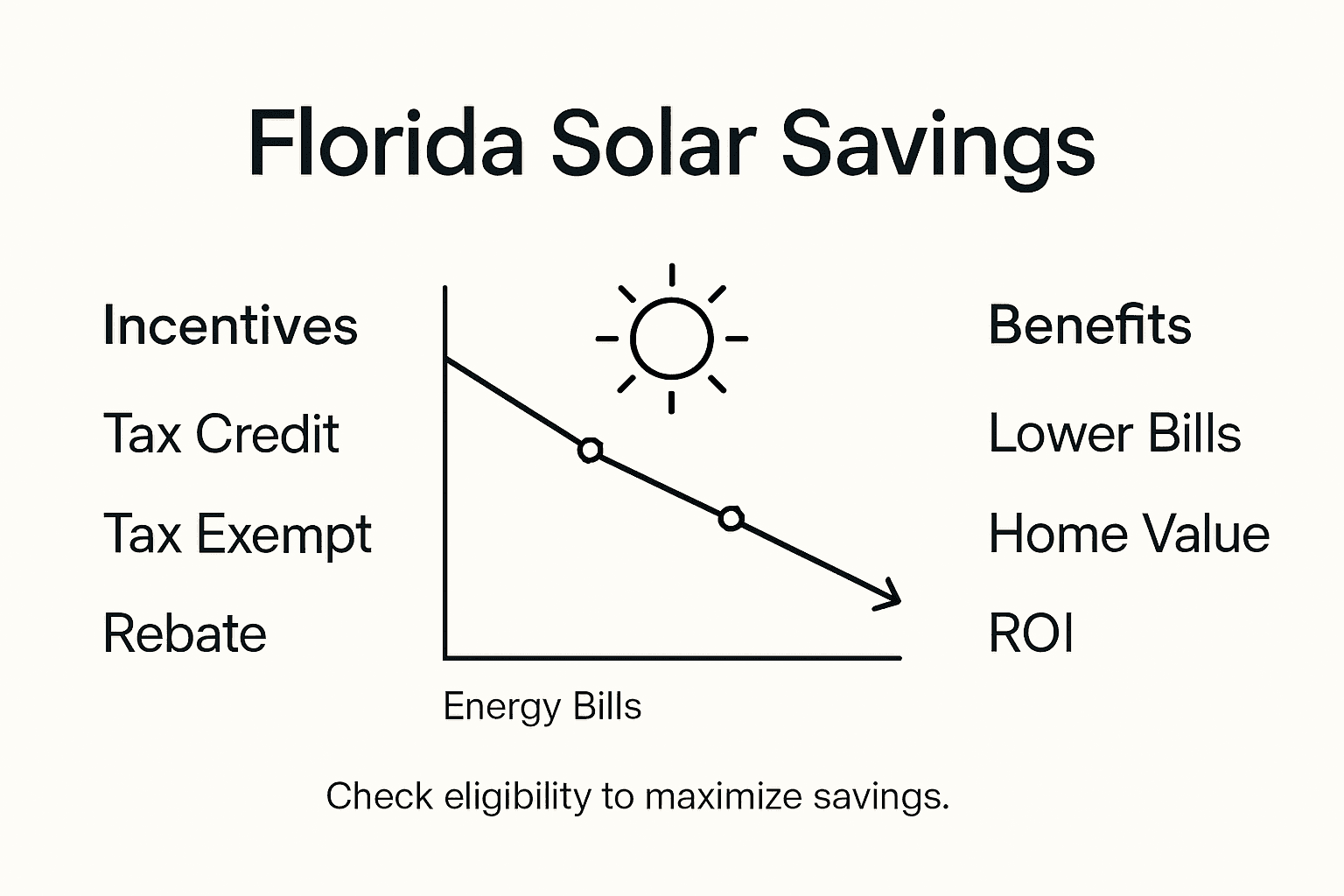
Solar energy investments in Florida represent a strategic financial opportunity with multifaceted economic advantages. Clean energy programs are creating substantial economic benefits that extend far beyond immediate utility bill reductions. Low-income households, in particular, can potentially realize average energy bill savings of 38%, transforming solar from an environmental choice to a critical financial strategy for household budget management.
The financial impact of solar installations goes beyond monthly utility savings. Residential solar systems demonstrate remarkable value appreciation for homeowners, with typical home values increasing by approximately $15,000 after installation. This value enhancement stems from reduced energy costs, increased property attractiveness, and the long-term economic benefits associated with renewable energy infrastructure. Factors such as system size, local electricity rates, sunlight exposure, and roof characteristics significantly influence the total financial return on solar investments.

Comprehensive financial benefits include multiple layers of savings and incentives. Homeowners can expect reduced monthly electricity expenses, potential tax credits, increased property value, and protection against future energy price fluctuations. The cumulative effect of these financial advantages makes solar investments particularly attractive in Florida, where abundant sunshine and progressive renewable energy policies create an optimal environment for solar adoption. Net metering programs, federal tax credits, and state-level incentives further enhance the economic proposition of transitioning to solar energy.
Pro tip: Calculate your potential solar savings by comparing current electricity costs with projected solar system production, factoring in available incentives and your specific energy consumption patterns.
Common Mistakes and How to Avoid Them
Homeowners exploring solar panel installations in Florida frequently encounter several critical pitfalls that can significantly impact their investment’s effectiveness and longevity. Solar maintenance mistakes are particularly common among Florida residents, with many assuming basic practices will suffice for their solar system’s optimal performance. These misconceptions can lead to reduced energy efficiency, potential equipment damage, and unnecessary financial losses.
One of the most prevalent errors is underestimating the importance of professional maintenance and cleaning. Many homeowners mistakenly believe that Florida’s frequent rain is sufficient to keep solar panels clean, which can result in significant performance degradation. Attempting do-it-yourself cleaning without proper knowledge can also void warranties and potentially cause permanent damage to delicate solar panel surfaces. Seasonal variations, particularly during high pollen periods, require specialized cleaning techniques that professional services are best equipped to handle.
Financial and technical planning mistakes can also undermine solar investment potential. Homeowners often fail to conduct comprehensive energy assessments, neglect to optimize panel placement, or choose inappropriate system sizes for their specific energy consumption needs. Additional common errors include overlooking potential shading issues, failing to understand net metering policies, and not thoroughly investigating available local and federal incentives. These oversights can dramatically reduce the expected financial returns and overall effectiveness of a solar energy system.
This table compares common mistakes with recommended actions to optimize solar investment performance:
| Common Mistake | Potential Consequence | Suggested Best Practice |
|---|---|---|
| Skipping professional maintenance | Lower energy output | Schedule expert assessments annually |
| DIY panel cleaning | Warranty void, damage risk | Hire certified solar cleaning services |
| Poor system sizing | Excess costs or inefficiency | Conduct thorough energy evaluations |
| Ignoring incentives research | Missed financial savings | Consult experts and check all programs |
Pro tip: Schedule an annual professional solar panel assessment to identify potential maintenance issues, optimize system performance, and ensure you’re maximizing your energy production and financial benefits.
Unlock the Full Potential of Florida Solar Incentives with PES Solar
Navigating Florida’s diverse solar incentives can be complex, but the financial rewards and long-term savings are well worth the effort. If you want to avoid common pitfalls like missing out on valuable tax credits or choosing the wrong system size, you need a trusted partner who understands the local landscape. At PES Solar, we specialize in guiding homeowners and businesses through every step of solar adoption—from system design optimized for your energy needs to maximizing state and federal incentive programs.
Experience comprehensive solar solutions that deliver:
- Expert consultation tailored to Florida’s specific solar incentive programs
- High-quality installations featuring Tesla Powerwall batteries and REC solar panels
- Financing options that make renewable energy affordable and accessible
Take advantage of Florida’s solar incentives today and secure significant savings while boosting your home’s value. Visit PES Solar to schedule your free consultation and learn how we help you turn solar incentives into real financial benefits.
Don’t let paperwork, unclear eligibility, or maintenance worries hold you back. Act now to begin your solar journey with a local expert who puts your energy goals first at PES Solar.
Frequently Asked Questions
What are the main solar incentives available in Florida?
Florida offers various solar incentives, including sales tax exemptions on solar equipment, property tax exemptions for renewable energy installations, and federal investment tax credits that allow homeowners to deduct a percentage of their installation costs from federal taxes.
How can I maximize my savings with solar incentives in Florida?
To maximize your savings, research multiple incentive programs, combine state and federal benefits, and document all equipment purchases and installation costs to ensure eligibility for tax credits.
What are the eligibility requirements for solar incentives in Florida?
Eligibility typically includes residential property ownership, proof of income, and completing energy assessments that demonstrate a minimum energy efficiency improvement. Local municipalities may have additional requirements.
What common mistakes should I avoid when applying for solar incentives?
Common mistakes include underestimating the importance of professional maintenance, failing to conduct thorough energy assessments, and not fully understanding available incentives. Ensuring accurate documentation and consulting with experts can prevent these pitfalls.
Recommended
- Maximize Savings: Florida Solar Incentives Guide | PES Solar
- Is It Worth Getting Solar Panels In Florida? | PES Solar
- Do Solar Panels Add Value In Florida? | PES Solar
- Are Solar Panels Tax Deductible In Florida? | PES Solar
- Solar Panel Installation Winter Park FL
- Solar Panel Installation Pine Hills FL
