
For many Florida homeowners, figuring out how to pay for a solar panel system can feel overwhelming when you see the price tag. This decision matters, since the right solar financing option can shrink your utility bills, lift your property value, and unlock thousands in tax credits and rebates. Whether you prefer ownership with full incentives or want the simplicity of a lease, understanding your real choices means you keep more in your pocket while enjoying dependable clean energy.
Table of Contents
- What Are Solar Financing Options?
- Popular Ways to Pay for Home Solar
- How Solar Loans, Leases, and PPAs Work
- Florida-Specific Incentives and Tax Credits
- PACE Programs and Alternative Financing
- Comparing Costs, Risks, and Savings
Key Takeaways
| Point | Details |
|---|---|
| Solar Financing Options | Various methods exist for financing solar panel systems, including loans, leases, and cash purchases, allowing homeowners to choose based on their financial situation. |
| Ownership Benefits | Owning your solar system through loans or cash provides tax credits and incentives, maximizing financial returns. |
| Consider PACE Financing | PACE financing ties loans to property taxes, offering access to solar for those with lower credit scores but may complicate property sales. |
| Leases and PPAs | Leasing options like leases and Power Purchase Agreements (PPAs) reduce upfront costs but do not provide tax benefits or equity building. |
What Are Solar Financing Options?
Solar financing options are the various methods you can use to pay for a solar panel system without placing the entire cost upfront. Think of it like buying a car. You could pay cash on the spot, but most people spread the cost across monthly payments. Solar works similarly, offering you multiple pathways to go solar based on your financial situation, credit profile, and long-term goals.
At their core, financial mechanisms for solar projects include loans, lease agreements, power purchase agreements, and cash purchases. Each option has different implications for ownership, tax benefits, and long-term savings. The U.S. Department of Energy supports these options through programs designed to lower the upfront capital barrier, making solar more accessible to homeowners like you in Florida.
The financing landscape breaks down into several key categories:
- Loans and mortgages allow you to borrow money to purchase your system, then repay it over 5 to 20 years. You own the system from day one, meaning you capture all tax credits and incentives.
- Leases let a third party own your system while you pay a monthly fee to use the solar power it generates. No ownership means no federal tax credits, but also no maintenance responsibility.
- Power Purchase Agreements (PPAs) work like leases but tie your payment to the actual electricity produced rather than a fixed monthly amount.
- Cash purchases require you to pay the entire system cost upfront, offering maximum returns but requiring significant capital.
- Government grants and rebates reduce your out-of-pocket costs, often combined with other financing methods to improve affordability.
What makes this especially relevant for Florida homeowners is that blended financing models combine multiple funding sources including grants, private investment, and community participation. This approach reduces financial barriers and opens ownership opportunities that traditional large-scale financing often overlooks. In Florida specifically, you have access to federal tax credits, state-level programs, and utility incentives that can be layered onto your chosen financing method to dramatically reduce your effective cost.
The real decision comes down to this: what matters more to you? Maximum financial returns through ownership and tax benefits, or simplicity and minimal upfront costs through leasing? Your income level, credit score, tax situation, and how long you plan to stay in your home all influence which option makes the most sense. A moderate to high income household in Florida typically has the most options available, since you can qualify for traditional loans and are positioned to benefit from tax incentives that lower-income households may not fully leverage.
Pro tip: Before choosing a financing option, calculate your payback period for each scenario. The payback period shows when the system pays for itself through energy savings, and it directly impacts which financing method generates the most wealth for your specific situation.
Popular Ways to Pay for Home Solar
When you decide to go solar, you are not locked into one payment method. Florida homeowners have multiple realistic options for funding their systems, each with distinct advantages depending on your financial situation and goals. The way you pay directly affects your ownership status, tax benefits, maintenance responsibilities, and long-term savings potential.
Cash Purchase
Paying cash upfront is the straightforward approach. You own the system outright from day one, capture every dollar of federal tax credits and state incentives, and have zero monthly payments once installed. This method makes sense if you have significant savings available and want maximum returns on your investment. The downside is obvious: it requires substantial capital that most homeowners do not have sitting around. If you can afford it, this is the fastest path to maximum savings, but it’s not realistic for most people.
Solar Loans
This is where most Florida homeowners land, and for good reason. Solar loans allow you to purchase your system while spreading payments over 5 to 20 years. You own the system immediately, which means you get all tax credits and incentives. The key is finding the right loan product. You have several sources to consider:
- Bank loans offer competitive rates if you have good credit, typically 3-7% interest depending on your profile and loan term.
- Credit union loans frequently feature lower fees and better interest rates than banks, often ranging from 2-6%. If you belong to a credit union, this should be your first stop.
- Home equity loans and lines of credit use your home as collateral, often providing lower rates since the lender has security, but they do increase your debt obligation against your property.
- Government-backed programs through the U.S. Department of Energy and state-level initiatives provide favorable terms for qualified applicants, sometimes with rates below 4%.
The monthly payment from your loan is typically covered by your electricity savings, meaning solar essentially pays for itself through reduced utility bills. This is why solar loans are so popular with moderate to high-income homeowners in Florida.
Leases and Power Purchase Agreements
Leasing lets someone else own your system while you enjoy the benefits. You pay a monthly fee (lease) or per-kilowatt-hour rate (PPA) for the solar power generated. Zero upfront costs means immediate savings, and the system owner handles all maintenance and repairs. The catch: you do not own the system, so you cannot claim tax credits or incentives. You also do not build equity in the system. Leases work well if you want simplicity and have limited capital, but they typically cost more over time compared to ownership financing.
Property Assessed Clean Energy Financing
PACE financing is a Florida-specific option that ties your loan repayment to your property through a special assessment on your property tax bill. This approach is attractive because it follows the property rather than the person, meaning if you sell, the new owner assumes the PACE obligation. Interest rates can be competitive, though terms vary by program. This option is particularly relevant for Florida homeowners since many municipalities and counties have established PACE programs.
Grants and Rebate Programs
Do not overlook this. Florida offers various rebates and incentives that directly reduce your costs regardless of which financing method you choose. The federal Investment Tax Credit (ITC) alone covers 30% of your system cost. Some utilities offer rebates, and certain municipalities have additional programs. These can be combined with any financing method, effectively lowering your loan amount or cash outlay.
Comparing Your Options
Your best choice depends on three factors: How much capital do you have available right now? What is your credit score and ability to qualify for loans? How long do you plan to stay in your home? A homeowner with excellent credit and steady income typically maximizes wealth through a loan or cash purchase. Someone with limited capital but good credit can benefit from a lease. Higher-income households often maximize returns by combining a loan with available tax credits and rebates.
Here’s a consolidated summary comparing the major solar financing options for Florida homeowners:
| Financing Method | Ownership Status | Tax Incentive Eligibility | Monthly Payment Level |
|---|---|---|---|
| Cash Purchase | Full ownership | Eligible for all incentives | None after installation |
| Solar Loan | Full ownership | Eligible for all incentives | Moderate, ends after term |
| PACE Financing | Full ownership | Eligible, if system owned | Low, tied to tax bill |
| Lease | No ownership | Not eligible | Moderate, fixed fee |
| Power Purchase Agreement | No ownership | Not eligible | Low-medium, usage based |
Pro tip: Request quotes from at least three different lenders (bank, credit union, and a solar-specific financing company) and compare the total cost over your loan term, not just the interest rate, since origination fees and terms dramatically affect your actual savings.
How Solar Loans, Leases, and PPAs Work
Understanding how each financing method actually operates is crucial before committing to a solar system. The mechanics differ significantly between ownership and non-ownership options, affecting everything from your monthly costs to your long-term wealth building. Let’s break down exactly how each one functions so you can visualize what your specific situation would look like.
Solar Loans: Building Equity
A solar loan works like any other loan you might be familiar with. You borrow money from a lender, use it to purchase your solar system, and then repay that money over a set period, typically 5 to 20 years. You own the system from day one. The moment installation is complete, the system is yours, and you can claim all federal tax credits, state incentives, and utility rebates available in Florida.
Here is the actual payment structure: You receive a monthly bill from your lender that includes the principal amount borrowed plus interest. Simultaneously, your solar system generates electricity, reducing your utility bill. In most cases, your solar savings exceed your loan payment, meaning you come out ahead each month. Over time, as you pay down the loan, you build equity in an asset that produces free electricity.
The interest rate you qualify for depends on your credit score, income, loan term, and lender. A homeowner with excellent credit might secure a loan at 3.5%, while someone with fair credit might pay 6-7%. This is why shopping around with multiple lenders matters so much. The difference between a 3.5% and 6% loan over 15 years could mean thousands of dollars in additional interest.
One critical detail: because you own the system, you are responsible for maintenance and repairs after the warranty period expires. Most quality solar systems last 25 to 30 years with minimal maintenance, so this is rarely a major concern.
Leases: Predictable Monthly Payments
A solar lease flips ownership. A third-party company installs and owns the system on your roof. You pay them a fixed monthly fee for the right to use the solar electricity generated. Think of it like leasing a car instead of buying one. You do not own it, but you benefit from it.

The mechanics are straightforward: The solar company handles all installation, permits, and inspections. Once operational, you pay a predictable monthly lease payment, typically ranging from $100 to $300 depending on system size and location. You use the electricity the system produces, and when you use more solar power than you generate, you buy the difference from your utility at standard rates. The solar company owns the system, handles all maintenance and repairs at no cost to you, and keeps responsibility for system performance.
The appeal is obvious: zero upfront cost and no maintenance burden. However, there is a significant tradeoff. Because you do not own the system, you cannot claim the federal tax credit, state incentives, or utility rebates. These benefits go to the company that owns the system. Over a 20-year period, this typically means you save less money compared to ownership financing.
Additionally, leases are tied to your property, not to you personally. If you sell your home, the new owner assumes the lease obligation. Most leases require the new owner to qualify for the lease transfer, which can complicate the sale. Some potential buyers refuse to purchase homes with existing solar leases because they do not want the long-term obligation.
Power Purchase Agreements: Pay Per Kilowatt-Hour
A PPA is similar to a lease but with one critical difference: instead of paying a fixed monthly amount, you pay based on the electricity produced. The solar company still owns the system, and you still have zero upfront cost and no maintenance responsibility.
The payment model works like this: Each month, your PPA provider measures how many kilowatt-hours your system generates. You pay a rate per kilowatt-hour, typically 10-15% below your utility rate, for only the electricity you actually use from the system. If your system produces more electricity than you need, the excess flows to the grid, and the utility credits your account. If you need more power than the system produces, you buy additional electricity from your utility at standard rates.
The advantage is flexibility and transparency. You pay only for what you use. During months when your system generates less (winter months in Florida), your bill is lower. During high-production months, you benefit from maximum generation. This aligns payment with actual benefit received.
Like leases, PPAs eliminate upfront costs and maintenance responsibility, but you do not claim tax credits or incentives. Property transfer complications apply here as well, though many homebuyers actually prefer PPAs over leases because the payment structure feels more like a utility bill than a long-term lease obligation.
Key Differences at a Glance
Ownership and Tax Benefits: Only loans and cash purchases give you ownership and access to tax credits and incentives. Leases and PPAs leave these benefits with the system owner.
Monthly Costs: Loans create predictable payments that are fixed regardless of system performance. Leases create fixed payments. PPAs vary based on system output, rewarding good sun exposure with lower bills.
Maintenance: Loan owners maintain their systems. Lease and PPA customers have zero maintenance responsibility.
Flexibility: Loans offer the most flexibility because you own the asset. Leases and PPAs tie you to a long-term contract with the system owner.
Property Transfer: Loans are portable when you sell. Leases and PPAs require the new owner to assume the contract, which can complicate sales.
Pro tip: Request the actual contract terms and calculate your total cost over 20 years for each option available to you, accounting for expected electricity price increases, because the financing method that costs least today might not be the best option long-term.
Florida-Specific Incentives and Tax Credits
Florida homeowners have access to some of the most valuable solar incentives in the nation, and understanding them is essential to maximizing your actual savings. These incentives dramatically reduce your net cost and can mean the difference between solar paying for itself in 7 years versus 12 years. The key is knowing which incentives apply to your situation and how to claim them correctly.
Federal Investment Tax Credit
The most significant incentive available is the federal Solar Investment Tax Credit (ITC). This is not a rebate you receive in the mail. It is a tax credit you claim when you file your federal income taxes. A tax credit directly reduces your tax liability dollar for dollar, which is far more valuable than a deduction.
Here is the critical number: The federal ITC currently covers 30% of your total solar system installation costs through 2025. If your system costs $25,000, you can claim a $7,500 credit on your taxes. This applies whether you purchased the system with cash, took a loan, or used a home equity line of credit. You must own the system to claim this credit, which is why ownership financing is so attractive for moderate to high-income households.
The credit begins phasing down after 2025, dropping to 26% in 2026 and 22% in 2027, then expiring entirely after 2027. This creates genuine urgency to go solar sooner rather than later. The longer you wait, the smaller the federal benefit becomes.
State and Local Tax Incentives
Beyond the federal ITC, Florida offers several state-level benefits. Florida has a property tax exemption for solar energy systems. This means the value your solar system adds to your home is not subject to property taxes, effectively protecting your home value increase from taxation. If your home value increases by $25,000 due to solar installation, you pay zero additional property taxes on that increased value.
Additionally, Florida exempts solar equipment from sales tax, saving you 6-7.5% on equipment costs depending on your county. On a $25,000 system, this saves approximately $1,500 to $1,875 at purchase.
Local utility companies also offer rebate programs. These vary by provider but can range from $500 to $2,500 depending on system size and your utility. The specific rebates available depend on which utility serves your address, so you need to check with your local provider.
Understanding Incentive Stacking
Here is where it gets powerful. These incentives stack together, meaning you claim multiple incentives on the same system. Consider this real scenario for a Florida homeowner in a moderate to high-income bracket:
- System cost: $25,000
- Federal ITC (30%): $7,500 tax credit
- State sales tax exemption (7%): $1,750 savings
- Property tax exemption: Protects future property value from taxation
- Utility rebate: $1,500 (example amount)
- Your actual net cost: Around $14,250 (before financing costs)
That means you financed or paid roughly 57% of the actual system cost, while incentives covered 43%. This is why solar financing pencils out so well for homeowners in your income range.
How to Access These Incentives
Claiming the federal ITC requires owning your system and having sufficient federal tax liability to utilize the full credit. If you do not owe $7,500 in federal taxes, you cannot claim the full credit that year, though you can potentially carry unused credits forward to future years. This is why higher-income households benefit most from ownership financing.
State and local incentives are claimed through your solar installation company. The federal and state solar incentive programs are well documented and your installer should walk you through each one applicable to your address. Reputable solar companies handle the paperwork for claiming most incentives, particularly the ITC.
One important detail: if you lease your solar system or use a PPA, none of these incentives apply to you. The system owner claims them instead. This is a major financial advantage of ownership financing over leasing.
The Real Impact on Your Bottom Line
Let’s talk about what this means for your actual savings. A moderate-income Florida homeowner with a $25,000 solar system and 10,000 annual kilowatt-hours of usage typically experiences:
- Annual electricity savings: $1,200 to $1,500
- 5-year savings: $6,000 to $7,500
- 20-year savings: $24,000 to $30,000
- Payback period with incentives: 6 to 8 years
- Years of free electricity after payback: 12 to 14 years
Without claiming available incentives, your payback period extends to 10 to 12 years. The difference is substantial and directly affects your return on investment.
Pro tip: Before signing any solar contract, request a written document showing all federal, state, and local incentives you qualify for with the exact dollar amounts, then verify these numbers independently on the DSIRE website or with a tax professional to ensure nothing is being missed.
PACE Programs and Alternative Financing
If traditional solar loans do not fit your situation, Florida offers alternative financing pathways that can make solar accessible regardless of your credit score or available capital. One of the most significant options is PACE financing, which operates differently from conventional loans and opens doors for homeowners who might otherwise struggle to qualify for standard solar financing.
Understanding PACE Financing
PACE stands for Property Assessed Clean Energy, and it is fundamentally different from traditional financing because the loan is attached to your property, not to you personally. Instead of making monthly payments to a lender, PACE financing allows homeowners to fund energy improvements through their property tax bills, spreading repayment over extended periods, sometimes 20 years or longer.
Here is how it works mechanically. A PACE program provider finances your solar installation upfront. Rather than receiving a traditional loan bill each month, you receive a special assessment on your property tax bill. Your property tax bill increases by the amount of the PACE assessment, and you pay it as part of your regular property taxes. From the lender’s perspective, they are secured by your property itself, which is why PACE programs can offer competitive interest rates even to homeowners with weaker credit profiles.
The interest rates on PACE financing typically range from 4% to 8%, competitive with or better than many traditional solar loans. The repayment terms are longer, often 15 to 20 years, which means lower monthly payments compared to a standard 10-year solar loan, though you pay more total interest over the life of the loan.
The Critical Property Transfer Issue
This is where PACE financing requires careful consideration. Unlike a traditional loan that you pay off and own outright, a PACE assessment stays attached to your property. If you sell your home, the new owner assumes the PACE obligation. This is not optional. The assessment transfers automatically with the property deed.
This creates a real problem in competitive real estate markets. Potential buyers may be hesitant to assume a 15 to 20-year obligation they did not choose. Some buyers will refuse to purchase homes with active PACE assessments, effectively limiting your buyer pool. If you plan to stay in your Florida home for 10 plus years, this is less concerning. If you might relocate within 5 years, PACE becomes risky because you could struggle to sell.
Before committing to PACE, ask yourself: Am I planning to stay in this home long-term? If not, a traditional solar loan is safer because it stays with you, not the property.
Advantages of PACE for Specific Situations
Despite the property transfer concern, PACE works exceptionally well for certain homeowners. If you have moderate to fair credit and struggle to qualify for traditional bank loans, PACE bypasses credit score concerns because the lender secures the loan against your property. If you have limited liquid savings but strong property equity, PACE lets you tap that equity without a home equity line of credit.
PACE also works well for homeowners who plan to stay put. The longer repayment terms mean your monthly payment (through property taxes) is lower than a traditional loan, which improves cash flow. Over 20 years, your solar system generates electricity for decades after the PACE assessment is paid off, creating substantial long-term wealth.
Another advantage: PACE financing does not typically affect your ability to refinance your mortgage. Since it is a property tax assessment rather than a traditional loan, mortgage lenders view it differently than taking on additional debt. You can refinance your primary mortgage without having to pay off the PACE assessment.
Comparing PACE to Other Financing Options
Consider this comparison for a $25,000 solar system:
Traditional Solar Loan (10 years, 5% interest): Monthly payment approximately $265, total interest paid $6,800.
PACE Financing (20 years, 6% interest): Monthly payment (property tax increase) approximately $150, total interest paid $11,000. Lower monthly outlay, but more total interest over time.
Lease: Monthly payment $150 to $200, no tax credits claimed, no ownership, system owner keeps all incentives.
Cash Purchase: Zero monthly payment, capture all incentives, but $25,000 capital requirement.
For homeowners with fair credit and uncertain liquidity, PACE often represents the sweet spot between accessibility and long-term value.
Other Alternative Financing Routes
Beyond PACE, Florida homeowners have other options. Some employers offer solar financing programs with preferential rates for employees. Certain credit unions provide solar-specific loans with rates competitive with banks. Government-backed programs through the Department of Energy occasionally offer favorable terms for qualified borrowers.
The key is shopping comprehensively. Compare not just interest rates but total costs, monthly payments, repayment periods, and how each option affects your ability to sell or refinance your home.
Critical Questions Before Choosing PACE
Before signing any PACE agreement, answer these honestly: How long do I plan to stay in this home? Am I comfortable with the assessment transferring to a new owner if I sell? Do I have sufficient income to cover the increased property tax bill alongside my regular payments? Have I reviewed the actual contract terms and compared the total cost to traditional financing?
PACE is not inherently bad, but it is not appropriate for everyone. A homeowner planning to relocate in five years should avoid it. A retiree expecting to downsize should avoid it. But a middle-aged professional firmly planted in Florida who wants lower monthly payments and worries about credit qualification can benefit significantly.
Pro tip: Request PACE quotes alongside traditional solar loan quotes from banks and credit unions, then calculate your total out-of-pocket cost over 20 years for each option, accounting for the property transfer implications, before deciding which financing method truly minimizes your lifetime cost.
Comparing Costs, Risks, and Savings
Choosing the right solar financing method requires more than gut feeling. You need actual numbers showing total costs, risks you are assuming, and realistic long-term savings for each option available to you. The cheapest monthly payment is not always the best choice, and the option that sounds simplest often costs thousands of dollars more over time.
Understanding Total Cost of Ownership
Every financing method has a true cost that goes beyond monthly payments. Different solar financing options vary in upfront costs and long-term savings, so comparing them requires looking at the full 20 to 25-year lifecycle, not just the first five years.
Consider a $25,000 solar system installed in a typical Florida home. Here is what you actually spend with each method:
Cash Purchase: $25,000 upfront, zero ongoing payments, claim $7,500 federal tax credit, net cost $17,500. Total 20-year electricity savings $24,000 to $30,000. Net 20-year position: $6,500 to $12,500 profit.
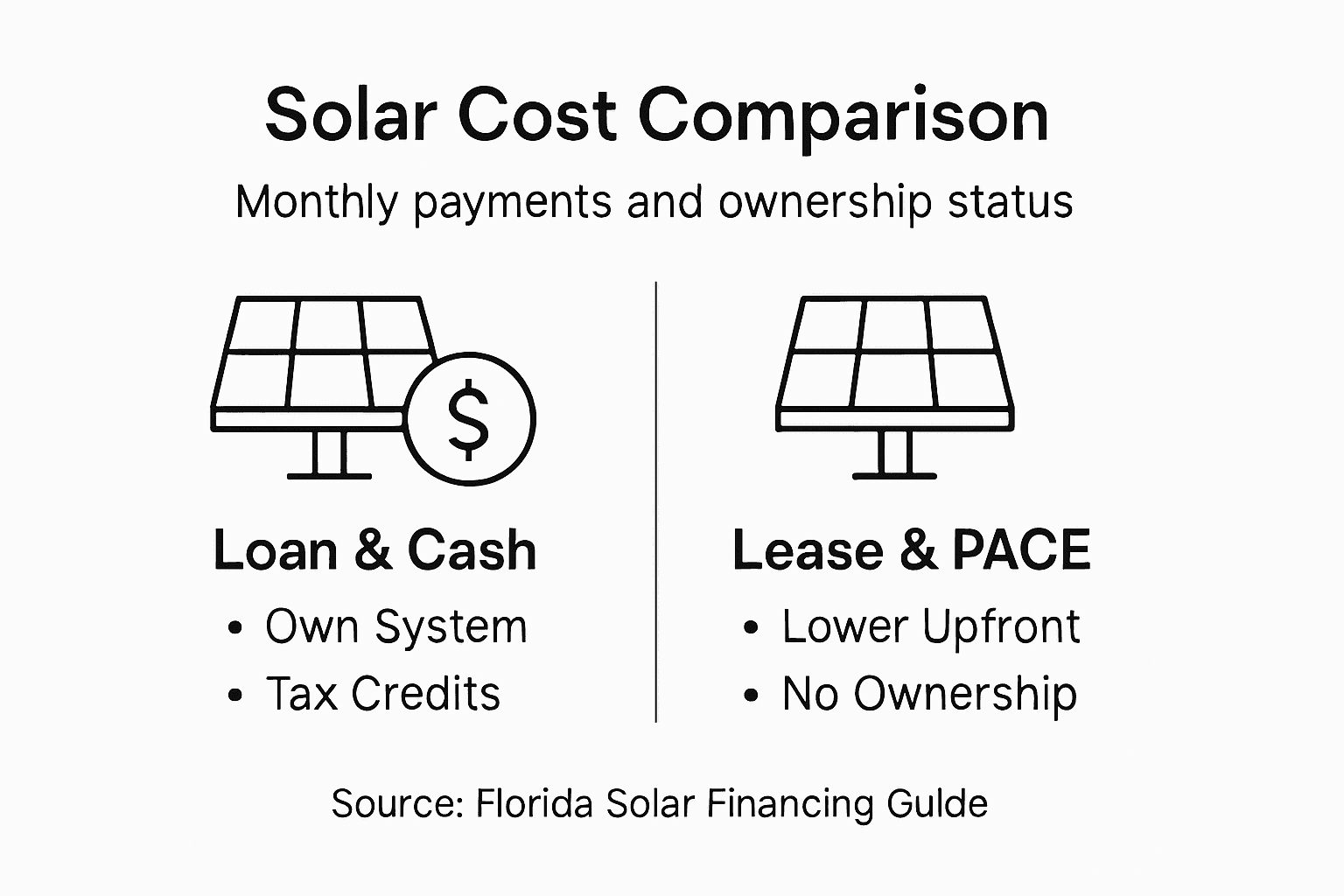
Solar Loan (10 years, 5.5% interest): Zero down, monthly payment $265, total paid $31,800, claim $7,500 federal tax credit, net cost $24,300. Total 20-year electricity savings $24,000 to $30,000. Net 20-year position: Breakeven to $5,700 profit.
PACE Financing (20 years, 6% interest): Zero down, monthly payment (property tax increase) $150, total paid $36,000, claim $7,500 federal tax credit only if you own it (PACE is ownership), net cost $28,500. Total 20-year electricity savings $24,000 to $30,000. Net 20-year position: Losses of $1,500 to $4,500 if savings fall short of estimate.
Solar Lease (20 years, $160 monthly): Zero down, total paid $38,400, zero tax credits, no ownership. Total 20-year electricity savings $18,000 to $24,000 (after lease payments). Net 20-year position: No equity built, system owner keeps all incentives.
Solar PPA (20 years, $0.12 per kilowatt-hour): Zero down, pay based on production, typically $100 to $150 monthly, total paid $24,000 to $36,000 depending on production. Zero tax credits, no ownership. Total 20-year electricity savings $12,000 to $20,000 (after PPA payments). Net 20-year position: No equity built, third party keeps incentives.
Notice something crucial: cash purchase and solar loans create wealth over 20 years. Leases and PPAs shift incentives to someone else, reducing your benefit. This is why ownership financing makes sense for moderate to high-income homeowners who can qualify for loans or have capital available.
Risk Assessment for Each Option
Beyond cost, each method transfers different risks to you or the system owner. Risk is not necessarily bad, but understanding who bears it matters.
Cash and Loan Ownership: You assume all maintenance and repair risk. A $5,000 inverter replacement at year 15 comes out of your pocket. Your property value depends on the system performing as expected. If production drops below estimates, you still owe the loan but get less benefit. This is real risk, but most quality systems have 25-year warranties covering major components.
Lease and PPA: The system owner assumes all maintenance and performance risk. They replace failed components at their cost. If production falls short of estimates, that is their problem, not yours. Your only risk is contractual obligation. You must continue paying even if the system underperforms. You cannot walk away easily. This transfers risk away from you but locks you into a long-term contract.
PACE Financing: You own the system, so you assume maintenance risk like a traditional loan. However, the assessment transfers to new owners if you sell. Your risk is reduced liquidity when selling, as some buyers refuse properties with PACE. This is a real risk in competitive real estate markets.
The key question: Are you comfortable assuming maintenance risk in exchange for ownership and incentives, or do you prefer simplicity and predictability even if it costs more?
Below is a quick reference for the main risks associated with each solar financing option:
| Financing Option | Primary Risk | Impact if Selling Home |
|---|---|---|
| Cash/Loan | Maintenance costs | Easy transfer, no contract ties |
| Lease | Contract may hinder resale | Buyer must assume lease |
| PACE Financing | Buyer assumes tax assessment | Reduced buyer pool risk |
| PPA | Long-term payment obligation | Buyer must accept payment terms |
Real-World Scenario Comparison
Let us apply this to an actual Florida homeowner situation. You are a 45-year-old professional with good credit, $40,000 annual income, and plan to stay in your home 15 plus years.
Option 1: Solar Loan: $265 monthly payment, claim $7,500 federal tax credit next year, own the system, build equity. After 10 years, system is paid off, you have 15 years of free electricity. Payback period: 8 years. 20-year net benefit: $8,000 to $12,000.
Option 2: Solar Lease: $160 monthly payment, zero upfront, zero tax credits, zero maintenance. No equity built. After 20 years, system owner removes the panels. You saved $12,000 in electricity costs, paid $38,400 in lease fees, net savings only $2,400 after accounting for foregone incentives. 20-year net benefit: $2,400.
Option 3: PACE: $150 monthly property tax increase, claim $7,500 federal tax credit, own the system. Total paid over 20 years: $36,000. Interest exceeds loan option. More expensive than traditional loan. Only makes sense if you could not qualify for the loan.
For this homeowner, the solar loan clearly wins. Lower total cost, maximum savings, reasonable monthly payment, and you own an appreciating asset.
Scenario Where Lease Makes Sense
Not every homeowner should finance a loan. If you have fair credit, limited capital, and do not plan to stay long-term, a lease might be the right call. You get immediate savings without debt, no maintenance worries, and can walk away when you sell (though the lease transfers to the new owner, which complicates sale).
But go in eyes open. You sacrifice $7,500 plus in incentives and pay more total cost for the convenience of zero upfront payment.
Creating Your Personal Comparison
Do not rely on solar company estimates alone. Request itemized quotes from at least three providers showing total cost for each financing option they offer. For each scenario, calculate: What is my monthly payment? What is the total amount I pay over 20 years? What tax credits do I claim? What are realistic electricity savings based on my usage patterns? What is my payback period? What is my 20-year net profit or loss?
Then assign your own risk tolerance score. If you value simplicity and predictability over maximum savings, lease might win despite higher total cost. If you value building equity and maximizing savings and you can handle maintenance risk, ownership financing wins.
Pro tip: Run your personal numbers through multiple solar company calculators, then verify them independently using your actual utility bills and local electricity rates, because overly optimistic production estimates can skew the comparison and lead you toward the wrong financing method.
Discover the Best Solar Financing Solutions Tailored for Florida Homeowners
Navigating solar financing options can feel overwhelming with choices like loans, leases, and PACE programs. If you want to maximize your savings while enjoying ownership benefits such as tax credits and increased property value, understanding these options is just the first step. At PES Solar, we specialize in helping Florida homeowners overcome financing challenges by offering personalized solar energy solutions designed to fit your budget and goals.
Why choose PES Solar? Because we not only provide expert system installation but also guide you through financing paths that unlock federal incentives and local rebates. Our team works closely with you to find the financing strategy that best matches your credit profile, income level, and long-term residence plans. Experience the confidence of going solar with trusted providers and premium products including Tesla Powerwall and REC solar panels. Learn more about how we support you every step of the way at PES Solar.
Ready to reduce your energy bills and build real equity with solar ownership? Visit PES Solar today for a free estimate and expert consultation. Discover the potential of solar loans, PACE financing, and cash purchase advantages customized just for Florida residents. Take control of your energy future now and start saving with confidence.
Frequently Asked Questions
What are the different solar financing options available?
Solar financing options include cash purchases, solar loans, leases, power purchase agreements (PPAs), and Property Assessed Clean Energy (PACE) financing. Each option varies in terms of ownership, tax benefit eligibility, and monthly payment structures.
How do solar loans work and what are their benefits?
Solar loans allow you to borrow money to purchase a solar system while building equity from day one. Benefits include ownership of the system, eligibility for tax credits and incentives, and monthly payments that can be offset by the energy savings generated by the system.
What are the advantages of leasing a solar system compared to owning it?
Leasing a solar system provides zero upfront cost and eliminates maintenance responsibilities, as the leasing company handles all installation and upkeep. However, you won’t benefit from tax credits or build equity in the system, making it generally more expensive over time compared to ownership options.
How do federal and state incentives impact solar financing in Florida?
Federal incentives like the Investment Tax Credit (ITC) allow you to claim a percentage of your solar installation costs on your taxes. Additionally, Florida offers a property tax exemption for solar systems and sales tax exemptions, which collectively lower your overall expenses and enhance the financial benefits of going solar.
Recommended
- Solar Incentives In Florida: Boosting Savings And Value
- 7 Key Commercial Solar Incentives For Florida Businesses
- Why Go Solar In Florida: Real Savings And Value
- Solar Power For Homes: Cost Savings And Energy Freedom
- Guide to Energy-Efficient Windows for Homes and Projects
- Solar Panel Installation Tampa FL
- Solar Panel Installation Orlando FL
