
Replacing your electric bill with solar power sounds promising, but questions about long-term protection can keep Florida homeowners up at night. Investing in solar panels is a major financial choice, and understanding what a warranty actually covers makes all the difference for your peace of mind. This guide breaks down the key types of solar panel warranties so you can make a confident decision for reliable savings and lasting energy independence.
Table of Contents
- What Are Solar Panel Warranties?
- Types Of Solar Panel Warranty Coverage
- Warranty Lengths And Key Differences
- Common Exclusions And Transferability
- How Warranties Affect Resale And Savings
Key Takeaways
| Point | Details |
|---|---|
| Importance of Warranties | Solar panel warranties provide key financial protection against defects and performance issues. |
| Types of Coverage | Product, performance, and workmanship warranties each cover specific aspects of solar systems. |
| Impact on Resale Value | Transferable warranties enhance property value and attract potential buyers in the real estate market. |
| Understanding Exclusions | Homeowners must be aware of common warranty exclusions to safeguard their investment. |
What Are Solar Panel Warranties?
Solar panel warranties represent a critical financial safeguard for Florida homeowners investing in solar energy systems. These comprehensive protection agreements shield consumers from potential manufacturing defects, performance issues, and unexpected repair costs associated with photovoltaic installations. Solar panel performance standards established by the U.S. Department of Energy help ensure these warranties maintain high-quality benchmarks for consumer protection.
Typically, solar panel warranties cover two primary aspects of system performance:
- Product Warranty: Protects against manufacturing defects and physical component failures
- Performance Warranty: Guarantees a specific electricity generation level over time
Most major manufacturers offer warranties ranging between 10-25 years, providing homeowners significant long-term coverage. These warranties can transfer to new property owners, which potentially increases home resale value and provides additional financial security for solar investments.
Solar panel warranties are more than just paperwork—they’re a promise of reliable, consistent energy production for your Florida home.
The warranty typically encompasses several key elements:
- Protection against panel degradation
- Coverage for manufacturing defects
- Replacement of underperforming components
- Workmanship guarantees from installation professionals
Pro tip: Always review warranty details carefully and understand exactly what is and isn’t covered before finalizing your solar panel installation.
Types Of Solar Panel Warranty Coverage
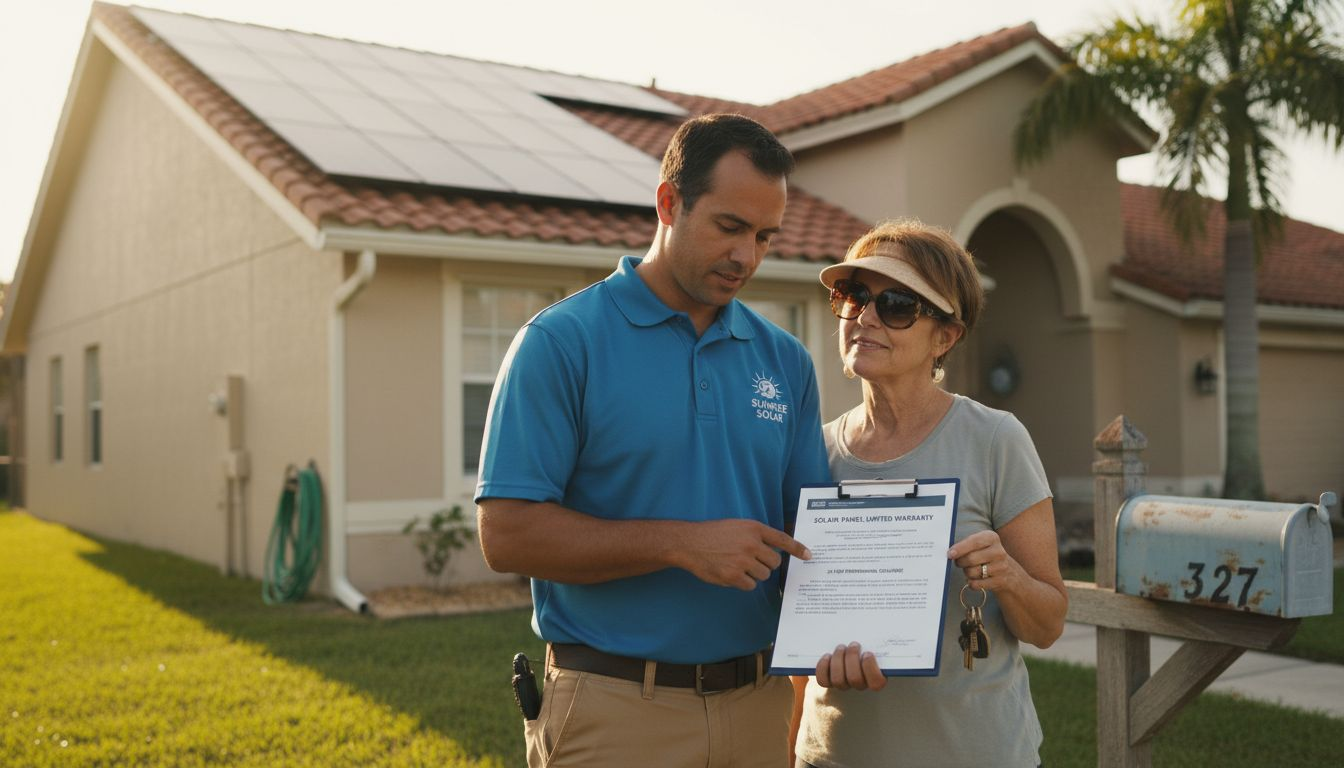
Solar panel warranties in Florida come in three primary categories, each providing critical protection for homeowners investing in renewable energy systems. Solar panel warranty standards established by federal regulations ensure comprehensive consumer protection across different warranty types.
The three main types of solar panel warranty coverage include:
- Product Warranty: Covers physical defects and manufacturing issues
- Performance Warranty: Guarantees minimum electricity generation levels
- Workmanship Warranty: Protects against installation-related problems
A Product Warranty typically spans 10-12 years and protects against manufacturing defects, material failures, and unexpected component breakdowns. This warranty ensures that if panels fail due to production issues, the manufacturer will replace or repair them at no additional cost to the homeowner.
The Performance Warranty is particularly crucial for Florida solar installations. This long-term coverage, usually extending 25-30 years, guarantees that solar panels will continue producing a specified percentage of their rated electrical output. Most manufacturers promise panels will retain at least 80-90% of their original performance capacity after 25 years.
Comprehensive solar panel warranties transform your investment from a potential risk into a reliable, long-term energy solution.
Lastly, Workmanship Warranties provided by installation professionals typically cover:
- Installation quality
- Mounting system integrity
- Electrical connection reliability
- System component compatibility
Pro tip: Request detailed documentation for each warranty type and understand the specific conditions and transfer processes before finalizing your solar panel installation.
Here’s a side-by-side comparison of the three main solar panel warranties for Florida homeowners:
| Warranty Type | Typical Duration | Main Focus | Who Provides It |
|---|---|---|---|
| Product Warranty | 10-12 years | Component defects and failures | Panel manufacturer |
| Performance Warranty | 25-30 years | Guaranteed energy output | Panel manufacturer |
| Workmanship Warranty | 5-10 years | Installation quality | Solar installer/company |
Warranty Lengths And Key Differences
Solar panel warranties in Florida differ significantly in their coverage duration and specific protections. Written warranty standards established by federal regulations provide critical guidelines for manufacturers and consumers alike, ensuring transparency and consumer protection.
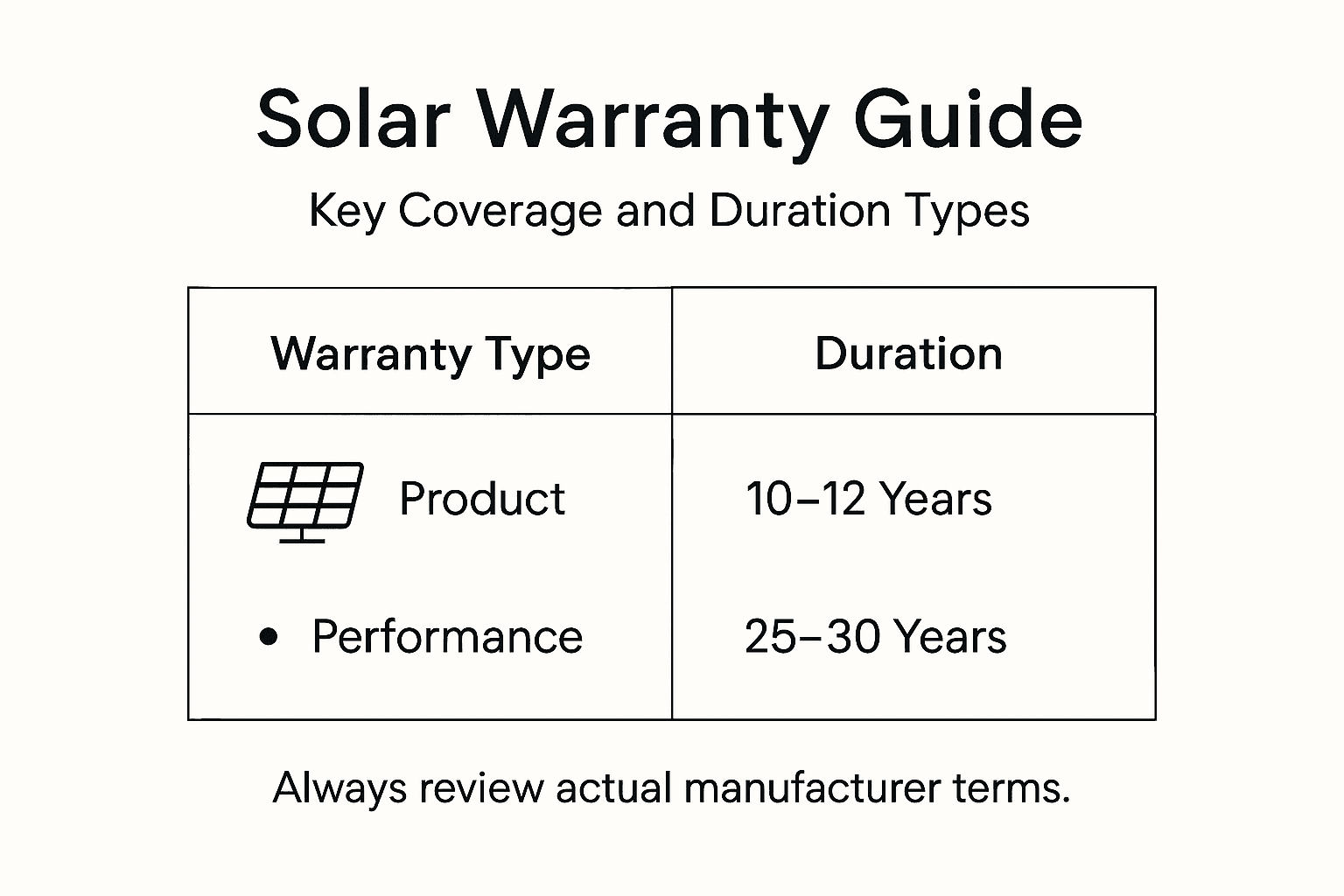
The typical warranty lengths for solar panel systems vary dramatically across different coverage types:
- Product Warranty: 10-12 years coverage
- Performance Warranty: 25-30 years duration
- Workmanship Warranty: 5-10 years protection
Product warranties offer the shortest coverage period but provide the most immediate protection. These warranties typically address manufacturing defects, material failures, and unexpected component breakdowns. Manufacturers guarantee that if panels fail due to production issues within the specified timeframe, they will replace or repair the components at no additional cost to the homeowner.
Performance warranties represent the longest and most comprehensive protection for solar investments. These extended warranties guarantee that solar panels will maintain a specific percentage of their original electrical output over decades. Most manufacturers promise panels will retain at least 80-90% of their peak performance capacity after 25 years, which is particularly important for Florida’s intense solar conditions.
Warranty length isn’t just about time—it’s about ensuring your solar investment continues delivering value year after year.
Workmanship warranties, while typically the shortest, provide critical protection for installation-related issues:
- Cover installation quality and precision
- Address potential mounting system problems
- Ensure electrical connection reliability
- Validate overall system component compatibility
Pro tip: Always compare warranty details across multiple manufacturers and carefully review the specific terms, conditions, and transferability before making your final solar panel investment.
Common Exclusions And Transferability
Solar panel warranties come with specific limitations that Florida homeowners must carefully understand. Warranty transfer policies highlight critical nuances in protecting your solar investment across different scenarios.
Common warranty exclusions typically include:
- Environmental Damage: Extreme weather events like hurricanes
- Improper Maintenance: Neglect or unauthorized repairs
- Physical Damage: Accidental impacts or structural modifications
- Installation Errors: Work performed by non-certified technicians
Most manufacturers have strict guidelines about what voids a solar panel warranty. Unauthorized modifications, improper cleaning techniques, or repairs conducted by individuals without manufacturer certification can immediately invalidate warranty coverage. In Florida’s challenging climate, understanding these exclusions becomes particularly crucial for protecting your solar investment.
Warranty transferability represents another complex aspect of solar panel protection. While many manufacturers allow warranty transfers to new homeowners, this process isn’t automatic. Specific documentation, notification requirements, and sometimes transfer fees must be managed precisely to maintain continuous coverage.
Not all warranties are created equal—the details matter more than the duration.
The typical warranty transfer process involves:
- Notify the manufacturer of property ownership change
- Complete required transfer documentation
- Pay any applicable transfer fees
- Verify new owner’s registration with manufacturer
Pro tip: Always request detailed documentation about warranty transfer processes directly from your solar panel manufacturer before selling your home.
How Warranties Affect Resale And Savings
Solar panel warranties play a critical role in enhancing property value and financial returns for Florida homeowners. Warranty transfer mechanisms demonstrate how comprehensive coverage can significantly impact real estate transactions and long-term energy savings.
The financial benefits of transferable solar warranties include:
- Increased Property Value: Transferable warranties make solar installations more attractive to potential buyers
- Continued Energy Savings: New homeowners inherit the remaining warranty protection
- Reduced Maintenance Costs: Comprehensive coverage minimizes unexpected repair expenses
- Investment Security: Warranties provide confidence in the solar system’s long-term performance
Potential home buyers view transferable solar warranties as a significant asset. A solar installation with an active, comprehensive warranty can increase home value by offsetting the initial investment cost and providing assurance of continued energy production. In the Florida real estate market, homes with well-documented solar warranties often command premium prices compared to properties without such protection.
The savings potential extends beyond the immediate property value. Transferable warranties ensure that the original investment continues to generate returns for subsequent homeowners. Most performance warranties guarantee 80-90% energy production capacity for 25 years, creating a compelling financial proposition for both current and future property owners.
A robust solar panel warranty isn’t an expense—it’s a valuable asset that travels with your property.
Key considerations for maximizing warranty value include:
- Maintain detailed warranty documentation
- Follow manufacturer maintenance guidelines
- Register warranty transfers promptly
- Disclose full warranty details during property sales
Pro tip: Collect and organize all solar panel warranty documentation in a dedicated file to streamline potential property sales and demonstrate the system’s value to future buyers.
Below are key ways solar panel warranties impact a property’s resale potential and savings:
| Warranty Impact | Benefit for Homeowner | Benefit for Buyer |
|---|---|---|
| Increased Home Value | Higher market price for solar-equipped home | Reduced risk, more certainty |
| Lower Maintenance Costs | Fewer unexpected repair bills | Reliable ongoing coverage |
| Easier Resale | Smoother sales process, clear documentation | Attracts more buyers |
| Continued Savings | Lasting energy cost reductions | Inherits energy savings |
Secure Your Florida Solar Investment With Trusted Warranty Protection
Understanding the crucial role of solar panel warranties is the first step in protecting your investment against manufacturing defects and performance issues. Florida homeowners face unique challenges such as intense sun exposure and seasonal storms that can impact solar system durability. At PES Solar, we focus on delivering not only high-quality solar installations but also transparent warranty information that empowers you to make confident, long-term decisions for your home or business.
Our team guides you through product, performance, and workmanship warranty options to ensure your system continues generating savings while maintaining peak efficiency. With comprehensive coverage backed by trusted brands and expert installation, you avoid costly repairs and enjoy peace of mind knowing your investment is secure.
Ready to protect your solar investment and increase your property value with expert-backed warranty coverage? Visit PES Solar today to get your free estimate and learn how our certified team can help you leverage Florida’s solar incentives with guaranteed system performance. Don’t wait until issues arise—take action now and secure reliable energy savings for decades.
Frequently Asked Questions
What are the main types of solar panel warranties?
The main types of solar panel warranties include Product Warranties, which cover manufacturing defects; Performance Warranties, which guarantee minimum electricity generation levels; and Workmanship Warranties, which protect against installation-related issues.
How long do solar panel warranties typically last?
Solar panel warranties generally last between 10-12 years for Product Warranties, 25-30 years for Performance Warranties, and 5-10 years for Workmanship Warranties, depending on the type and manufacturer.
What common exclusions should I be aware of in solar panel warranties?
Common exclusions in solar panel warranties include damage from environmental events, improper maintenance, physical damage from accidents, and issues arising from installation errors by non-certified technicians.
How do solar panel warranties impact home resale value?
Transferable solar panel warranties can increase property value by making the solar system’s benefits more attractive to potential buyers, providing assurance of continued energy production and lower maintenance costs.
