
Many people think off-grid solar means flipping a switch and forgetting about energy forever. The reality is more nuanced but equally compelling. Off-grid solar systems provide genuine energy independence through carefully engineered combinations of panels, batteries, and controls. For Florida homeowners and businesses, these systems offer storm resilience and freedom from utility dependence, though they require thoughtful planning around climate challenges, regulatory compliance, and upfront investment. This guide walks you through everything you need to understand about off-grid solar in Florida’s unique environment.
Table of Contents
- Key takeaways
- What is off-grid solar and how does it work?
- Why off-grid solar makes sense in Florida’s unique environment
- Navigating regulations and safety standards for Florida off-grid solar systems
- Off-grid solar vs grid-tied: what Florida homeowners should know
- Explore professional off-grid solar solutions with ProE Solar
- Frequently asked questions
Key Takeaways
| Point | Details |
|---|---|
| Core components | Off grid solar operates without utility power using solar panels, battery banks, charge controllers, and inverters. |
| Battery chemistry | LiFePO4 batteries deliver more cycles and higher usable capacity than lead acid, enabling longer periods of independence. |
| Florida design factors | Florida climate and permitting rules influence system sizing, component selection, and hurricane durability requirements. |
| Economic tradeoffs | Upfront costs are higher, but independence during storms and for remote sites can justify the investment. |
| Autonomy sizing | Size the battery bank for three to five days of autonomy to cover extended cloudy periods without generator backup. |
What is off-grid solar and how does it work?
Off-grid solar represents a complete departure from utility dependence. Unlike grid-tied systems that remain connected to power lines, off-grid photovoltaic systems operate independently through four essential components working in harmony.
Solar panels capture sunlight and convert it to DC electricity. MPPT charge controllers optimize this power flow while protecting batteries from overcharge damage. Battery banks store energy for nighttime and cloudy periods. Inverters transform stored DC power into the AC electricity your appliances need.
The battery component deserves special attention because it determines system capability and longevity. Three main types dominate the market: flooded lead-acid, sealed AGM, and lithium iron phosphate (LiFePO4). LiFePO4 batteries have revolutionized off-grid solar through superior performance metrics. They deliver 3,000 to 5,000 charge cycles compared to 500 to 1,000 for lead-acid options. Their depth of discharge reaches 80 to 90 percent versus 50 percent for traditional batteries, meaning you can use more stored energy without damaging the cells.
Charge controllers play a critical but often misunderstood role. MPPT (Maximum Power Point Tracking) controllers continuously adjust electrical resistance to extract maximum power from panels under varying conditions. They can boost energy harvest by 20 to 30 percent compared to simpler PWM controllers, especially during Florida’s partly cloudy days.
Inverters complete the system by converting battery DC voltage to household AC power. Modern inverters provide pure sine wave output that safely runs sensitive electronics, unlike older modified sine wave units that could damage equipment. Quality inverters include built-in surge capacity to handle motor startup loads from air conditioners and well pumps.
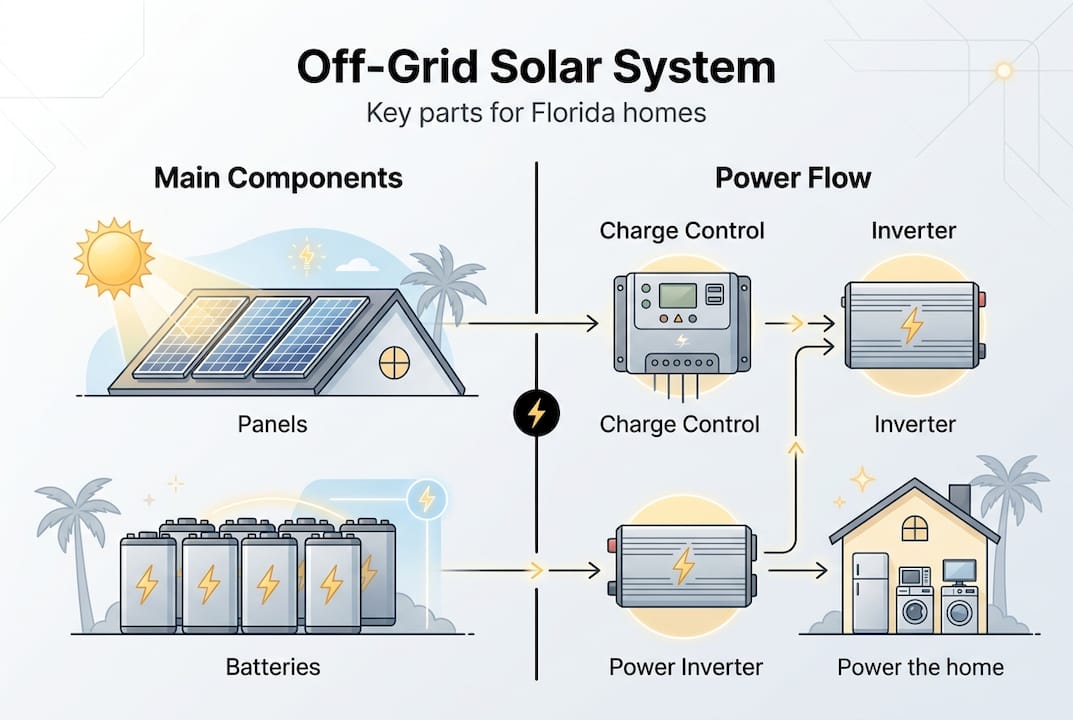
Many people assume off-grid solar requires constant monitoring and complex maintenance. Reality proves simpler. Modern systems with LiFePO4 batteries need minimal intervention beyond occasional panel cleaning and annual connection checks. The technology has matured significantly, making reliable off-grid operation achievable for homeowners willing to understand basic system principles.
Pro Tip: Size your battery bank for three to five days of autonomy to handle extended cloudy periods without generator backup. Florida’s weather patterns make this cushion essential for true energy independence.
When you’re ready to move forward, our detailed installation guide breaks down the process step by step for Florida conditions.
Why off-grid solar makes sense in Florida’s unique environment
Florida’s geography and climate create both challenges and opportunities for off-grid solar adoption. Understanding these factors helps you make informed decisions about system design and feasibility.
The state contains 20 million acres of rural parcels where utility connection proves prohibitively expensive. When grid extension costs exceed $20,000 per mile, off-grid solar becomes economically competitive despite higher upfront investment. Agricultural operations, remote cabins, and properties in developing areas represent prime candidates for off-grid solutions.
Florida’s climate presents unique design challenges that directly impact system sizing and component selection. High humidity accelerates corrosion on connections and mounting hardware, requiring marine-grade materials and regular inspection. Air conditioning dominates energy consumption, with typical homes using 40 to 60 percent of daily power for cooling. A 1,500 square foot home requires substantial battery capacity to handle these loads plus dehumidification needs.
| Home Size | Daily Energy Use (kWh) | Recommended Battery Bank (kWh) | Panel Array (kW) |
|---|---|---|---|
| 1,000 sq ft | 25-35 | 75-105 | 8-10 |
| 1,500 sq ft | 35-50 | 105-150 | 10-14 |
| 2,000 sq ft | 50-70 | 150-210 | 14-18 |
| 2,500 sq ft | 65-85 | 195-255 | 18-22 |
Hurricane resilience drives many Florida residents toward off-grid solar, but this benefit requires proper installation. Wind speeds in coastal zones can exceed 150 mph during major storms. Your mounting system must meet High Velocity Hurricane Zone (HVHZ) standards, which specify engineered attachments, reinforced rails, and tested hardware assemblies. Panels themselves rarely fail; improperly secured mounting causes nearly all storm damage.
Florida’s abundant sunshine provides the silver lining that makes off-grid solar viable. The state averages 230 to 250 sunny days annually, with peak sun hours ranging from 4.5 to 5.5 depending on location. This solar resource allows properly sized systems to generate surplus power during summer months, building battery reserves for shorter winter days.
Irrigation pumps for agriculture and landscaping represent another compelling off-grid application. Wells located far from power lines traditionally required expensive trenching or diesel generators. Solar-powered pumping eliminates ongoing fuel costs while providing reliable daytime operation when irrigation needs peak.
Pro Tip: Design your system for worst-case December conditions when sun angles are lowest and days shortest. If the system works in winter, summer becomes easy.
Learn more about optimizing solar performance in Florida’s climate to maximize your investment.
Navigating regulations and safety standards for Florida off-grid solar systems
Florida’s regulatory framework for solar installations applies equally to off-grid and grid-tied systems, surprising many who assume disconnection from utilities means freedom from permits. Understanding these requirements prevents costly delays and ensures safe, legal operation.
Permits are mandatory for all solar installations in Florida, regardless of grid connection status. The Florida Building Code 2023 edition and National Electrical Code 2020 establish minimum standards for design, installation, and inspection. Local jurisdictions may impose additional requirements, particularly in coastal High Velocity Hurricane Zones.
Key regulatory frameworks governing Florida off-grid solar include:
- Florida Building Code (FBC) 2023 covering structural mounting and wind load calculations
- National Electrical Code (NEC) 2020 Article 690 for photovoltaic systems and Article 706 for energy storage
- NFPA 855 Standard for Installation of Stationary Energy Storage Systems when battery banks exceed certain capacities
- Local amendments in Miami-Dade and Broward counties with stricter wind zone requirements
- Florida Fire Prevention Code for battery room ventilation and fire suppression
Permit applications typically require detailed plans showing panel layout, electrical single-line diagrams, structural calculations, and equipment specifications. Inspectors verify proper grounding, conductor sizing, overcurrent protection, and disconnect accessibility during field visits. The process takes two to six weeks depending on jurisdiction workload and plan complexity.
Battery installations face particular scrutiny due to fire and thermal runaway risks. NFPA 855 governs large battery systems with requirements for ventilation, spacing, fire detection, and suppression equipment. Lithium battery installations need dedicated rooms or outdoor enclosures with proper clearances. Some jurisdictions require thermal monitoring systems that alert to dangerous temperature increases.
Hurricane zone requirements dramatically impact installation costs and complexity. Miami-Dade County maintains the nation’s strictest standards through its Product Control Division. Systems in HVHZ areas need engineered mounting designs with tested and approved hardware. Roof attachments must penetrate into structural members, not just sheathing. Rail systems require specific spacing and reinforcement.
Insurance considerations add another layer of complexity. Many homeowners policies exclude or limit coverage for solar equipment, particularly battery systems. Specialized solar equipment riders or separate policies may be necessary. Insurers often require proof of proper permitting, professional installation, and code compliance before extending coverage.
Working with licensed contractors familiar with Florida’s regulatory landscape streamlines the process significantly. Licensed solar contractors understand local requirements, maintain relationships with building departments, and carry proper insurance. DIY installations, while legal, face additional scrutiny during inspections and may complicate insurance claims.
Pro Tip: Request a pre-application meeting with your local building department before finalizing system design. Inspectors can identify potential issues early, saving time and revision costs.
Our comprehensive guide to Florida solar regulations covers additional details, and we’ve created a resource specifically about streamlining the permitting process.
Off-grid solar vs grid-tied: what Florida homeowners should know
Choosing between off-grid and grid-tied solar represents one of the most consequential decisions in your renewable energy journey. Each approach offers distinct advantages and limitations that become particularly pronounced in Florida’s context.
| Factor | Off-Grid Solar | Grid-Tied Solar |
|---|---|---|
| Upfront Cost | $40,000-$80,000 for typical home | $15,000-$30,000 for typical home |
| Monthly Savings | Eliminates utility bills entirely | Reduces bills 70-90% with net metering |
| Storm Resilience | Continues operating during outages | Shuts down during outages (safety requirement) |
| Maintenance | Battery replacement every 10-15 years | Minimal; panels only |
| Payback Period | 15-25 years | 7-12 years |
| Best For | Remote locations, resilience priority | Grid-served areas, economics priority |
Cost differences between these approaches stem primarily from battery requirements. Off-grid systems need substantial energy storage to cover nighttime use and cloudy periods, while grid-tied systems use the utility as a virtual battery. A typical Florida home requires 100 to 150 kWh of battery capacity for three days autonomy, representing $15,000 to $30,000 in battery costs alone.
Net metering programs available to grid-tied customers provide economic benefits impossible for off-grid systems to match. When your panels generate excess power, the utility credits your account at retail rates. You draw these credits during low production periods, effectively using the grid as free storage. Experts generally favor grid-tied or hybrid systems for cost effectiveness and net metering advantages.
Storm resilience represents off-grid solar’s most compelling advantage in hurricane-prone Florida. Grid-tied systems must shut down during outages to prevent backfeeding power into lines that utility workers assume are dead. Your panels could be generating perfectly good electricity while you sit in the dark. Off-grid systems continue operating regardless of grid status, providing lights, refrigeration, and communication when neighbors lose power.
“The primary value of battery storage in Florida comes from resilience during hurricanes and grid failures, not from daily bill savings. Batteries provide peace of mind that’s hard to quantify but very real when storms approach.”
Hybrid systems offer a middle path worth considering. These grid-tied systems include battery backup for critical loads. During normal operation, they function like standard grid-tied systems with net metering benefits. When the grid fails, they automatically switch to battery power for essential circuits you’ve designated. This approach costs less than full off-grid while providing storm resilience.
Follow these steps to determine which system type fits your situation:
- Calculate your daily energy consumption from recent utility bills
- Identify whether grid connection is available and affordable at your location
- Assess your storm resilience needs and critical load requirements
- Compare total system costs including batteries, installation, and maintenance
- Calculate payback periods for each approach based on current utility rates
- Consider future plans for the property and potential resale value impact
Pro Tip: If grid connection is available and affordable, start with grid-tied solar and add battery backup later if desired. This staged approach spreads costs over time while capturing immediate savings.
Explore options for adding batteries to existing grid-tied systems and learn about solar power reliability in different configurations.
Explore professional off-grid solar solutions with ProE Solar
Transitioning to off-grid solar requires expertise in system design, regulatory compliance, and Florida-specific installation challenges. Professional guidance ensures your investment delivers reliable performance for decades while meeting all safety and legal requirements.
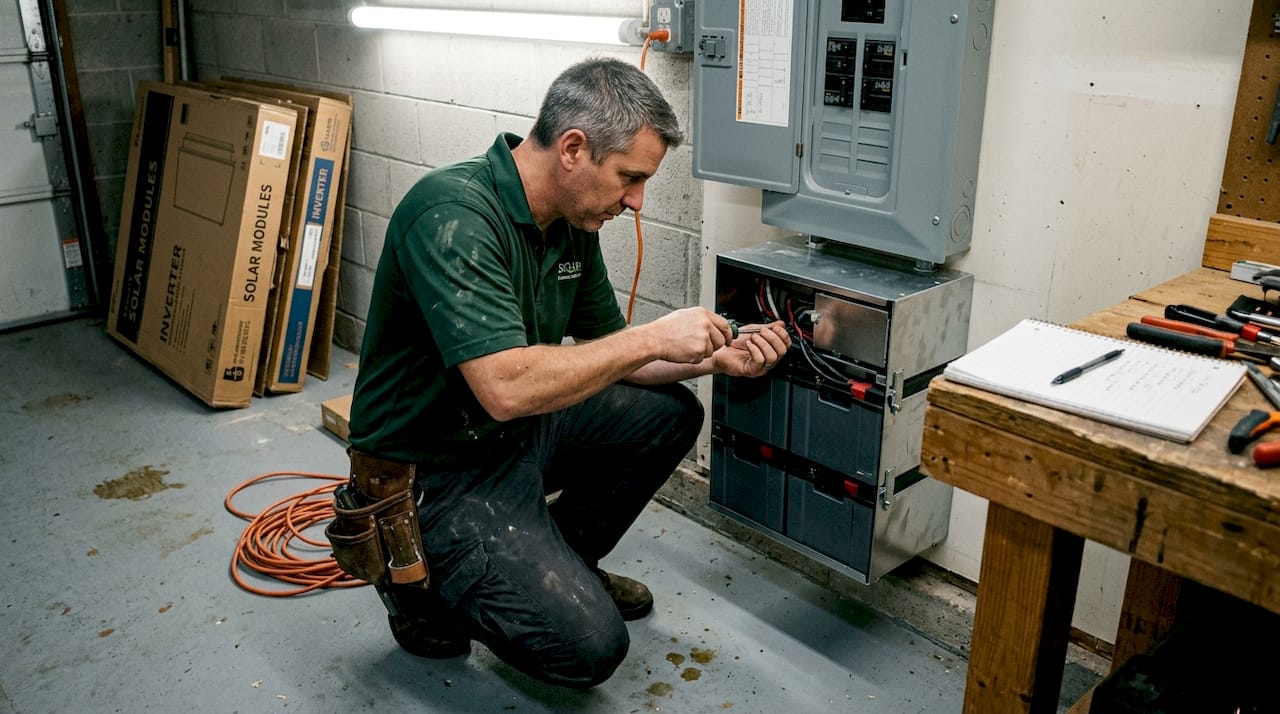
Our team specializes in designing off-grid systems optimized for Florida’s climate and regulatory environment. We handle permitting, structural engineering, and inspections while you focus on your energy independence goals. Whether you’re building in a remote location or seeking ultimate storm resilience, we’ll create a solution matching your specific needs and budget.
Financing options make off-grid solar more accessible than ever. We’ve compiled a comprehensive guide to Florida solar financing programs including loans, leases, and incentive programs that reduce upfront costs. Our financing specialists help you navigate options to find the best fit for your situation.
Proper maintenance extends system life and protects your investment. Learn essential practices in our solar panel maintenance guide covering cleaning, inspection, and component care specific to Florida conditions. We also offer ongoing maintenance services to keep your system performing optimally.
Ready to explore off-grid solar for your Florida property? Contact our experienced team for a customized assessment and proposal. We’ll evaluate your site, calculate energy needs, and design a system that delivers true energy independence.
Frequently asked questions
What is the average cost of off-grid solar systems in Florida?
Off-grid solar systems in Florida typically cost $40,000 to $80,000 for a complete residential installation, with batteries representing 35 to 45 percent of total expense. While upfront investment is substantial, grid extension costs exceeding $20,000 per mile make off-grid economically competitive in rural areas. The system eliminates monthly utility bills entirely, providing long-term savings that offset initial costs over 15 to 25 years.
How durable are off-grid solar systems against Florida hurricanes?
Properly installed off-grid solar systems demonstrate exceptional hurricane durability when designed to Florida Building Code standards. Code-compliant systems show failure rates below 0.1 percent even in Category 5 hurricanes. The key lies in engineered mounting systems with reinforced attachments to structural roof members. Panels themselves withstand extreme winds; mounting failures cause nearly all storm damage, making professional installation with proper permitting essential.
Do off-grid solar systems require special permits in Florida?
Yes, all solar installations require permits in Florida regardless of grid connection status. Off-grid systems must comply with Florida Building Code 2023 and National Electrical Code 2020, with additional requirements for battery installations under NFPA 855. The permitting process includes plan review, structural calculations, and field inspections to verify code compliance. Working with licensed contractors familiar with Florida solar regulations streamlines approval and ensures legal, safe operation.
Can off-grid solar systems fully replace grid electricity in Florida homes?
Off-grid solar can completely replace grid electricity, but Florida’s high energy demands make this challenging and expensive. Substantial battery banks are necessary to handle air conditioning and dehumidification loads that consume 40 to 60 percent of daily energy. A typical 1,500 square foot home needs 100 to 150 kWh of battery storage plus 10 to 14 kW of solar panels for reliable year-round operation. This approach works best for rural properties, remote locations, or homeowners prioritizing energy independence and storm resilience over economics.
