
Rising electricity bills are a constant headache for Florida small businesses, especially in retail and hospitality. As Florida stands out as the third-largest solar energy producer in the United States and solar installation costs lower, more business owners are turning to commercial solar to manage expenses while supporting sustainability. This guide will help you understand how commercial solar can cut your energy costs, take advantage of state and federal incentives, and position your business for long-term growth and resilience.
Table of Contents
- Understanding Commercial Solar in Florida
- Types of Commercial Solar Systems Available
- How Commercial Solar Reduces Energy Expenses
- Federal and Florida Solar Incentives Explained
- Financial Impact and Return on Investment
- Practical Steps for Commercial Solar Installation
Key Takeaways
| Point | Details |
|---|---|
| Commercial Solar Adoption in Florida | The state offers unique advantages for businesses looking to switch to solar power due to excellent solar irradiance and supportive policies. |
| Economic Benefits | Businesses can significantly reduce operational costs and enhance financial stability by investing in solar technology, including potential tax incentives. |
| Types of Solar Systems | Options like rooftop, ground-mounted, and in-front-of-the-meter systems cater to different business needs and energy requirements. |
| Financial Incentives | Businesses should leverage federal and state solar incentives to reduce installation costs and improve long-term returns on investment. |
Understanding Commercial Solar in Florida
Florida represents a dynamic landscape for commercial solar energy, emerging as a top solar energy producer in the United States. With abundant sunshine and increasingly supportive policies, businesses across the state are discovering significant advantages in transitioning to solar power. The dramatic increase in solar generation over recent years signals a transformative moment for Florida’s commercial energy sector.
The economic potential of commercial solar in Florida extends far beyond simple energy production. Research indicates that solar projects generate substantial local economic benefits, including job creation, increased labor income, and meaningful contributions to gross domestic product. Strategic solar installations can help businesses reduce operational expenses while simultaneously supporting Florida’s broader economic development goals. By investing in solar technology, companies position themselves as forward-thinking organizations committed to sustainability and long-term financial efficiency.
Commercial solar adoption in Florida is particularly compelling due to several unique regional factors. The state’s geographic location provides exceptional solar irradiance, making solar panels exceptionally productive. Additionally, federal clean energy incentives and state-level supportive policies are creating an increasingly attractive environment for businesses considering solar investments. Companies can leverage these incentives to offset installation costs and accelerate their return on investment, making solar a financially strategic decision.
Pro tip: Before initiating a commercial solar project, conduct a comprehensive energy audit to precisely determine your organization’s specific solar requirements and potential savings opportunities.
Types of Commercial Solar Systems Available
Business owners in Florida have several compelling options for commercial solar systems, with rooftop and ground-mounted arrays representing the primary installation approaches. Rooftop systems utilize existing building infrastructure, maximizing space efficiency and minimizing additional land requirements. These installations are particularly attractive for businesses with substantial roof areas that receive consistent direct sunlight, allowing for seamless energy generation without disrupting existing operations.
Commercial solar configurations can be strategically designed to meet diverse business needs. Ground-mounted systems offer greater flexibility in panel positioning and can accommodate larger solar arrays for businesses with expansive property. Roof-mounted systems are typically more compact but can be equally effective, especially for retail centers, warehouses, and office complexes. Each configuration provides unique advantages depending on the specific energy requirements, property layout, and financial objectives of the business.
The commercial solar landscape in Florida includes sophisticated models like ‘in-front-of-the-meter’ installations, which enable building owners to generate revenue by leasing rooftop space for solar projects. These systems range from small-scale arrays to medium-sized commercial installations, designed to maximize energy production and financial returns. Businesses can choose between grid-connected systems that feed excess energy back to the electrical grid or standalone systems with battery storage for increased energy independence and resilience during potential power interruptions.
Here’s a quick comparison of major commercial solar system types for Florida businesses:
| System Type | Best For | Key Advantage | Space Requirement |
|---|---|---|---|
| Rooftop Array | Large roof buildings | Maximizes unused roof area | No extra land needed |
| Ground-Mounted | Businesses with open land | Flexible orientation options | Requires significant ground |
| In-Front-of-Meter | Owners with leasable rooftops | Generates landlord revenue | Rooftop or ground required |
| Standalone (Battery) | High energy independence need | Provides backup during outages | Space for panels & batteries |
Pro tip: Consult with a professional solar engineer to conduct a comprehensive site assessment, which will help determine the most appropriate solar system configuration for your specific commercial property and energy consumption patterns.
How Commercial Solar Reduces Energy Expenses
Florida businesses can significantly lower their operational costs through strategic solar energy investments that provide stable, low-cost electricity alternatives. By generating their own renewable energy, companies can dramatically reduce dependence on traditional grid electricity, which typically experiences frequent price fluctuations and escalating rates. Solar installations offer businesses a predictable energy cost structure, allowing for more accurate financial planning and long-term budget stability.
The economic benefits of commercial solar extend beyond immediate energy savings. Utility-scale solar facilities create a direct pathway to reduced operational expenses by displacing more expensive fossil fuel-generated electricity. Businesses can potentially offset a substantial portion of their energy consumption through on-site solar generation, which translates to immediate and ongoing cost reductions. Additionally, many solar installations qualify for significant tax incentives and depreciation benefits, further enhancing the financial attractiveness of these renewable energy investments.

Commercial solar systems provide multiple layers of financial optimization for businesses. By generating excess energy that can be fed back into the electrical grid, companies can create additional revenue streams through net metering programs. These systems also help businesses hedge against future energy price increases, providing a stable and predictable energy cost structure. The long-term financial model of solar investments typically demonstrates a robust return on investment, with many businesses recouping their initial installation costs within 5-7 years through accumulated energy savings and incentive programs.
Pro tip: Conduct a comprehensive energy audit and financial analysis before installing solar to precisely quantify potential savings and identify the most cost-effective solar configuration for your specific business needs.
Federal and Florida Solar Incentives Explained
Businesses in Florida can leverage comprehensive solar incentive programs that significantly reduce the financial barriers to solar energy adoption. The federal Investment Tax Credit (ITC) remains the cornerstone of solar incentives, allowing businesses to deduct a substantial percentage of their solar installation costs directly from federal tax obligations. This powerful incentive can offset up to 30% of total project expenses, making solar investments dramatically more accessible for commercial enterprises across the state.
Florida offers a unique landscape of state-level solar incentives that complement federal programs. Property tax exemptions specifically designed for solar installations prevent additional property tax assessments on the increased value created by solar systems. Businesses can install solar infrastructure without worrying about higher property tax bills, which further enhances the financial attractiveness of renewable energy investments. Additionally, net metering policies in Florida allow companies to receive credit for excess electricity generated, creating an additional revenue stream and improving overall project economics.
The complex ecosystem of solar incentives requires strategic navigation to maximize financial benefits. Beyond tax credits and exemptions, Florida businesses can access performance-based incentives, accelerated depreciation benefits, and various grants that support commercial solar projects. Local utility companies often provide additional rebates and incentive programs, creating multiple layers of financial support. These incentives not only reduce upfront costs but also dramatically improve the long-term return on investment for commercial solar installations, making renewable energy a compelling financial strategy for forward-thinking businesses.
Review these core financial incentives for Florida commercial solar projects:
| Incentive Type | Who Qualifies | Core Benefit |
|---|---|---|
| Federal ITC Tax Credit | All business solar owners | Offsets up to 30% of system cost |
| State Property Tax Exempt | Solar property owners | Excludes solar value from assessments |
| Net Metering | Grid-connected businesses | Earns credit for excess generation |
| Utility Rebates | Eligible utility customers | Reduces upfront installation expense |
Pro tip: Consult with a tax professional and solar energy specialist to develop a comprehensive incentive strategy that captures all available federal, state, and local solar investment opportunities.
Financial Impact and Return on Investment
Florida businesses can expect substantial financial benefits from solar investments, with commercial solar projects demonstrating robust economic potential. The typical return on investment for commercial solar systems ranges between 5-7 years, after which businesses essentially generate free electricity. Initial installation costs are significantly offset by multiple financial advantages, including reduced energy expenses, tax incentives, and potential revenue generation through excess energy production.
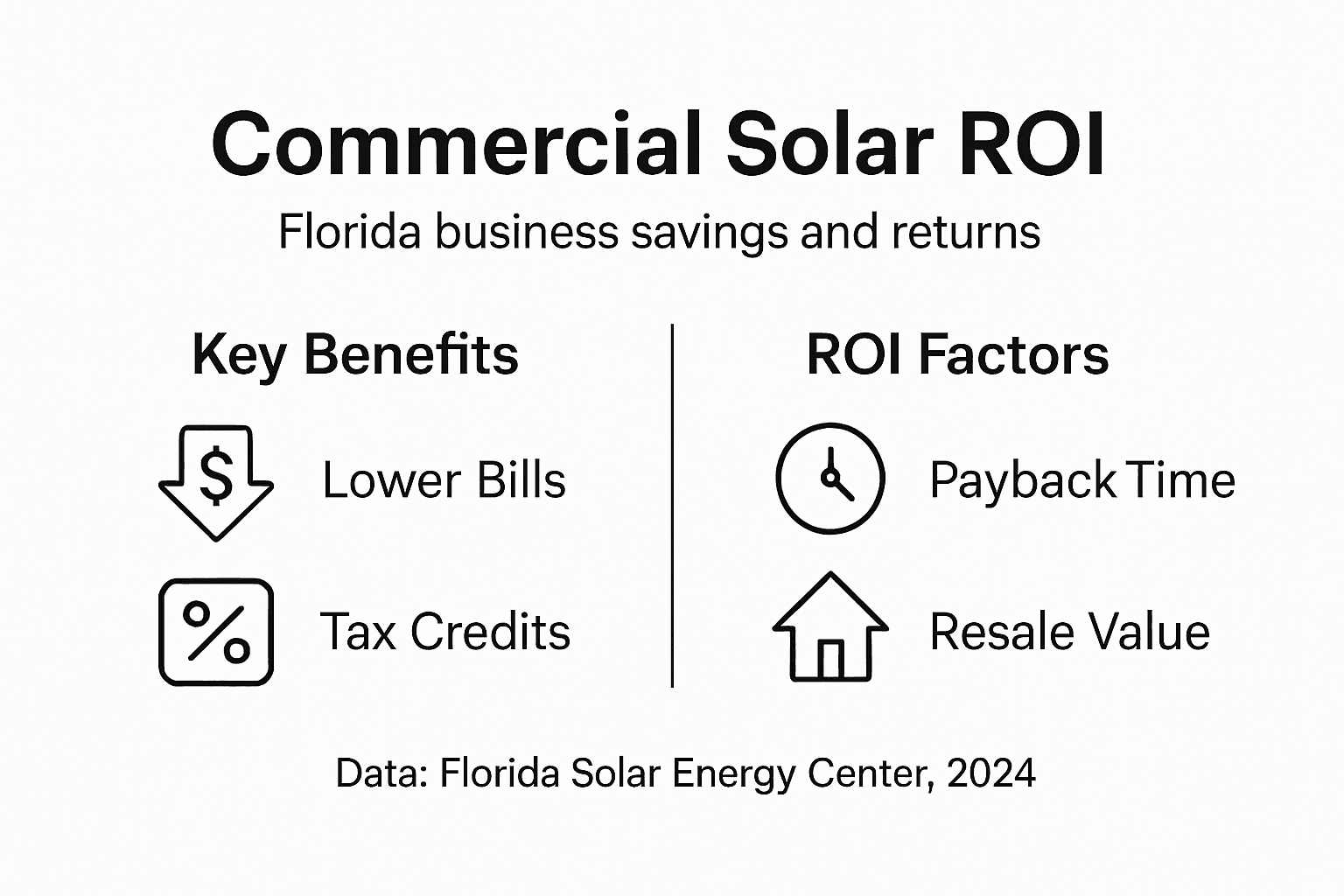
The economic modeling of commercial solar investments reveals multiple layers of financial impact. Utility-scale solar projects contribute to broader economic growth by creating local jobs, increasing labor income, and generating additional tax revenues. Businesses can expect not just energy cost savings, but also potential property value increases and enhanced corporate sustainability credentials. The declining costs of solar technology, combined with federal and state incentives, have made solar investments increasingly attractive for commercial enterprises seeking strategic financial opportunities.
Careful financial analysis is crucial when evaluating solar investment potential. Key considerations include system efficiency, local solar irradiance, available incentives, and specific energy consumption patterns. Businesses should conduct comprehensive financial modeling that accounts for federal tax credits, accelerated depreciation benefits, state-level incentives, and projected energy savings. By understanding these complex financial dynamics, companies can make informed decisions that align solar investments with their long-term economic and sustainability objectives.
Pro tip: Engage a financial advisor with specific solar investment experience to develop a detailed pro forma analysis that captures all direct and indirect financial benefits of your commercial solar project.
Practical Steps for Commercial Solar Installation
Florida businesses planning commercial solar installations must navigate a structured process, beginning with comprehensive site assessment and permitting requirements. Initial steps involve conducting a detailed energy audit to determine precise power needs, roof or ground space availability, and potential solar system configurations. Professional solar engineers will evaluate structural integrity, sun exposure, and electrical infrastructure to design a system that maximizes energy production and financial returns.
The technical design phase requires meticulous planning and documentation. Electrical diagrams and structural support plans must be prepared in compliance with Florida Building Code regulations, including certification by the Florida Solar Energy Center (FSEC). Businesses need to submit comprehensive documentation showing module specifications, grounding details, and electrical system integration. This phase involves collaboration between solar engineers, electrical contractors, and building management to ensure seamless system design and regulatory compliance.
Implementation of a commercial solar installation typically follows a systematic timeline spanning 12 to 24 months. Key stages include securing necessary permits, selecting certified installation contractors, coordinating grid interconnection, and managing potential disruptions to business operations. Businesses should prioritize working with experienced solar developers who can manage financing, ownership structures, and ongoing maintenance. The installation process requires careful coordination to minimize operational interruptions while ensuring high-performance solar infrastructure that meets both energy production goals and regulatory standards.
Pro tip: Schedule a comprehensive energy audit with a professional solar consultant before initiating your installation to identify the most cost-effective and efficient solar configuration for your specific business needs.
Unlock the Full Potential of Commercial Solar for Your Florida Business
If you are a Florida business owner seeking to cut energy expenses, maximize tax incentives, and position your company as a leader in sustainability you understand the value of a well-planned commercial solar system. This article highlights essential concepts like solar energy audits, system configurations, and incentive programs that are crucial to unlocking long-term financial and environmental benefits. At PES Solar we specialize in guiding businesses through these challenges by offering expert installation services, financing options, and energy solutions such as Tesla Powerwall batteries tailored to your unique needs.
Take control of your energy future today by partnering with seasoned professionals who understand Florida’s commercial solar landscape inside and out. Visit PES Solar to schedule a free consultation and discover how our comprehensive services can help you leverage federal and state solar incentives while delivering reliable energy savings. Don’t wait for rising electricity costs to impact your business budget act now and start reaping the rewards of solar energy with trusted experts by your side.
Frequently Asked Questions
What are the primary benefits of commercial solar for businesses?
Commercial solar systems provide significant cost savings by reducing energy expenses, offer stable electricity pricing, and create potential revenue streams through net metering. Additionally, they enhance sustainability credentials and contribute to local economic growth through job creation.
How can commercial solar installations help businesses reduce operational costs?
By generating their own renewable energy, businesses can lower dependence on traditional grid electricity, which often fluctuates in price. This leads to a predictable energy cost structure, enabling better financial planning and long-term budget stability.
What types of commercial solar systems are available for businesses?
The primary types of commercial solar systems include rooftop arrays, ground-mounted systems, and in-front-of-the-meter installations. Each type offers unique advantages depending on the specific energy needs, property layout, and financial objectives of the business.
What financial incentives are available for commercial solar investments?
Businesses can benefit from the federal Investment Tax Credit, state property tax exemptions, and net metering policies. These incentives significantly reduce installation costs and enhance the overall return on investment for solar projects.
