
Most Florida homeowners think installing solar panels means they can forget about power outages and rising electricity costs. That’s only half true. Without solar battery storage, your panels shut down the moment the grid fails, leaving you in the dark during hurricanes and storms. Solar battery storage changes everything by capturing excess energy during sunny days and delivering it when you need it most, whether that’s during a multi-day outage or peak evening hours when utility rates spike. This guide walks you through how battery storage works, what benefits and limitations you’ll face in Florida’s unique climate, and how to size a system that delivers real energy independence.
Table of Contents
- Key takeaways
- How solar battery storage works: technology and efficiency
- Benefits and limitations of solar battery storage in Florida
- Sizing your solar battery system for energy independence
- Regulatory and safety considerations for Florida solar batteries
- Explore the best solar battery options and installation guides
- FAQ
Key Takeaways
| Point | Details |
|---|---|
| Storage technology basics | Solar batteries store excess DC from panels and deliver it as usable AC power through a battery management system and hybrid inverter. |
| LFP heat endurance | Lithium iron phosphate chemistry resists Florida heat better and maintains capacity longer than many other chemistries. |
| Backup mode focus | During outages Florida homeowners prioritize backup mode to keep essential devices running while still preserving some daily savings. |
| System coupling choice | For new installations DC coupling offers higher efficiency while reducing long term costs, whereas AC coupling can ease adding batteries to existing solar systems. |
How solar battery storage works: technology and efficiency
Solar batteries capture the DC electricity your panels generate and store it for later use. Most systems rely on lithium-ion technology, primarily lithium iron phosphate (LFP), because this chemistry handles Florida’s brutal heat far better than alternatives. When sunlight hits your panels, the electricity flows into the battery pack where a battery management system (BMS) monitors voltage, temperature, and charge levels to prevent overheating or overcharging. A hybrid inverter sits between your battery and home circuits, converting stored DC power into the AC electricity your appliances need.
The efficiency of your system depends heavily on how it connects to your home. DC-coupled systems link batteries directly to your solar panels before the inverter, achieving round-trip efficiency of 93-97%. AC-coupled systems convert solar DC to AC first, then back to DC for battery storage, losing energy in each conversion and dropping efficiency to 85-90%. For new installations, DC coupling makes more sense. If you’re adding batteries to an existing grid-tied system, AC coupling offers easier integration.
Your battery operates in three primary modes. Self-consumption mode stores excess daytime solar energy and releases it during evening peak hours, cutting your utility bills. Backup mode keeps the battery charged specifically for outages, sacrificing some daily savings for emergency readiness. Standby mode maintains a partial charge, balancing daily use with backup reserves. Most Florida homeowners prioritize backup mode during hurricane season and switch to self-consumption the rest of the year.
LFP batteries deliver energy density between 90-160 Wh/kg, which sounds technical but means a compact unit can store substantial power without taking over your garage. These batteries handle 6,000-10,000 charge cycles before capacity drops to 80%, translating to 15-20 years of reliable service. Compare that to older lead-acid batteries that fail after 3-5 years, and the value becomes clear. When evaluating solar battery options for Florida homes, focus on LFP chemistry and verified cycle ratings.
Pro Tip: DC-coupled systems cost more upfront but save money over 20 years through higher efficiency. If you’re building a new solar setup, spend the extra $1,200-$1,800 for DC coupling.
| System Type | Round-Trip Efficiency | Best For | Installation Complexity |
|---|---|---|---|
| DC-coupled | 93-97% | New installations | Moderate |
| AC-coupled | 85-90% | Retrofits | Low |
| LFP chemistry | N/A | Florida heat | Standard |
| NMC chemistry | N/A | Cooler climates | Standard |
Benefits and limitations of solar battery storage in Florida
Battery storage transforms how you handle power outages. When hurricanes knock out grid power for 48-72 hours or longer, your battery keeps critical loads running. That means your refrigerator stays cold, your phone charges, and your medical devices continue operating. Battery islanding technology detects grid failure within milliseconds and switches your home to battery power without interruption. For Florida residents who’ve sat through week-long outages after major storms, this capability alone justifies the investment.
LFP batteries shine in Florida’s climate. Temperatures above 104°F accelerate degradation in most battery chemistries, but LFP batteries resist heat damage far better than nickel manganese cobalt (NMC) or lead-acid alternatives. A properly installed LFP system in a climate-controlled garage maintains 90% capacity after 10 years, while NMC batteries in the same conditions drop to 75-80%. Heat tolerance directly impacts your return on investment, making chemistry selection critical for Florida installations.
Now for the reality check. Batteries don’t power your entire home indefinitely. The average Florida household consumes 30 kWh daily, but a typical residential battery holds 10-13.5 kWh. You’ll need to prioritize critical loads like refrigeration, lighting, communication devices, and medical equipment. Whole-home backup requires either multiple batteries (expensive and sometimes prohibited by code) or a hybrid system combining batteries with a backup generator. NFPA 855 safety standards restrict residential battery systems above 20 kWh, limiting your options for massive storage arrays.
Post-storm recharging presents another challenge. If your panels suffer damage or heavy cloud cover persists for days, your battery depletes without replenishment. Smart system design includes oversized solar arrays that generate enough power to run your home and recharge batteries simultaneously, even on partly cloudy days. This typically means installing 20-30% more panel capacity than your daily consumption requires, adding $3,000-$5,000 to project costs.
Pro Tip: Map your critical loads before buying batteries. Use a power meter to measure actual consumption of your must-have devices. Most homeowners overestimate their backup needs by 40-50%, leading to oversized, expensive systems.
Florida’s frequent lightning strikes and power surges also demand robust surge protection. Quality battery systems include built-in surge suppressors, but you should verify this feature before purchasing. Cheaper systems skip this protection, leaving your $10,000-$15,000 investment vulnerable to a single lightning strike. When reviewing top home solar batteries, confirm surge protection specifications exceed 20,000 amps.
Sizing your solar battery system for energy independence
Sizing starts with identifying your critical loads and measuring their power consumption. Grab your utility bills from the past year and calculate your average daily usage in kilowatt-hours. Then list every device you’d run during an outage: refrigerator (150W), LED lights (60W), phone chargers (20W), modem and router (30W), laptop (65W), ceiling fans (75W each). Add up the watts, divide by 1,000 to get kilowatts, then multiply by the hours you’d run each device. This gives you your critical load profile.
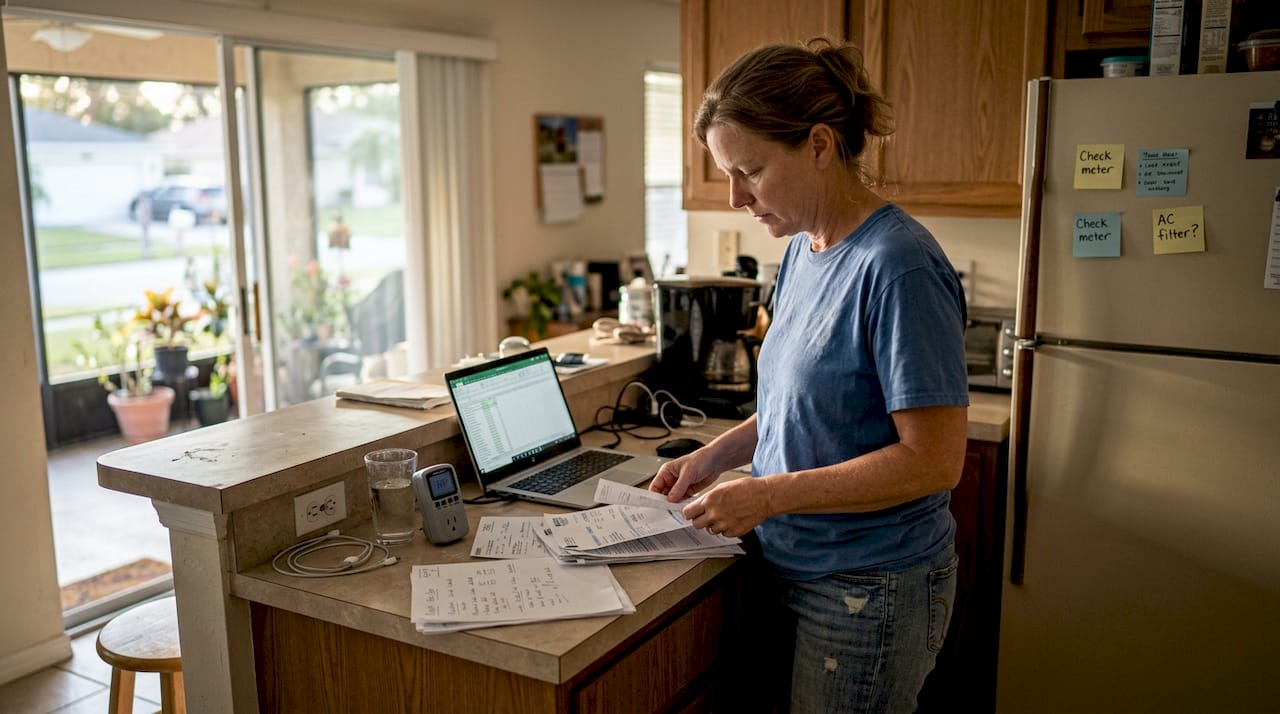
A 10 kWh battery sustains approximately 8-9 hours at a 1 kW critical load, perfect for overnight backup or short daytime outages. If you need longer coverage, a 13.5 kWh battery extends runtime to roughly 12 hours at the same load level. These numbers assume you’re not running air conditioning, which consumes 3-5 kW alone and drains batteries in 2-3 hours. Florida’s heat makes AC tempting during outages, but it’s simply not practical on battery power alone.
Here’s your step-by-step sizing process:
- Calculate total critical load wattage by adding up all must-run devices
- Determine how many hours of backup you need (8 hours minimum recommended for Florida)
- Multiply critical load (in kW) by desired hours to get required battery capacity
- Add 20% buffer for battery degradation and conversion losses
- Compare result against NFPA 855 limits and available battery models
- Factor in solar panel capacity to ensure daytime recharging during multi-day outages
| Battery Size | Critical Load | Backup Duration | Typical Coverage |
|---|---|---|---|
| 10 kWh | 1 kW | 8-9 hours | Fridge, lights, devices |
| 13.5 kWh | 1 kW | 12 hours | Extended critical loads |
| 10 kWh | 2 kW | 4-5 hours | Fridge, lights, fans, devices |
| 20 kWh | 1.5 kW | 12-13 hours | Maximum residential capacity |
Florida’s climate adds complexity to sizing decisions. Hurricane season runs June through November, exactly when you need maximum backup capacity. But the rest of the year, you’ll use batteries primarily for daily load shifting, storing cheap daytime solar power for expensive evening use. Size your system for hurricane preparedness, then optimize settings for daily savings during calmer months. This dual-purpose approach maximizes your investment year-round.
Household energy habits matter more than you’d expect. Families who cook with electric stoves, run pool pumps, or charge electric vehicles need substantially larger systems. A Tesla Model 3 requires 50-75 kWh for a full charge, instantly consuming 4-6 days worth of typical battery storage. If you drive electric, separate your transportation charging from your backup power planning or accept that vehicle charging stops during grid outages.
Pro Tip: Hybrid systems combining a 10-13.5 kWh battery with a 7-10 kW portable generator offer the best balance for extended Florida outages. Batteries handle the first 24 hours silently and efficiently, then the generator kicks in for multi-day events, recharging batteries overnight.
Consider future expansion when sizing your initial system. Many battery models allow you to add capacity later by stacking additional units, but you’ll pay more per kWh than buying a larger system upfront. If budget allows, install your full target capacity immediately. If not, verify your chosen battery supports modular expansion and plan your electrical panel capacity accordingly. Understanding how solar power homes work helps you make smarter long-term sizing decisions.
Regulatory and safety considerations for Florida solar batteries
NFPA 855 establishes the safety framework for residential battery installations nationwide, and Florida enforces these standards strictly. The code limits residential battery capacity to 20 kWh in most dwelling units, a restriction that surprises homeowners planning whole-home backup. Installations exceeding this threshold require commercial-grade safety systems including dedicated fire suppression, which adds $8,000-$12,000 to project costs. For most Florida homes, staying under the 20 kWh limit makes financial and practical sense.
Flood zones present special challenges in coastal Florida. Local codes require battery systems in flood-prone areas to be elevated above base flood elevation levels, often 8-12 feet above grade. This means rooftop or second-story installations rather than convenient garage mounting. Elevated installations increase labor costs by 30-40% and may require structural reinforcements to support battery weight. Check your property’s FEMA flood zone designation before finalizing installation plans.
Garage installations, the most common placement in Florida, must address heat management. Batteries perform optimally between 50-77°F, but Florida garages routinely hit 95-110°F in summer. Quality installers add ventilation, insulation, or mini-split air conditioning to maintain safe operating temperatures. Skipping climate control shortens battery life by 40-50% and voids most manufacturer warranties. Budget $1,500-$3,000 for proper garage climate management.
Certification requirements protect you from substandard installations. Your installer should hold:
- NABCEP PV Installation Professional certification
- Florida-licensed electrical contractor credentials
- Manufacturer-specific battery installation training certificates
- Current liability insurance covering battery system failures
Battery management systems prevent the most common safety risks. Quality BMS units monitor each cell’s voltage and temperature, disconnecting the battery if readings exceed safe parameters. This prevents thermal runaway, the chain reaction that causes battery fires. Cheap batteries skip sophisticated BMS features, relying on basic overcurrent protection that doesn’t catch temperature-related failures. When comparing systems, verify the BMS monitors individual cell temperatures, not just pack-level averages.
Your Florida solar panel checklist should include verification that your installer pulls proper permits and schedules mandatory inspections. Florida requires electrical, building, and sometimes fire department inspections before energizing battery systems. Installers who suggest skipping permits to save money are exposing you to insurance claim denials and code violations that complicate future home sales. Legitimate installers include all permit fees in their quotes and handle inspection scheduling.
Understanding Florida solar panel rules helps you navigate HOA restrictions that sometimes prohibit visible battery installations. Florida statute 163.04 limits HOA authority over solar installations, but batteries occupy a gray area. Some HOAs require screening or specific placement to maintain neighborhood aesthetics. Review your HOA covenants and Florida solar rights laws before signing installation contracts.
Explore the best solar battery options and installation guides
Choosing the right battery for your Florida property means evaluating dozens of specifications across multiple brands. Our curated solar battery options list for Florida homeowners compares leading models on the metrics that matter most: heat tolerance, cycle life, warranty terms, and compatibility with Florida’s grid requirements. We’ve tested these systems in real Florida conditions, not laboratory settings, giving you practical insights you won’t find in manufacturer brochures.
Installing solar batteries involves electrical work, structural considerations, and permit navigation that overwhelm most DIY enthusiasts. Our solar installation steps guide walks you through the entire process, from initial site assessment through final inspection. You’ll learn how installers size systems, route conduit, configure inverters, and program battery management systems for optimal Florida performance. Even if you hire professionals for installation, understanding the process helps you ask better questions and spot potential shortcuts.
For homeowners ready to take the next step, our home solar panel installation guide covers the complete integration of panels and batteries into a cohesive energy independence system. You’ll discover how proper system design maximizes both daily energy savings and emergency backup capability, turning your Florida home into a resilient power station that performs year-round.
FAQ
What is the lifespan of a typical solar battery in Florida?
LFP batteries last 15-20 years in Florida installations when properly maintained, delivering 6,000-10,000 charge cycles before capacity drops to 80%. The heat-resistant chemistry handles Florida’s climate far better than alternatives, maintaining performance even during brutal summer months. Garage installations with climate control extend lifespan toward the upper end of this range, while unconditioned outdoor installations trend toward 12-15 years.
Can solar batteries power my entire home during an outage?
Typical residential batteries support critical loads, not whole-home power consumption. The average Florida home uses 30 kWh daily, but standard batteries hold 10-13.5 kWh, enough for refrigeration, lighting, and communication devices for 8-12 hours. Whole-home backup requires hybrid systems combining batteries with generators, since NFPA codes restrict residential battery capacity to 20 kWh maximum.
How does Florida’s climate affect solar battery performance?
High temperatures accelerate degradation in most battery chemistries, but LFP batteries resist heat damage effectively. Florida’s frequent hurricanes drive demand for reliable backup power and islanding capabilities that keep homes energized during extended outages. Proper installation with climate control in garages or conditioned spaces maintains optimal performance despite summer heat exceeding 95°F.
Are there any safety regulations I should know for installing solar batteries at home?
NFPA 855 limits residential battery systems to 20 kWh capacity without commercial-grade fire suppression. Florida codes require flood zone elevation, proper ventilation, and certified installer credentials for legal installations. Your installer must pull electrical and building permits, schedule mandatory inspections, and ensure battery management systems meet current safety standards before energizing your system.
How much does a complete solar battery system cost in Florida?
Complete systems including batteries, inverters, installation, and permits range from $12,000-$18,000 for 10-13.5 kWh capacity. Federal tax credits cover 30% of total costs, reducing your net investment to $8,400-$12,600. Larger systems approaching the 20 kWh residential limit cost $18,000-$25,000 before incentives. Prices vary based on battery brand, installation complexity, and whether you’re adding batteries to existing solar or installing a complete new system.
