
Managing a Florida residential building means balancing energy costs, tenant demands, and lasting property value. Solar power is more than a buzzword for sustainability—it supports these goals with measurable results. Integrating solar photovoltaic systems can reduce utility expenses while enhancing building appeal and market price, a key consideration confirmed by research showing rooftop solar often has a positive effect on residential property values. This approach positions your portfolio for both immediate savings and long-term competitive strength.
Table of Contents
- Defining Solar Power In Property Management
- Why Property Managers Care About Solar
- Solar Technologies Used In Residential Management
- How Solar Fits Into Property Management Strategy
- Solar Technologies For Residential Properties
- Photovoltaic (Pv) Panel Systems
- Battery Storage And Hybrid Systems
- Installation Cost Components
- Choosing The Right System For Your Property
- Financial Incentives And Florida Regulations
- Federal Tax Credits And Rebates
- Net Metering And Interconnection Rules
- Florida’s Solar Ranking And Growth Trajectory
- Planning Your Incentive Strategy
- Operational Benefits And Maintenance Needs
- Minimal Daily Operations
- Essential Maintenance Tasks
- Monitoring And Early Detection
- Long-Term System Reliability
- Environmental Factors In Florida
- Cost Savings, Risks, And Return On Investment
- Quantifying Your Annual Savings
- Calculating Return On Investment
- Property Value Enhancement
- Managing Financial Risks
- Financing Pathways
Key Takeaways
| Point | Details |
|---|---|
| Solar Power Integration | Incorporating solar energy systems into properties enhances financial returns and property value while reducing operational costs. |
| Technological Choices | Property managers should evaluate solar technologies, such as photovoltaic panels and hybrid systems, to maximize energy efficiency and savings. |
| Financial Incentives | Understanding available federal and state incentives is crucial for minimizing upfront costs and improving ROI for solar installations. |
| Maintenance and Monitoring | Regular monitoring and minimal maintenance ensure optimal system performance, minimizing downtime and maximizing energy production over the system’s lifespan. |
Defining Solar Power in Property Management
Solar power in property management refers to the integration of solar energy systems into residential buildings to reduce operational costs and enhance property value. Unlike utility-scale installations, this approach focuses on rooftop or ground-mounted systems that directly serve individual properties or multi-unit complexes.
Solar power is radiant energy from the sun converted into usable electricity through photovoltaic (PV) technology. Property managers leverage this renewable resource to lower utility expenses, decrease carbon footprint, and improve tenant satisfaction.
For Florida property managers, solar integration represents a strategic operational decision. It goes beyond sustainability marketing—it’s about measurable financial returns and competitive advantage in the residential market.
Why Property Managers Care About Solar
Your primary concerns revolve around bottom-line economics and tenant retention. Solar addresses both directly.
Key benefits include:
- Reduced energy costs: Lower monthly utility bills translate to improved net operating income
- Property value appreciation: Research on renewable energy and housing prices shows rooftop solar tends to have positive effects on residential property values
- Tenant appeal: Energy-efficient properties attract quality renters willing to stay longer
- Operational predictability: Fixed solar production replaces volatile grid electricity rates
- Tax incentives and rebates: Federal credits and Florida-specific programs reduce upfront investment
Understanding these drivers helps you evaluate whether solar makes sense for your specific property portfolio.
Solar Technologies Used in Residential Management
Three primary technologies apply to property management settings:
- Solar photovoltaics (PV): Panels convert sunlight directly to electricity using semiconductor cells. This is the dominant choice for residential buildings.
- Solar thermal systems: These use sunlight to heat water for domestic use or heating purposes.
- Hybrid systems: Combined PV and battery storage (like Tesla Powerwall units) maximize energy independence and provide backup during grid outages.
For most Florida residential properties, rooftop PV systems paired with optional battery backup deliver the strongest financial outcomes.
Here’s a concise summary of residential solar technologies and their primary business impacts:
| Technology Type | Core Function | Business Impact |
|---|---|---|
| Photovoltaic Panels | Convert sunlight into electricity | Cuts utility expenses |
| Solar Thermal Systems | Use sunlight to heat water | Lowers water heating costs |
| Hybrid (PV + Battery) | Combine energy production with storage | Enables backup, boosts savings |
How Solar Fits Into Property Management Strategy
Solar isn’t an isolated addition—it’s part of your broader energy and financial management approach. Effective integration requires understanding how systems interact with your building’s electricity consumption patterns, tenant base, and long-term ownership timeline.
Property managers must evaluate whether to own systems outright, utilize leasing arrangements, or partner with solar providers for shared savings models. Each approach carries different financial and operational implications.
Rooftop solar systems on residential buildings consistently show positive or neutral effects on property values, unlike utility-scale solar which may cause modest depreciation in some areas.
The distinction matters. Your residential building benefits from distributed solar in ways that utility-scale farms do not.
Understanding these fundamentals positions you to make informed decisions about solar adoption. The next step involves calculating actual financial impacts specific to your properties.
Pro tip: Start by analyzing your property’s energy consumption patterns and utility bills from the past 12 months—this baseline data determines system sizing and expected savings accuracy.
Solar Technologies for Residential Properties
Residential solar technologies have evolved significantly, offering property managers multiple options to match their specific energy needs and financial goals. The most common approach combines photovoltaic panels with modern inverters and increasingly, battery storage systems for maximum reliability.
Understanding what each technology does—and how they work together—helps you make informed decisions about system design and long-term value. Florida’s sunny climate makes residential solar particularly effective year-round.
Photovoltaic (PV) Panel Systems
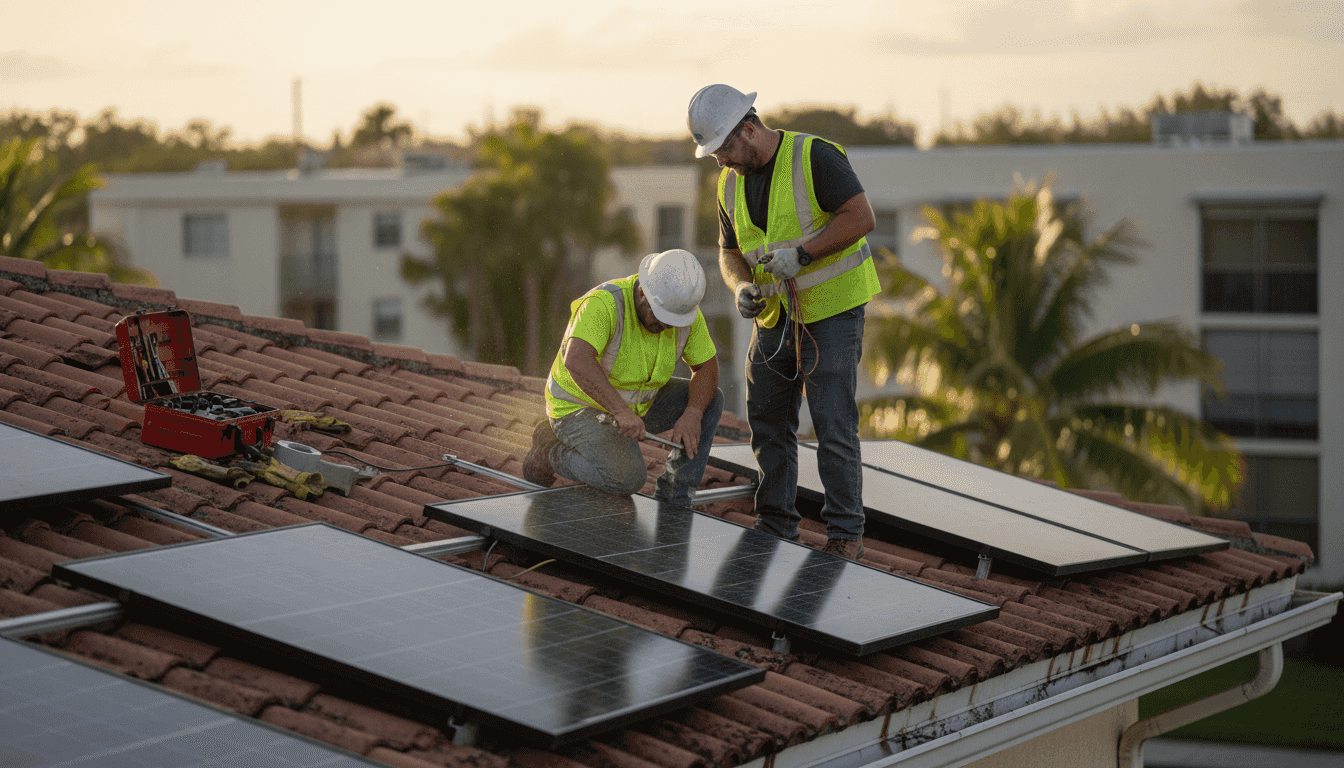
Solar photovoltaic panels are the foundation of most residential installations. These silicon-based panels convert sunlight into electricity through semiconductor cells and require minimal maintenance once installed.
Typical residential PV systems include:
- Solar modules: Individual panels rated between 300-400 watts each
- Inverters: Convert DC electricity from panels into AC power for your building
- Mounting hardware: Securely attach panels to rooftops or ground structures
- Wiring and disconnects: Safely route power throughout the system
- Monitoring equipment: Track real-time production and performance
Panel efficiency continues improving annually. Modern residential panels achieve 18-22% efficiency ratings, meaning more electricity from the same roof space compared to older systems.
Battery Storage and Hybrid Systems
Battery storage transforms your solar system from energy producer to energy manager. When panels generate excess power during peak sunlight hours, batteries capture that energy for evening use or grid outages.
Tesla Powerwall units are popular for Florida residential properties because they:
- Store 13.5 kWh of usable energy per unit
- Enable backup power during grid failures
- Optimize consumption based on time-of-use electricity rates
- Provide 10-year warranty coverage
Hybrid systems—combining PV panels with battery backup—maximize your independence from grid volatility. This matters especially in Florida’s hurricane season when power outages can last days.
Installation Cost Components
Understanding cost breakdown helps you evaluate total investment and ROI. Residential solar installation costs include hardware, labor, permits, and overhead expenses that vary by location and installer.
Typical cost allocation for a residential system:
- Hardware (modules, inverters, batteries): 40-50% of total cost
- Labor and installation: 25-35%
- Permitting and inspections: 5-10%
- Overhead and profit margin: 10-15%
System size directly impacts total cost. A 5 kW system costs less than a 10 kW system, but larger systems generate more electricity and provide faster payback periods.
Choosing the Right System for Your Property
Your specific technology choice depends on three factors: available roof space, energy consumption patterns, and budget.
Small to medium residential buildings work well with standard PV-only systems. Larger multifamily complexes benefit from hybrid systems with battery backup, particularly if tenant power reliability is a competitive advantage.
Modern residential solar systems are sized specifically for your building’s energy needs, not oversized, which maximizes efficiency and reduces unnecessary equipment costs.
Location matters too. South-facing rooftops in Florida typically generate 15-20% more electricity than east or west-facing installations due to sun angle optimization.
Pro tip: Request a detailed energy audit before selecting technology—your property’s consumption patterns from the past 24 months reveal the ideal system size and component mix that maximizes savings.
Financial Incentives and Florida Regulations
Florida’s solar incentive landscape offers substantial financial advantages for property managers willing to navigate the regulatory framework. Unlike some states with aggressive renewable mandates, Florida takes a utility-driven approach—which actually creates unique opportunities for cost reduction.
Understanding what incentives apply to your specific property type and knowing Florida’s net metering rules directly impacts your bottom-line solar ROI.
Federal Tax Credits and Rebates
The Investment Tax Credit (ITC) remains the primary federal incentive for solar installations. Property managers can claim 30% of total installation costs as a tax credit through 2032, with gradual reductions thereafter.
Beyond federal credits, Florida offers:
- Property tax exemptions: Solar equipment installations qualify for exemptions on increased property value
- Sales tax exemptions: Solar materials and equipment avoid Florida’s 6% sales tax
- Utility rebates: Major providers offer incentive programs reducing upfront costs
- Home Energy Rebate programs: Financial support available for eligible residential properties completing solar upgrades
These stack on top of each other, significantly reducing net installation expenses. A $50,000 system might cost under $30,000 after combining ITC, tax exemptions, and utility rebates.
See the table below for a quick reference on Florida solar incentives and related requirements:
| Incentive Type | Financial Benefit | Key Requirement |
|---|---|---|
| Investment Tax Credit (ITC) | 30% federal tax credit | System installed by 2032 |
| Property Tax Exemption | No tax on added value | Certified solar equipment |
| Sales Tax Exemption | Saves 6% on equipment purchase | Applies to solar materials |
| Net Metering Credits | Utility bill credits for excess power | Must connect to the grid |
Net Metering and Interconnection Rules
Florida’s net metering policy allows your solar system to feed excess electricity back to the grid, earning credits against future consumption. This matters tremendously for buildings with variable energy usage patterns.
Key regulations include:
- Systems up to 2 MW qualify for standard net metering
- Utilities must credit excess generation at retail electricity rates
- Credits roll over monthly, providing flexibility for seasonal variations
- Interconnection standards ensure safe system integration
Florida requires utilities to provide net metering policies and interconnection standards for residential and commercial solar systems, protecting your investment value and operational flexibility.
Florida’s Solar Ranking and Growth Trajectory
Florida ranks third nationally in installed solar capacity despite lacking aggressive renewable mandates. This means the market is mature, competitive, and driven by economics rather than policy mandates.
Current state snapshot:
- 10.7% of electricity comes from solar today
- Growth driven primarily by utility investments and customer economics
- Tax exemptions and rebates make residential solar financially attractive
- Installation costs continue declining annually
This regulatory stability benefits property managers. You’re not betting on uncertain future incentives—these programs have proven staying power.
Florida’s approach relies on utility competition and customer economics rather than government mandates, creating a stable incentive environment for long-term solar investments.
Planning Your Incentive Strategy
Timing matters. Some utility rebate programs have annual funding caps that deplete quickly. Properties applying early in the calendar year often capture maximum rebates.
Your property type also affects available incentives. Residential multifamily buildings access different programs than commercial complexes. Work with your solar provider to identify which incentives your specific property qualifies for before signing contracts.
Pro tip: Document all incentive programs available in your utility service area 90 days before installation—some rebate programs change annually, and early planning ensures you capture maximum financial benefits.
Operational Benefits and Maintenance Needs
Solar systems require far less maintenance than most building systems, yet proper care directly determines long-term performance and return on investment. Modern residential solar installations operate reliably for 25+ years with minimal intervention—but neglecting maintenance erodes production and profitability.
Understanding what maintenance entails helps you budget for ongoing costs and avoid unexpected downtime that impacts tenant satisfaction.
Minimal Daily Operations
Once installed, solar systems operate automatically with no daily involvement from property management. The system detects sunlight, produces electricity, and feeds it into your building with zero operator input required.
Key operational features:
- Automated production: Inverters manage power generation and conversion continuously
- Grid integration: Excess electricity flows to the grid automatically during peak production
- Remote monitoring: Most systems include app-based dashboards showing real-time output
- Safety shutoffs: Automatic disconnection during outages protects grid workers
Your role shifts from operations to oversight. Monthly monitoring takes 10 minutes and instantly flags problems before they impact savings.
Essential Maintenance Tasks
Proper operation and maintenance maximize solar system performance and reliability over 25+ year lifetimes, reducing downtime and protecting your investment returns.
Maintenance requirements include:
- Panel cleaning: Remove dirt, pollen, and debris (2-4 times yearly in Florida)
- Electrical inspections: Check connections and inverter function annually
- Component testing: Verify proper voltage and current output during inspections
- Monitoring system performance: Track production trends for early fault detection
- Safety documentation: Keep permits, inspections, and maintenance records
Florida’s climate presents unique challenges. Salt air near coastlines, frequent summer storms, and year-round pollen require slightly more aggressive cleaning than inland areas.
Monitoring and Early Detection
Remote monitoring technology revolutionizes solar maintenance. These systems track every panel’s output and alert you instantly if production drops unexpectedly. This early warning catches problems—bird nests blocking panels, failing inverters, electrical faults—before they significantly impact savings.
Effective monitoring systems:
- Alert you to underperforming panels within hours
- Provide detailed production analytics and weather data
- Enable remote troubleshooting before technician visits
- Document performance history for insurance and warranty claims
Most property managers spend 15-30 minutes monthly reviewing monitoring dashboards. Anything unusual triggers a service call rather than waiting for quarterly inspections.
Regular system monitoring detects issues early, reducing downtime and ensuring sustained energy production throughout the system’s 25+ year lifespan.
Long-Term System Reliability
Solar components degrade predictably. Panels typically lose 0.5% efficiency annually—meaning a system still produces 88% of original output after 25 years. Inverters last 12-15 years before replacement becomes necessary.
Planning for eventual inverter replacement costs today prevents budget surprises. Setting aside $2,000-$5,000 from annual solar savings creates a maintenance reserve covering replacements and repairs.
Environmental Factors in Florida
Maintenance needs vary based on environmental conditions including dust, weather, and shading, affecting long-term operational efficiency. Coastal properties need more frequent cleaning due to salt spray and corrosion risks.
Florida-specific considerations:
- Hurricane season requires securing mounting hardware
- High humidity accelerates corrosion without proper protection
- Year-round pollen accumulation reduces panel efficiency
- Occasional freeze cycles demand weatherproof electrical connections
Pro tip: Schedule professional panel cleaning in early spring and mid-summer; Florida’s pollen peaks during these periods, and cleaning before peak production months maximizes annual savings.
Cost Savings, Risks, and Return on Investment
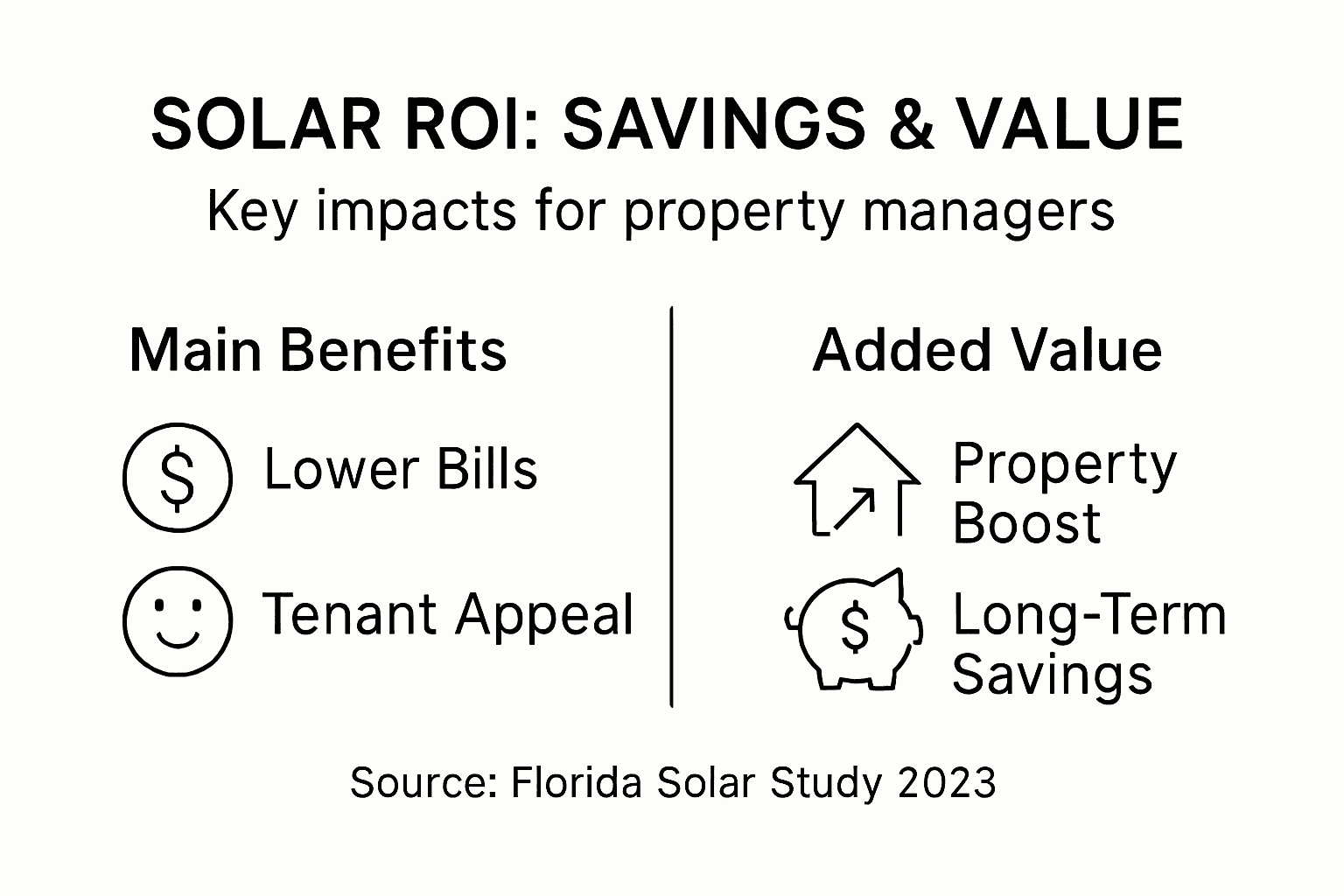
Solar ROI hinges on a straightforward equation: total savings minus costs divided by initial investment. For Florida property managers, this typically yields payback periods of 6-9 years, after which solar generates pure profit for decades.
But understanding the complete financial picture—including risks and financing options—separates solid decisions from costly mistakes.
Quantifying Your Annual Savings
Electricity bill reduction forms the primary savings mechanism. A typical 10 kW residential system saves $1,200-$1,800 annually in Florida, depending on utility rates and usage patterns.
Savings sources include:
- Lower monthly utility bills: 50-80% reduction in electricity costs depending on system size
- Net metering credits: Excess generation offsets future consumption during cloudy periods
- Inflation protection: Electricity rates rise 2-3% yearly; solar locks in today’s costs
- Tax incentive recovery: Immediate 30% federal credit reduces net investment
Over 25 years, a $40,000 system investment (after incentives) typically generates $120,000-$180,000 in cumulative savings. That’s compound value creation without tenant impact or operational complexity.
Calculating Return on Investment
Residential solar ROI depends on installation costs, energy savings, incentives, and financing terms that vary significantly by property and utility.
Key ROI components:
- System cost: $50,000-$80,000 before incentives for typical residential installations
- Available incentives: 30% federal ITC, property/sales tax exemptions, utility rebates
- Annual savings: Electricity bill reductions plus avoided rate increases
- Financing: Loans, leases, or cash purchase dramatically affect net returns
- Maintenance costs: $300-$600 yearly for cleaning and inspections
Example ROI calculation: A $60,000 system with $18,000 in tax credits costs $42,000 net. Generating $1,500 annual savings yields 3.6% annual return—competitive with conservative investments and improving with inflation.
Property Value Enhancement
Solar installations can positively affect property values by reducing utility costs and enhancing appeal to renters, creating dual financial benefits beyond energy savings.
Value appreciation mechanisms:
- Rent premium: Energy-efficient buildings command 5-10% higher rents
- Tenant retention: Lower operating costs improve unit affordability
- Market appeal: Solar signals sustainable, forward-thinking management
- Refinancing advantages: Lenders view solar installations favorably
This dual benefit—immediate savings plus property appreciation—makes solar a superior investment compared to most facility upgrades.
Managing Financial Risks
Risks exist but remain manageable with proper planning. Supply chain concentration for solar modules creates potential price volatility. Policy changes could affect future incentive availability, though current programs show staying power.
Mitigation strategies:
- Lock in pricing with binding quotes before supply disruptions
- Prioritize systems during incentive availability windows
- Choose established installers with track records and warranties
- Ensure comprehensive insurance coverage during installation
Solar ROI improves with larger systems and properties with higher electricity consumption, where absolute savings dollars compound more dramatically over time.
Financing Pathways
Property managers have shifted toward direct ownership with loans rather than leases, preserving full incentive benefits and long-term savings. This approach maximizes ROI by keeping all electricity savings in-house rather than sharing with third parties.
Common financing structures:
- Cash purchase: Highest returns but requires capital availability
- Solar loans: Preserve incentive access; payments offset by savings
- Equipment financing: Spreads costs over 5-7 years
- Performance contracting: Third-party funds system; you pay from savings
Pro tip: Calculate your specific payback period before signing contracts by gathering 12 months of utility bills, confirming available incentives with local utilities, and comparing total system costs from at least three installers.
Unlock Real Savings and Boost Property Value with Expert Solar Solutions
Managing property energy costs and enhancing tenant appeal are top priorities for Florida property managers striving for long-term success. The article highlights how solar power cuts utility expenses, stabilizes operational budgets, and increases residential property values by integrating rooftop photovoltaic systems and optional battery backups like Tesla Powerwall units. These strategies directly address your goals of reducing volatility in energy costs while attracting high-quality renters who value sustainable living.
Proesolar.com offers comprehensive support perfectly aligned with these needs. Our tailored solar panel installation services, flexible financing options, and deep knowledge of Florida-specific incentives empower you to capture maximum financial benefits. We specialize in deploying efficient residential solar technology designed to deliver measurable savings, ensure reliable power even during outages, and enhance your property’s market competitiveness.
Ready to turn solar potential into tangible value for your properties? Explore the advantages of partnering with a trusted local expert who understands your unique challenges. Visit PES Solar to learn more about how our customized solar solutions can meet your energy management objectives.
Looking for detailed insights on system types and maintenance benefits? Check out our installation services page for expert guidance and customer success stories.
Experience the confidence that comes from reliable solar expertise. Act now to secure your free consultation and start optimizing your properties’ energy future.
Discover how smarter solar choices deliver lasting savings and tenant satisfaction.
Save on energy costs. Increase property value. Partner with Pro E Solar today.
Looking to begin your solar journey?
Get your free estimate now at Pro E Solar and take the first step toward sustainable energy independence and financial success in property management.
Frequently Asked Questions
What are the main benefits of integrating solar power into property management?
Integrating solar power into property management can lead to reduced energy costs, property value appreciation, increased tenant appeal, predictable operational expenses, and access to tax incentives and rebates.
How does solar energy impact tenant satisfaction?
Solar energy can enhance tenant satisfaction by providing lower utility bills and offering energy-efficient living environments, which attract quality renters who prefer sustainable options.
What types of solar technologies are most suitable for residential properties?
The most suitable solar technologies for residential properties include solar photovoltaics (PV), solar thermal systems, and hybrid systems that combine PV with battery storage for enhanced energy independence.
How can property managers calculate the return on investment for solar installations?
Property managers can calculate the return on investment (ROI) by assessing total savings from lower utility bills, factoring in available tax credits, and evaluating overall system costs against the expected energy savings over time.
Recommended
- How Do Solar Panels Increase My Property Value? | PES Solar
- Role Of Solar In Homes – Savings And Value For Floridians
- 7 Examples Of Commercial Solar Projects For Cost Savings
- Why Go Solar In Florida: Real Savings And Value
- Unterschiede Solar- und Windenergieprojekte: Effizienz, Planung, Risiken
- Solar Panel Installation Tampa FL
- Solar Panel Installation Orlando FL
