
Most Florida property owners miss out on thousands in solar tax savings because they don’t understand how depreciation benefits work alongside the federal Investment Tax Credit. Business and rental property owners can combine accelerated depreciation through MACRS with a 30% ITC to recover costs faster, while homeowners benefit from residential credits and state exemptions. This guide breaks down exactly who qualifies, how these incentives stack, and the strategies to maximize your solar investment returns in 2026.
Table of Contents
- Key takeaways
- Understanding solar depreciation and tax credits in Florida
- How solar depreciation and ITC combine to maximize your tax savings
- Florida-specific tax incentives that enhance solar depreciation benefits
- Common pitfalls and nuanced considerations to avoid losing solar depreciation benefits
- Explore solar solutions with ProE Solar in Florida
- Frequently asked questions about solar depreciation benefits
Key Takeaways
| Point | Details |
|---|---|
| Who qualifies | Business and rental properties can use MACRS depreciation with the 30 percent ITC, while homeowners cannot depreciate but can claim the residential ITC. |
| ITC and MACRS stacking | Bonus depreciation is applied first, then MACRS on the remaining basis after reducing the depreciable basis by half of the ITC. |
| Residential ITC only | Homeowners on primary residences cannot claim MACRS depreciation and rely on the 30 percent residential ITC, with any unused credit carrying forward. |
| Florida incentives boost | Florida offers sales tax and property tax exemptions that amplify federal incentives for solar installations. |
Understanding solar depreciation and tax credits in Florida
Federal solar incentives operate through two primary mechanisms that work differently depending on your property type. Solar systems qualify as 5-year property under MACRS for businesses and rental property owners, allowing accelerated depreciation over 5 years using double declining balance method with half-year convention extending to 6 years. The Investment Tax Credit provides a direct percentage reduction in your tax liability based on system cost.
The eligibility split creates vastly different benefit structures. Homeowners on primary residences cannot claim MACRS depreciation; only Residential Clean Energy Credit (ITC 30% through 2032, non-refundable with carryforward). Businesses and rentals use commercial ITC under Section 48 plus MACRS. This distinction matters because commercial property owners access both benefits simultaneously while residential owners receive only the credit.
MACRS stands for Modified Accelerated Cost Recovery System, the IRS framework governing depreciation schedules for business assets. Solar installations fall into the 5-year property class, meaning you recover costs faster than traditional 27.5-year residential rental depreciation or 39-year commercial building schedules. The double declining balance method front-loads deductions, delivering larger tax savings in early years when cash flow matters most.
Florida property types determine your path:
- Primary residence: Residential ITC only, no depreciation
- Rental property: Both commercial ITC and MACRS depreciation
- Business facility: Both commercial ITC and MACRS depreciation
- Mixed-use property: Proportional allocation based on business percentage
Many property owners confuse residential and commercial designations. The IRS cares about how you use the property, not whether it’s a house or warehouse. A home office used exclusively for business can qualify portions for depreciation. Rental properties always qualify as business use regardless of structure type. Understanding solar panels tax deductibility in Florida requires examining your specific property classification and use patterns.
How solar depreciation and ITC combine to maximize your tax savings
The interaction between ITC and depreciation follows specific calculation rules that determine your total benefit. Depreciable basis is reduced by 50% of ITC claimed; for 30% ITC, basis equals 85% of cost. Bonus depreciation for 2026 is 20%, applied first, then MACRS on remainder. This sequencing maximizes front-loaded deductions while preserving the full credit value.
Here’s the step-by-step calculation process:
- Calculate ITC: System cost multiplied by 30% becomes your tax credit
- Reduce depreciable basis: Subtract 50% of ITC from system cost to get depreciation basis
- Apply bonus depreciation: Take 20% of adjusted basis as immediate Year 1 deduction
- Calculate MACRS: Apply depreciation percentages to remaining basis over 6 years
- Claim deductions: Report depreciation annually on Schedule C or business returns
Consider a $100,000 commercial solar installation in Florida:
| Year | Calculation | Amount |
|---|---|---|
| ITC (immediate) | $100,000 × 30% | $30,000 credit |
| Adjusted basis | $100,000 – ($30,000 × 50%) | $85,000 |
| Bonus depreciation (Year 1) | $85,000 × 20% | $17,000 deduction |
| Remaining basis | $85,000 – $17,000 | $68,000 |
| MACRS Year 1 | $68,000 × 20% | $13,600 deduction |
| Total Year 1 benefit | $30,000 + $17,000 + $13,600 | $60,600 |
Subsequent years follow MACRS percentages: 32% in Year 2, 19.2% in Year 3, 11.52% in Years 4-5, and 5.76% in Year 6. The front-loaded structure delivers maximum cash flow benefit when you need it most. Stacking ITC with bonus depreciation and MACRS creates superior benefits for businesses and rentals versus homeowners who access only the residential credit.

Pro Tip: Install and place your system in service during 2026 to capture the 20% bonus depreciation before it drops to 0% in 2027. Timing your installation by year-end maximizes first-year deductions and accelerates payback periods significantly.
The order matters because ITC reduces basis before depreciation calculations. Claiming them backward would inflate deductions beyond IRS allowances. Commercial solar tax incentives in Florida require precise sequencing to avoid audit triggers while maximizing legitimate benefits.
Florida-specific tax incentives that enhance solar depreciation benefits
Florida provides state-level exemptions that stack with federal benefits to reduce both upfront and ongoing costs. Florida offers sales tax exemption (6%) on solar equipment and property tax exemption on assessed solar improvements (100% residential, 80% non-residential). These exemptions apply regardless of whether you qualify for federal depreciation, making them valuable for all property types.
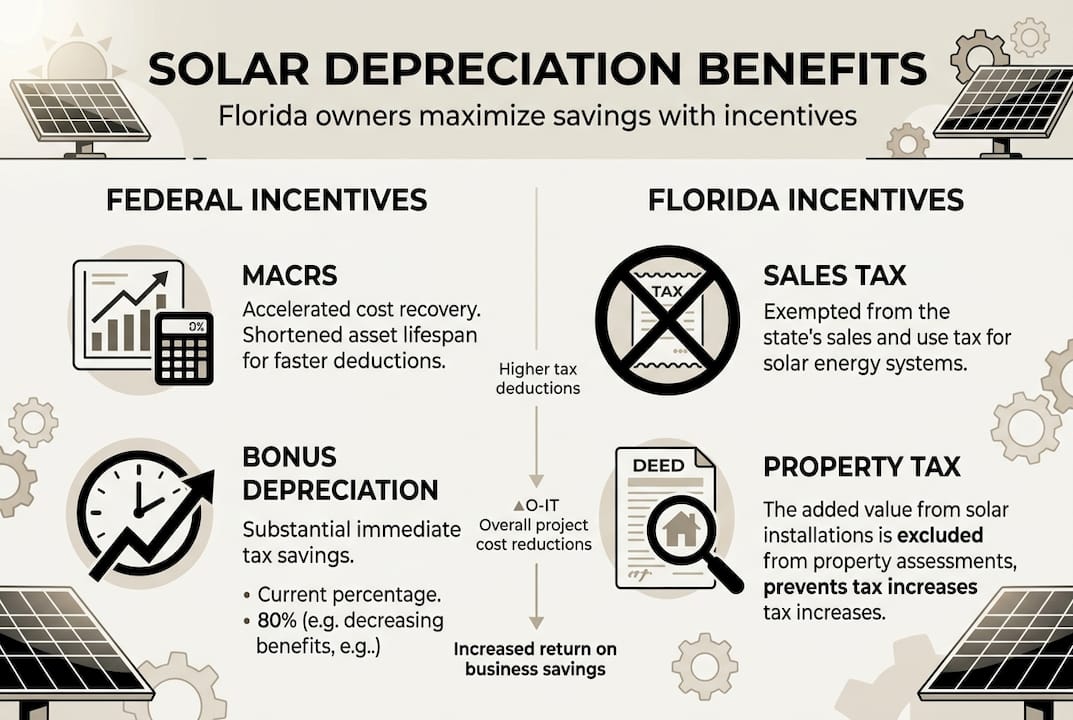
The sales tax exemption immediately reduces your installation cost. On a $100,000 system, you save $6,000 at purchase compared to other taxable improvements. This applies to equipment and installation labor, covering panels, inverters, batteries, racking, and professional installation services. The exemption flows through contractors to end customers automatically when properly documented.
Property tax exemptions preserve your property value without increasing annual tax bills. Residential installations receive 100% exemption on the added value solar systems bring to your home. Commercial properties get 80% exemption on assessed improvements. If your solar system adds $50,000 to property value, homeowners pay zero additional property tax while commercial owners pay tax on only $10,000 of that increase.
Typical savings scenarios for Florida installations:
- $30,000 residential system: $1,800 sales tax savings, $0 annual property tax increase
- $100,000 commercial system: $6,000 sales tax savings, 80% reduction on property tax assessment
- $250,000 industrial system: $15,000 sales tax savings, substantial ongoing property tax relief
These Florida benefits amplify federal incentives by reducing the net cost basis before you even calculate ITC and depreciation. A commercial owner combines 30% ITC, accelerated depreciation, 6% sales tax savings, and 80% property tax exemption for comprehensive cost recovery. Homeowners stack residential ITC with both Florida exemptions for significant total savings despite lacking depreciation access.
Pro Tip: Verify your local property appraiser correctly applies the solar exemption when assessing your property value. Some counties require separate documentation or applications to ensure you receive the full exemption benefit automatically.
Understanding how solar panels affect property taxes in Florida and exploring comprehensive solar incentive savings strategies helps you capture every available benefit at state and federal levels.
Common pitfalls and nuanced considerations to avoid losing solar depreciation benefits
Navigating solar tax benefits requires attention to specific restrictions and timing rules that can reduce or eliminate savings if mishandled. Many property owners forfeit thousands by claiming ineligible deductions or misunderstanding how credits and depreciation interact with their tax situations.
Key pitfalls to avoid:
- Claiming depreciation on primary residence systems (only rentals and businesses qualify)
- Leasing instead of owning (lessors claim credits and depreciation, not lessees)
- Tenants installing systems on rental properties (only property owners qualify)
- Assuming ITC is refundable (it only reduces tax liability, doesn’t create refunds)
- Including non-solar roof repairs in depreciable basis (only solar-specific costs qualify)
- Missing the placed-in-service deadline (must be operational by December 31 to claim that year)
ITC is non-refundable and low tax liability may limit immediate benefit but allows carryforward; leased systems’ credit flows to financier; tenants cannot claim benefits; vacation homes qualify for residential ITC. If your tax liability falls below your credit amount, you carry the unused portion forward to future years rather than receiving a refund check. This makes tax planning essential for maximizing benefit timing.
The lease versus own distinction creates dramatically different outcomes. When you lease solar equipment, the leasing company owns the system and claims all tax benefits. You receive lower lease payments reflecting their savings, but you lose direct access to ITC and depreciation. Purchase agreements, loans, and power purchase agreements structured as purchases preserve your benefit eligibility.
“Timing and ownership structure determine whether you capture full solar tax benefits or forfeit them to third parties. Commercial property owners must own systems outright and place them in service within the tax year to maximize depreciation and credit claims.”
Vacation and second homes occupy a middle ground. They qualify for residential ITC if you use them personally, but cannot claim depreciation unless you rent them out enough to establish business use. Mixed personal and rental use requires allocation formulas that split costs between deductible business portions and non-deductible personal use.
Roof work creates confusion because solar installations often require roof repairs or replacement. Only costs directly attributable to solar equipment qualify for ITC and depreciation. If you replace your roof solely to support solar panels, that cost may qualify. Roof repairs unrelated to solar installation remain separate capital improvements with different depreciation schedules. Documentation separating solar-specific from general roof work protects your deductions during audits.
Leveraging business solar incentives in Florida requires understanding these nuances to structure ownership, timing, and documentation correctly from the start.
Explore solar solutions with ProE Solar in Florida
Maximizing solar depreciation benefits and tax credits requires both financial knowledge and technical expertise to ensure proper system design, installation, and documentation. ProE Solar brings comprehensive experience helping Florida homeowners and business owners navigate federal ITC, MACRS depreciation, and state-specific exemptions while delivering high-performance solar installations tailored to your property needs.
Our team guides you through every step, from initial financial analysis to final commissioning. We provide detailed cost breakdowns that separate eligible expenses for accurate tax reporting, connect you with solar financing options in Florida that preserve your tax benefit eligibility, and deliver turnkey installations that meet all IRS placed-in-service requirements. Whether you need residential, commercial, or rental property solutions, we ensure your system qualifies for maximum incentives.
Explore our comprehensive resources including step-by-step installation guides and maintenance support to protect your investment long term. Our Florida-based expertise means we understand local permitting, utility interconnection, and property tax exemption processes that out-of-state installers often miss. Contact us to discuss how your specific property type and tax situation can benefit from strategic solar implementation in 2026.
Frequently asked questions about solar depreciation benefits
What are solar depreciation benefits?
Solar depreciation benefits allow business and rental property owners to deduct a portion of their solar system cost from taxable income each year over a 5-year schedule using MACRS. This accelerated depreciation recovers costs faster than standard building depreciation, reducing annual tax liability while the system generates energy savings.
Who can claim solar depreciation in Florida?
Only business owners and rental property owners can claim MACRS depreciation on solar installations. Homeowners with primary residences cannot depreciate their systems but qualify for the 30% residential clean energy credit instead. Mixed-use properties allocate benefits proportionally based on business versus personal use percentages.
How does bonus depreciation work for solar in 2026?
Bonus depreciation allows you to immediately deduct 20% of your adjusted depreciable basis in the first year before applying regular MACRS percentages. For 2026 installations, this front-loads significant deductions, but bonus depreciation drops to 0% in 2027, making 2026 the last year to capture this additional benefit.
Do Florida’s tax exemptions stack with federal benefits?
Yes, Florida’s 6% sales tax exemption and property tax exemptions apply independently of federal ITC and depreciation. Commercial owners combine all four benefits while homeowners stack residential ITC with both Florida exemptions, creating comprehensive savings regardless of depreciation eligibility.
What happens if I lease instead of buying my solar system?
Leasing transfers ownership and all tax benefits to the leasing company. You cannot claim ITC or depreciation on leased equipment. The lessor captures these benefits and typically passes savings through reduced lease payments, but you lose direct control over timing and amount of tax advantages.
Can I claim depreciation on a vacation home with solar panels?
Vacation homes qualify for residential ITC but not depreciation unless you rent them enough to establish business use. If rental activity meets IRS business thresholds, you can allocate costs between personal and rental use, claiming depreciation on the business portion while taking residential credit on personal use.
