
If you’re a Florida homeowner tired of rising electricity costs, solar panels offer a proven path to slash or even eliminate your monthly FPL bill. A typical 6.84 kW solar system, combined with Florida’s full retail net metering program and the 30% federal solar tax credit, can cover an average $100 monthly electric bill while boosting your home’s resale value by roughly 4.1%. This guide breaks down the real costs, savings mechanisms, and value additions you need to make an informed decision about going solar in 2026.
Table of Contents
- How Solar Panels Cut Your Electricity Bills In Florida
- Understanding Net Metering And Its Savings Benefits
- Solar Panels And Home Value: Increased Property Worth In Florida
- Protecting And Maintaining Solar Panels In Florida’s Climate
- Explore Your Solar Options With Pes Solar
- Frequently Asked Questions About Solar And Reducing Bills In Florida
Key takeaways
| Point | Details |
|---|---|
| System cost and coverage | A typical 6.84 kW solar system ranges from $14,900 to $18,500 before the 30% federal solar tax credit and covers a $100 monthly FPL bill. |
| Net metering credits | FPL’s full retail net metering program credits excess solar power at retail rates, with credits carrying over monthly until an annual true-up in January. |
| Home value boost | Homes with solar panels experience an average 4.1% increase in value nationwide, with Florida offering additional property tax exemptions. |
How solar panels cut your electricity bills in Florida
Solar panels eliminate or drastically reduce your monthly electric bill by generating electricity that offsets what you’d normally purchase from FPL. The upfront investment pays for itself through decades of savings, with most systems covering their costs within 7 to 10 years.
A 6.84 kW solar system ranges from $14,900 to $18,500 before the 30% federal solar tax credit and covers a typical $100 FPL electric bill. After applying the tax credit, your net cost drops to $10,430 to $12,950. This system size is calculated to match average Florida household consumption, which hovers around 1,100 kWh per month.
Cost breakdown for a 6.84 kW system:
| Item | Before Tax Credit | After 30% Tax Credit |
|---|---|---|
| System cost | $14,900 to $18,500 | $10,430 to $12,950 |
| Monthly savings | $100 | $100 |
| Payback period | 12 to 15 years | 9 to 11 years |
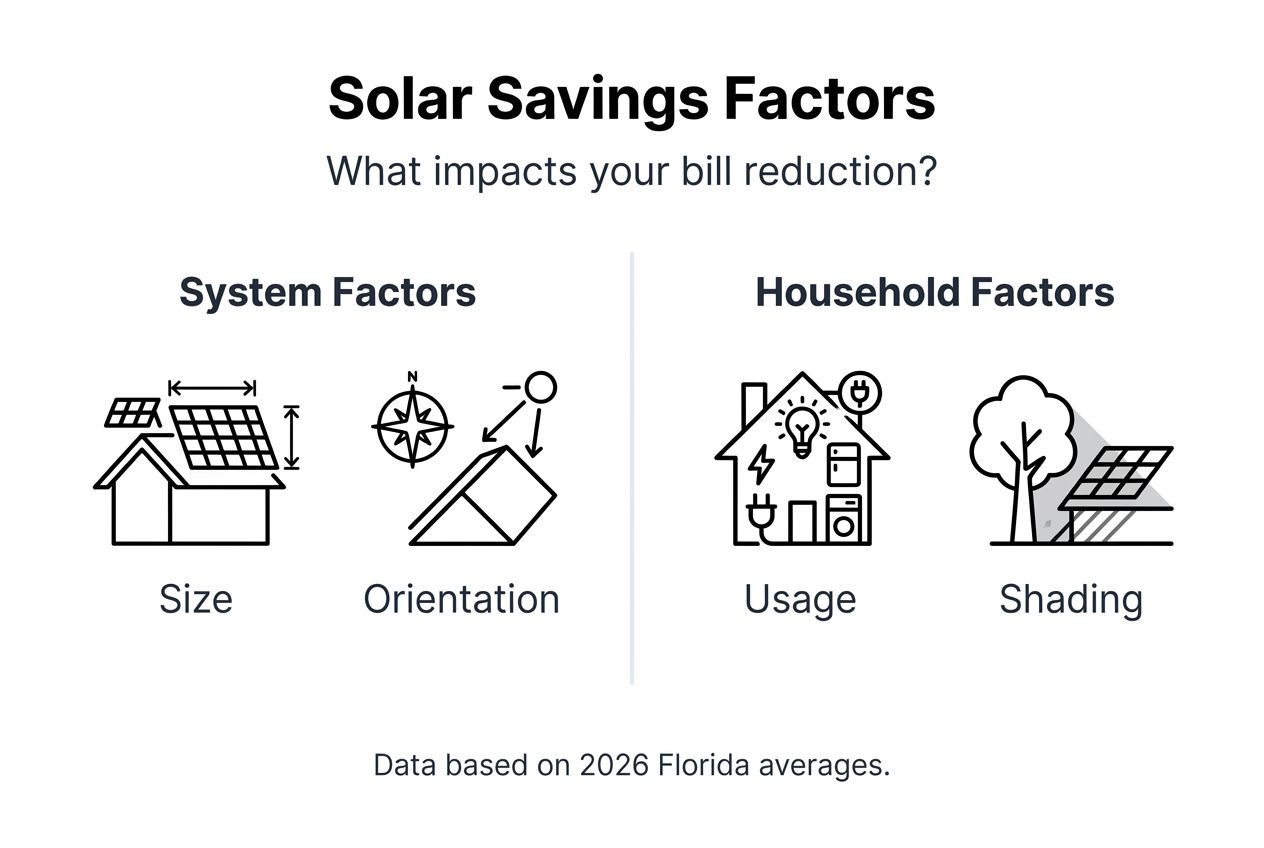
The actual savings depend on several factors. Your total electricity consumption, system size, roof orientation, shading, and local sunlight hours all influence how much energy your panels produce. Florida’s abundant sunshine gives you an advantage, with average peak sun hours ranging from 4.5 to 5.5 per day.
Net metering plays a crucial role in lowering bills in Florida homes. When your solar panels generate more electricity than you use, the excess energy flows back to the grid. FPL credits your account at the full retail rate, effectively banking energy for nights and cloudy days. These credits accumulate month to month, giving you flexibility throughout the year.
Factors affecting your solar savings:
- Your average monthly electricity consumption and seasonal patterns
- System size relative to your energy needs
- Roof angle, orientation, and available unshaded space
- Local weather patterns and average daily sunshine
- Time of day when you use the most electricity
Pro Tip: Installing a slightly larger system than your current needs can account for future consumption increases, like adding an electric vehicle or expanding your home, while maximizing your net metering credits.
Proper system sizing is critical. An undersized system won’t offset enough of your bill, while an oversized system may generate credits you can’t fully use before the annual true-up. Working with experienced installers ensures your system matches your energy profile.
Understanding net metering and its savings benefits
Net metering transforms your solar panels from a simple energy source into a financial tool that maximizes bill reduction. FPL operates a full retail net metering program where credits carry over monthly and are settled annually at retail rates. This means every kilowatt-hour you send to the grid has the same value as one you consume.
Here’s how the process works throughout the year. During sunny months, your system likely produces more electricity than you need. FPL credits your account for this excess at the retail rate, typically around $0.12 to $0.14 per kWh. In summer when your air conditioning runs constantly, you draw on these banked credits to cover the gap between production and consumption.
Credits accumulate month after month, providing financial flexibility across seasons. If you generate 1,200 kWh in March but only consume 900 kWh, you bank 300 kWh of credits. When June arrives and you consume 1,400 kWh but only generate 1,000 kWh, those banked credits cover the 400 kWh shortfall.
The annual true-up occurs each January. FPL reconciles your total production against total consumption for the previous 12 months. If you have excess credits remaining, they typically expire rather than converting to cash payments. This structure makes proper system sizing essential to avoid wasting potential savings.
Net metering advantages for Florida homeowners:
- Full retail rate credits maximize the value of every kilowatt-hour produced
- Monthly credit carryover smooths out seasonal consumption variations
- No separate meters or complex billing systems required
- Reduces dependence on expensive peak-hour electricity rates
- Provides predictable long-term savings that hedge against rate increases
Pro Tip: Understanding the solar installation process in Florida helps you navigate interconnection requirements and ensures your system qualifies for net metering from day one.
Maximizing net metering benefits requires strategic thinking about system size and energy usage patterns. Consider installing energy-efficient appliances and shifting high-consumption activities to daylight hours when your panels produce peak output. Running dishwashers, washing machines, and pool pumps during solar production hours reduces your reliance on banked credits.
The beauty of net metering lies in its simplicity. You don’t need batteries to benefit from 24-hour coverage. The grid acts as your virtual battery, storing excess energy and delivering it back when needed. This arrangement eliminates the upfront cost and maintenance of battery systems while providing the same functional benefit.
Solar panels and home value: increased property worth in Florida
Beyond monthly bill savings, solar panels deliver a substantial return through increased property value. Homes with solar panels experience an average 4.1% increase in value nationwide, and Florida’s market shows similar or stronger trends due to high energy costs and environmental consciousness among buyers.
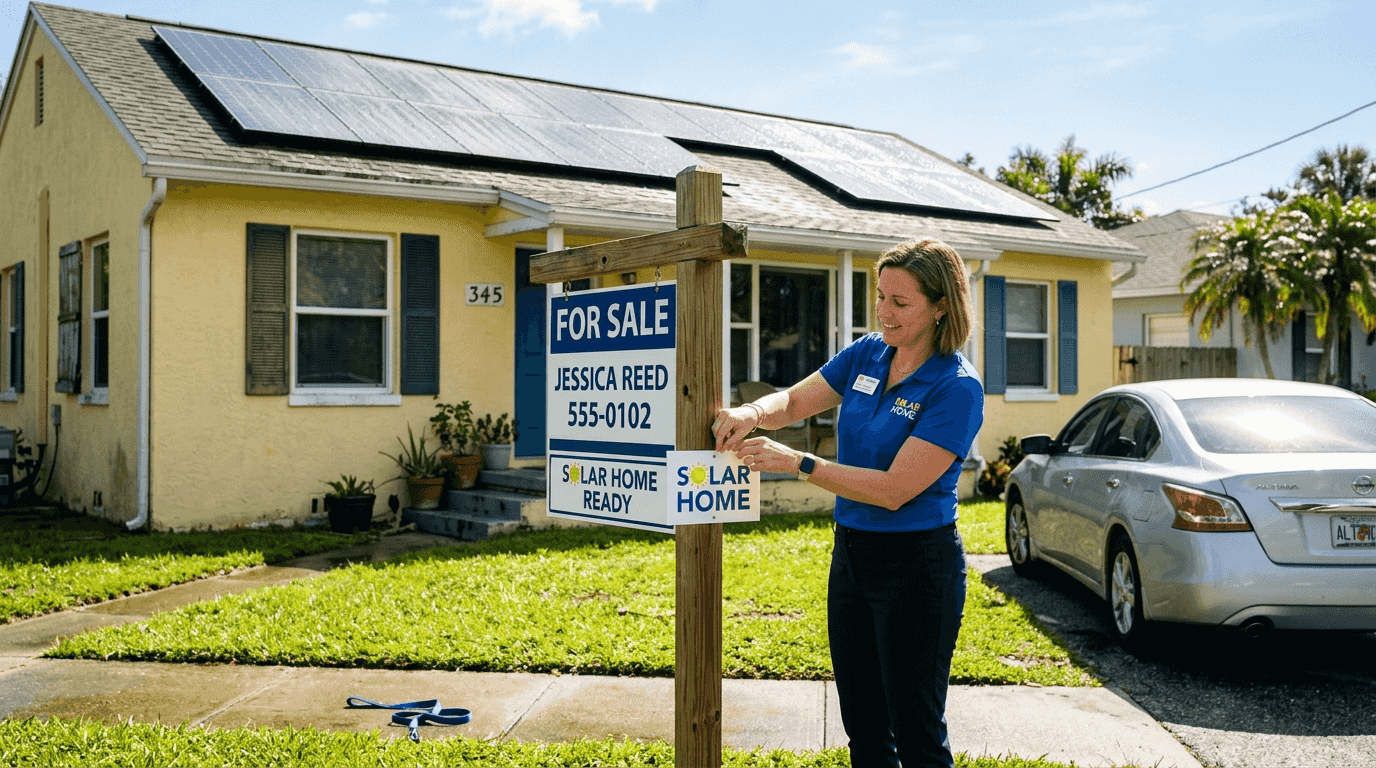
For a typical Florida home valued at $350,000, a 4.1% increase translates to roughly $14,350 in added value. This appreciation often exceeds the net system cost after tax credits, especially when you factor in years of accumulated energy savings. Buyers increasingly view solar as a premium feature rather than an afterthought.
Ownership structure matters significantly. Owned solar systems add full value to your home, while leased systems often complicate sales and may deter some buyers. Purchasers must either assume the lease or negotiate buyout terms, creating friction in the transaction. For maximum value appreciation, financing through a loan or paying cash provides the clearest benefit.
Florida sweetens the deal with a property tax exemption for residential solar installations. Despite adding tens of thousands in value to your home, solar panels increase home value in Florida without increasing your annual property tax bill. This exemption preserves more of your financial gain compared to other home improvements.
Comparing solar versus non-solar homes:
| Factor | Home Without Solar | Home With Solar |
|---|---|---|
| Resale value | $350,000 | $364,350 |
| Property tax basis | $350,000 | $350,000 (exempt) |
| Buyer appeal | Standard | Premium feature |
| Energy costs | Rising annually | Fixed/minimal |
The value proposition extends beyond pure numbers. Solar panels signal environmental responsibility, energy independence, and forward thinking to potential buyers. Younger homebuyers, in particular, prioritize sustainability features and long-term cost savings over purely cosmetic upgrades.
How solar adds comprehensive value:
- Immediate equity boost of approximately 4.1% of home value
- Protection from future electricity rate increases, a key selling point
- Enhanced marketability in competitive real estate environments
- Demonstrated commitment to sustainability attracts premium buyers
- Reduced operating costs make the home more affordable long term
Market data consistently shows that solar’s savings and value for Florida homes compound over time as electricity rates climb. What starts as modest monthly savings grows into substantial lifetime value, both through reduced bills and appreciation.
Pro Tip: Document all system details, warranties, and production history when selling. Buyers want reassurance about system performance and remaining warranty coverage, making comprehensive records a powerful sales tool.
Real estate agents increasingly highlight solar systems in listings, understanding their appeal to cost-conscious and environmentally minded buyers. A well-maintained system with solid production data becomes a major differentiator in crowded markets.
Protecting and maintaining solar panels in Florida’s climate
Florida’s hurricane-prone climate raises legitimate concerns about solar panel durability, but proper installation and minimal maintenance keep systems performing reliably for 25 years or more. The National Renewable Energy Laboratory found solar systems have a very low damage rate, even during multiple hurricane seasons.
Modern solar panels are engineered to withstand extreme weather. Most panels carry ratings for winds up to 140 mph when properly installed according to Florida building codes. Mounting systems use reinforced aluminum rails and specialized hurricane clips that anchor panels directly to roof trusses, not just the decking.
Common risks in Florida’s climate include wind forces during hurricanes, airborne debris like tree branches, and heavy rain that tests mounting seal integrity. However, statistical analysis shows solar panels often fare better than traditional roofing materials during severe weather events.
Recommended protective measures and maintenance:
- Ensure installation meets or exceeds Florida Building Code requirements for wind resistance
- Schedule annual inspections before hurricane season to check mounting hardware
- Trim nearby trees that could drop branches onto panels during storms
- Clean panels twice yearly to remove accumulated dirt, pollen, and salt spray
- Monitor production data monthly to catch potential issues early
- Consider micro-inverters or optimizers that isolate damage to individual panels
Maintenance requirements are remarkably light. Unlike HVAC systems or water heaters, solar panels have no moving parts to wear out. Rain naturally washes away most debris, though coastal homes may need occasional cleaning to remove salt buildup that reduces efficiency.
Pro Tip: Understanding solar panel maintenance requirements helps you budget time and costs accurately, typically just a few hours and minimal expense per year.
Inverters, which convert DC power from panels to AC power for your home, represent the most common maintenance item. Most inverters last 10 to 15 years and cost $1,500 to $3,000 to replace. Micro-inverters attached to individual panels generally outlast central inverters and simplify repairs.
Warranties provide substantial protection. Panel manufacturers typically offer 25-year performance warranties guaranteeing at least 80% to 85% of original output after two decades. Installation workmanship warranties cover mounting and sealing for 10 to 20 years, protecting against leaks and structural issues.
The long-term reliability of solar panels in Florida’s challenging climate has been proven through decades of installations. Systems installed in the 1990s and early 2000s continue producing significant electricity, validating the technology’s durability and sustained savings potential.
Explore your solar options with PES Solar
Now that you understand how solar panels cut bills, boost home value, and withstand Florida’s weather, the next step is exploring installation with experienced professionals. Working with qualified installers ensures you maximize available incentives while avoiding common pitfalls that undermine system performance.
PES Solar provides comprehensive guidance through every phase, from initial site assessment to final interconnection with FPL. Our team helps you navigate Florida’s permitting requirements and net metering paperwork, removing obstacles that delay or complicate DIY attempts. We’ll right-size your system to match your consumption patterns and future needs.
Financing makes solar accessible even if you don’t have cash available. Explore solar financing options in Florida that spread costs over time while you immediately start capturing savings. Many financing programs offer terms that ensure your monthly loan payment is lower than your pre-solar electric bill, delivering positive cash flow from day one.
Our solar panel installation guide walks through each milestone, from permit applications to final inspection. Understanding the timeline and requirements helps you plan accordingly and set realistic expectations. Following complete solar installation steps ensures nothing gets overlooked that could delay activation or reduce system performance.
Frequently asked questions about solar and reducing bills in Florida
What size solar system do I need to eliminate my electric bill?
Most Florida homeowners need a 6 to 8 kW system to cover average monthly consumption of 1,000 to 1,200 kWh. Your specific needs depend on your actual usage, available roof space, and shading conditions.
Can I claim the federal solar tax credit if I lease panels?
No, only system owners qualify for the 30% federal tax credit. When you lease, the leasing company owns the equipment and claims the credit. Learn more about federal tax credit leasing solar panels to understand financing implications.
Will hurricanes damage my solar panels?
Properly installed systems that meet Florida Building Code wind load requirements rarely sustain significant hurricane damage. Panels are rated for winds up to 140 mph and often outlast traditional roofing materials during severe weather.
How much does solar panel maintenance cost annually?
Maintenance costs typically run $150 to $300 per year for occasional cleaning and inspections. Most systems require minimal attention beyond monitoring production and cleaning panels once or twice annually.
Is it better to own or lease solar panels for maximum savings?
Owning delivers superior long-term savings because you capture the full federal tax credit, avoid lease payments, and add maximum value to your home. Ownership also simplifies future home sales by eliminating lease transfer complications.
How long do solar panels last in Florida’s climate?
Quality solar panels typically last 25 to 30 years or longer with minimal degradation. Most manufacturers guarantee at least 80% to 85% of original output after 25 years, even in Florida’s challenging weather conditions.
