
Florida homeowners see sunlight as more than just a bright spot in their day—it offers a powerful opportunity to save money and increase property value. With Florida ranking third nationally in solar capacity and over 20,000 megawatts installed, the proven reliability and economic benefits of solar are clear. Discover how understanding solar panel basics can help you make smart decisions that cut energy bills and maximize the value of your home through sustainable energy solutions.
Table of Contents
- Solar Energy Basics For Florida Homes
- Types Of Solar Systems And Key Features
- The Role Of Net Metering And Credits
- Financial Incentives For Florida Homeowners
- Estimating Long-Term Savings And Value
Key Takeaways
| Point | Details |
|---|---|
| Solar Advantage in Florida | Florida ranks third in solar capacity, making it an ideal place for solar technology with substantial economic growth. |
| Net Metering Benefits | Florida’s net metering allows homeowners to receive full retail rate credits for excess electricity, significantly enhancing financial benefits. |
| Financial Incentives | Homeowners can combine federal tax credits and Florida-specific incentives, potentially reducing installation costs by 50% or more. |
| Long-Term Savings | Most homeowners recoup their solar investment within 8-9 years, leading to significant long-term savings and increased property value. |
Solar Energy Basics for Florida Homes
Florida is a solar powerhouse, and understanding the fundamentals will help you make informed decisions about going solar. The state has become a national leader in renewable energy adoption, with proven technology and favorable policies that benefit homeowners.
Florida currently ranks third nationally in solar capacity with over 20,000 megawatts installed. This infrastructure demonstrates that solar technology works reliably in our climate and has created substantial economic growth across the state.
How Solar Panels Work in Florida
Photovoltaic (PV) panels convert sunlight directly into electricity through a process that happens silently on your roof. Florida’s high solar irradiance makes the state an ideal location for this technology to thrive year-round.
Here’s what happens when your system operates:
- Sunlight hits the panels and creates electrical current
- An inverter converts direct current (DC) into alternating current (AC) for home use
- Excess electricity flows back to the grid during the day
- You draw power from the grid at night or on cloudy days
This flow of electricity continues automatically without any action on your part. The system works efficiently even on overcast days because modern panels capture diffused sunlight, not just direct rays.
Florida’s Net Metering Advantage
Net metering in Florida allows homeowners to receive full retail rate credits for excess electricity generated. This policy is one of the most important reasons solar makes financial sense here.
When your panels produce more electricity than you use during peak sunlight hours, that surplus flows to the grid. Your utility meter runs backward, crediting your account at the full rate you’d normally pay for electricity.
This creates a natural monthly balance:
- Morning and afternoon: solar generates excess power
- Evening and night: you use grid power
- Monthly result: credits offset consumption charges
Florida’s net metering policy preserves full retail rate credits, making solar economics substantially more favorable than many other states.
Without this protection, the financial benefits of solar would be considerably smaller. The policy directly supports grid stability while rewarding your investment in renewable energy.
Why Florida’s Solar Market is Growing
Over 14,000 jobs exist in Florida’s solar industry today, reflecting massive growth over the past decade. The combination of consistent sunshine, favorable solar policies, and falling equipment costs has created the perfect environment for homeowner adoption.
The state has attracted $32 billion in solar investment, and solar now provides approximately 10.7% of Florida’s total electricity demand. This trend continues upward as more homeowners recognize the financial opportunity.
Pro tip: Request a free estimate from PES Solar to see exactly how much you could save based on your roof’s sun exposure, your current energy usage, and Florida’s specific solar incentives available to you.
Types of Solar Systems and Key Features
Not all solar systems work the same way. Understanding the different types helps you choose the right fit for your Florida home and energy goals.
The two main categories are grid-connected systems and stand-alone systems. Most Florida homeowners benefit from grid-connected options because they allow you to use utility electricity when needed and sell excess power back to the grid.
Grid-Connected Systems
Grid-connected systems are the most popular choice for Florida homeowners. They operate alongside your utility company’s power lines, creating a seamless energy exchange.
Here’s how they function:
- Solar panels generate electricity during daylight hours
- An inverter converts the electricity to the right voltage for your home
- You use solar power first, then draw from the grid as needed
- Excess power flows back to the grid, earning you credits
You never run out of power because the grid acts as backup storage. This design eliminates the need for expensive batteries in most cases, keeping installation costs reasonable.
Stand-Alone and Hybrid Systems
Grid-connected, stand-alone, and hybrid PV systems each serve different purposes. Stand-alone systems operate completely independently and include battery storage or backup generators.
Stand-alone systems make sense if you:
- Live off-grid or in a remote area without utility access
- Want complete energy independence
- Have backup power needs during extended outages
Hybrid systems combine solar with battery storage or other power sources. They offer reliability benefits and may provide backup power during grid outages, though at higher upfront costs.
Here is a comparison of the main solar system types for Florida homeowners:
| System Type | Grid Connection | Backup Power | Typical Setup Cost |
|---|---|---|---|
| Grid-Connected | Yes | Uses utility as backup | Lower (no batteries needed) |
| Stand-Alone | No | Batteries/generators | Higher (equipment & storage) |
| Hybrid | Optional | Batteries + grid | Highest (multiple sources) |
Key System Components
Every solar installation includes essential parts that work together seamlessly. Understanding these components helps you evaluate quality and performance.
Core components include:
- Solar panels convert sunlight into DC electricity
- Inverter converts DC electricity to AC for home use
- Mounting hardware secures panels to your roof safely
- Wiring and disconnects connect all components safely
- Meter tracks electricity flow in both directions
Panel efficiency varies based on the semiconductor materials used. Higher efficiency panels produce more electricity in the same roof space, which matters if your roof is limited.
Grid-connected systems in Florida eliminate storage costs while maintaining full net metering benefits, making them the most financially sensible choice for most homeowners.
System sizing matters tremendously. A properly sized system matches your average energy consumption without overbuilding unnecessary capacity. Oversized systems waste money; undersized systems fail to meet your needs.

Each Florida home is unique based on roof orientation, shading, and electricity usage patterns. Professional sizing ensures you get maximum value from your investment.
Pro tip: Request a detailed system design from PES Solar that shows exactly how many panels you need, where they’ll be positioned, and your estimated annual electricity production based on your home’s specific characteristics.
The Role of Net Metering and Credits
Net metering is the financial engine that makes solar affordable for Florida homeowners. Without it, your savings would be dramatically smaller, and your payback period would stretch years longer.
This policy allows you to bank credits when your panels produce more than you use. Those credits offset future electricity consumption, creating a direct financial benefit that compounds over time.
How Net Metering Works in Florida
Net metering enables homeowners to receive full retail credit for excess electricity sent back to the grid. When your solar panels generate more power than your home consumes during peak daylight hours, that surplus flows to the utility company’s grid.
Here’s the monthly cycle:
- Your panels generate electricity during sunny hours
- You use what you need, and excess goes to the grid
- Your meter tracks all electricity movement in both directions
- Monthly credits offset electricity you drew at night
- Any remaining balance carries forward to next month
This continuous exchange happens automatically without you doing anything. Your utility company credits surplus generation at the full retail rate you normally pay for electricity.
Credits and Annual Reconciliation
Florida’s rules protect your credits for a full 12 months. Any credits you accumulate must be used within the calendar year or they reset, so proper system sizing matters.
The annual reconciliation works like this:
- Monthly credits offset your consumption charges
- Unused credits carry forward within the year
- At year-end, remaining credits are reconciled
- Credits not used expire and reset annually
This structure encourages you to size your system appropriately. Oversizing wastes credits; undersizing leaves money on the table.
Why Florida’s Net Metering Policy Matters
Florida has no statewide cap on net metering participation, meaning unlimited homeowners can participate. The Florida Public Service Commission regulates interconnection and crediting to ensure fairness across all utilities.
Key protections include:
- Full retail rate credits for exported electricity
- No participation caps or limits
- Statewide consistent rules across all utilities
- 12-month credit validity windows
- Fair interconnection standards
Legislators attempted to reduce net metering credits to wholesale rates, but the effort was vetoed, preserving the consumer-friendly policy. This decision reflects recognition that net metering accelerates solar adoption while strengthening grid resilience.
Florida’s consumer-friendly net metering policy with full retail rate credits is the foundation of solar economics for homeowners, directly enabling affordable system payback periods.
Without this policy, solar installation would be considerably less attractive financially. The credits transform surplus generation into tangible bill reductions that accumulate month after month.
Pro tip: During your free estimate consultation with PES Solar, ask exactly how net metering credits will apply to your specific utility and what your expected annual credit balance might be based on system production estimates.
Financial Incentives for Florida Homeowners
Florida homeowners have access to substantial financial incentives that dramatically reduce solar installation costs. These programs transform what seems like a major investment into an affordable upgrade that pays for itself.
Combining federal tax credits with Florida-specific incentives creates compounding savings. Understanding what you qualify for is essential before making your final decision.
The Federal Solar Tax Credit
The Residential Clean Energy Credit offers a 30% tax credit on qualified solar energy system costs for systems installed through December 31, 2025. This is a direct reduction in your federal income taxes, not a rebate.
Eligible expenses include:
- Solar panels and installation labor
- Inverters and mounting hardware
- Solar water heaters
- Battery storage systems
- Electrical work and permits
You can claim this credit on a primary residence or secondary home. The credit applies to property owners who live in the home, not landlords or investors.
If the credit exceeds your tax liability in one year, you can carry the remaining amount forward to future tax years. This flexibility ensures you capture the full benefit even if your tax liability is lower than expected.
How the Federal Credit Works
A typical solar installation costs between $15,000 and $25,000 before incentives. The federal 30% residential clean energy credit reduces this substantially.
Example: A $20,000 system qualifies for a $6,000 tax credit, lowering your net cost to $14,000.
This calculation:
- Applies to the total installed system cost
- Includes all equipment and labor expenses
- Can be claimed when you file taxes
- Never expires if unused in the current year
The credit remains available through 2025, but timelines may change with future legislation. Installing sooner rather than later locks in this generous benefit.
Florida-Specific Incentives
Beyond the federal credit, Florida offers additional state and local incentives. Tax exemptions and rebate programs vary by utility and location.
Comprehensive incentive information for Florida includes:
- Property tax exemptions for solar installations
- Sales tax exemptions on solar equipment
- Utility rebates from specific providers
- Performance-based incentive programs
- Local government incentives
Your specific incentives depend on your utility company and county. Duke Energy, Florida Power and Light, and Tampa Electric offer different programs.
Stacking federal tax credits with state tax exemptions and utility rebates can reduce your net solar costs by 50% or more, making installation immediately affordable.
Many homeowners overlook state and local programs because they focus only on the federal credit. Missing these opportunities costs thousands in unclaimed savings.
Your utility company likely offers programs specific to your area. Some utilities provide upfront rebates that reduce the price you pay at installation.
Here is a summary of Florida’s top solar incentives and their potential impact:
| Incentive Type | Description | Typical Savings Impact |
|---|---|---|
| Federal Tax Credit | 30% of system cost back on taxes | $4,500 – $7,500 per system |
| State Tax Exemption | No property tax increase post-install | $1,000 – $2,000 over system life |
| Sales Tax Exemption | No sales tax on solar equipment | $900 – $1,500 upfront |
| Utility Rebates | Upfront cost reduction from providers | Varies, often $500 – $2,000 |
Maximizing Your Incentive Benefits
Timing matters when claiming multiple incentives. Federal credits reduce your tax liability, while rebates and exemptions lower upfront costs at installation.
The most effective approach sequences incentives properly:
- Receive utility rebates at system installation
- Claim state tax exemptions when filing annual taxes
- Claim federal tax credit on your next tax return
- Carry forward any unused federal credit to future years
This layered approach maximizes total savings across multiple programs and tax years.
Pro tip: Ask PES Solar to provide a detailed incentive estimate for your specific address, showing the federal tax credit, your utility’s rebates, state tax exemptions, and the final net cost after all incentives are applied.
Estimating Long-Term Savings and Value
Solar savings extend far beyond your first year. Understanding the complete financial picture helps you make confident decisions about your investment.
Most Florida homeowners recoup their solar investment within 8-9 years, then enjoy decades of additional savings. After break-even, every dollar your panels generate is pure profit.
The Complete Cost Picture
Upfront costs include solar panels, inverters, mounting hardware, installation labor, and electrical upgrades. These expenses seem substantial until you compare them against lifetime savings.
Typical Florida installation costs range from $15,000 to $25,000 before incentives. After federal tax credits, state exemptions, and utility rebates, your net cost drops dramatically.
Example breakdown for a $20,000 system:
- Federal 30% tax credit: $6,000
- State tax exemption: $1,500
- Utility rebate: $2,000
- Your net cost: $10,500
This example shows how incentives cut your investment in half. Your actual savings depend on your utility company and specific incentive programs available in your area.
Understanding Break-Even Point
Solar panels typically last 20-25 years while break-even occurs around 8-9 years, leaving substantial time for pure profit. Your break-even timeline depends on three factors.
Break-even is determined by:
- Your annual electricity bill (higher bills = faster payback)
- System size (larger systems cost more but save more)
- Local electricity rates (Florida’s rates are moderate)
A homeowner with a $150 monthly electric bill reaches break-even faster than someone with a $80 bill. Larger homes with higher consumption see quicker returns.
Long-Term Savings Over System Lifespan
After break-even, you enter the profit phase. Electricity rates typically increase 2-3% annually, making your savings grow every year.
Consider a homeowner with $1,500 annual electricity costs who goes solar:
- Years 1-9: System pays for itself through bill reductions
- Years 10-25: Continued savings as rates increase
- Total 25-year savings: $35,000 to $50,000+
These projections assume modest annual rate increases. If electricity rates climb faster, your savings accelerate accordingly.
Property Value Increase
Solar installations boost home resale value substantially. Homes with solar systems sell faster and at higher prices than comparable properties without solar.
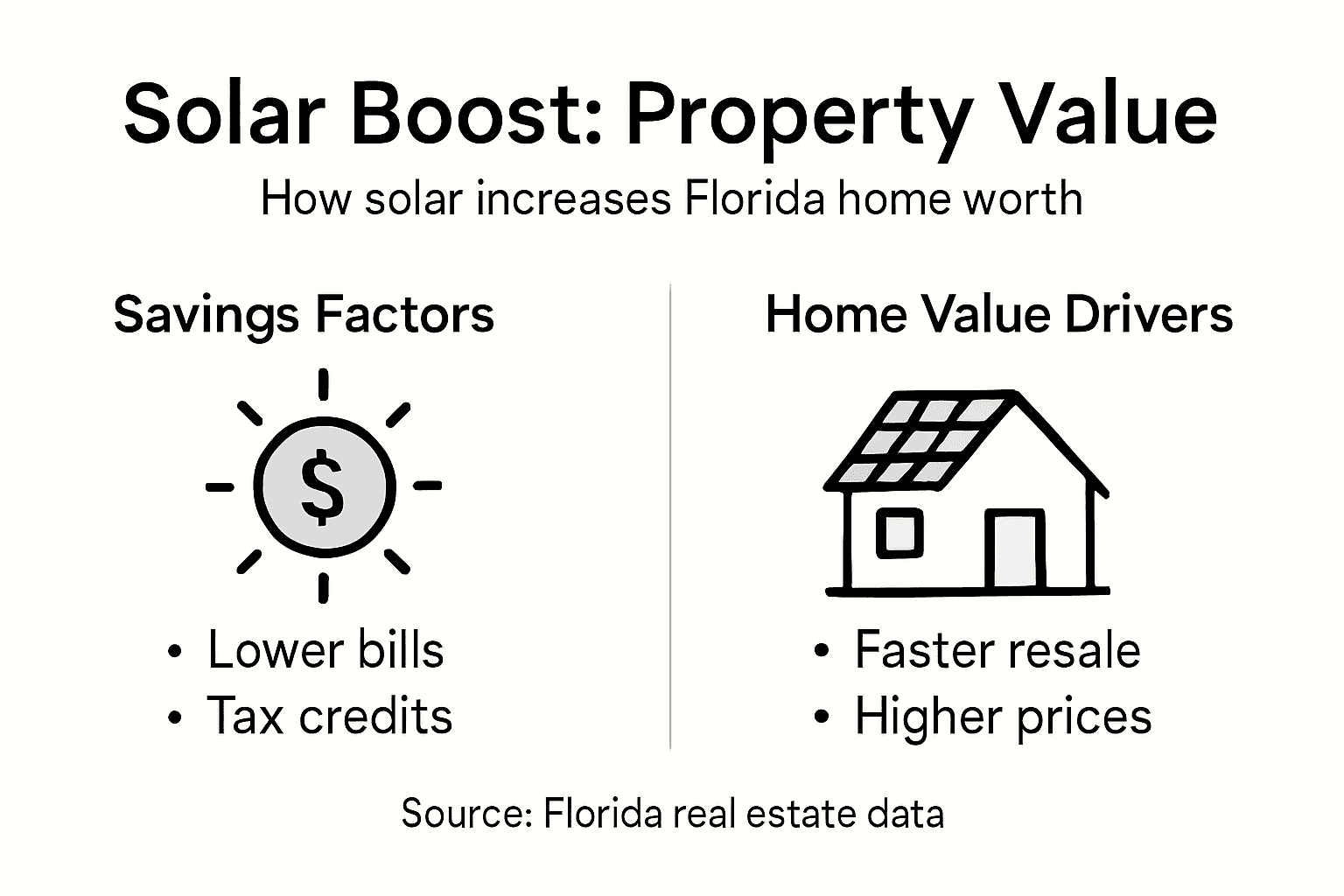
Solar systems increase property values while providing protection against rising utility costs, creating dual financial benefits. Buyers recognize the immediate economic advantage of lower electricity costs.
Property value gains typically match your total system investment. A $15,000 solar installation often increases home value by $15,000 or more.
Solar’s dual financial benefit—immediate bill savings plus long-term property value appreciation—makes it one of the highest-return home improvements available in Florida.
Unlike kitchen renovations or roof replacements that depreciate over time, solar gains value as electricity rates climb. You win financially whether you stay in your home or sell it.
Calculating Your Specific Savings
Your actual savings depend on personal factors unique to your home. System size, roof condition, shading, electricity usage, and local rates all affect the numbers.
Key variables to consider:
- Current annual electricity bill
- Your utility company and rate structure
- Available roof space and sun exposure
- System maintenance costs (minimal for modern systems)
- Potential rate increases over time
PES Solar provides personalized savings estimates based on your actual address and usage patterns. Generic calculators can’t account for your specific roof, shading, and electricity consumption.
Pro tip: Request a detailed 25-year savings projection from PES Solar that shows year-by-year electricity production, estimated bills, cumulative savings, and projected property value increase specific to your home.
Unlock Real Savings with PES Solar for Your Florida Home
Managing high electricity bills and navigating Florida’s solar options can feel complicated despite all the benefits explained in this article. If you want to turn your roof’s sunlight into consistent financial savings while leveraging essential concepts like net metering and federal tax credits, PES Solar is ready to help you make it happen. We specialize in personalized solar panel installation tailored to your home’s specific energy needs, roof orientation, and usage patterns to maximize your return on investment.
Our expert team ensures you benefit fully from Florida’s unique incentives and policies by designing and installing affordable grid-connected solar systems, including advanced solutions like Tesla Powerwall batteries and high-efficiency REC solar panels. Imagine cutting your bills, increasing your property value, and securing energy independence with peace of mind — that is the PES Solar promise.
Start your journey towards smarter energy choices. Request your free estimate today to see how much you can save by switching to solar in Florida.
Take control of your home’s energy future now. Visit PES Solar and discover practical, expert solar solutions that bring the financial benefits you deserve. Don’t wait for your next high electricity bill when you can power your Florida home sustainably and affordably today.
Frequently Asked Questions
What are the benefits of solar energy for Florida homeowners?
Solar energy helps Florida homeowners lower their electricity bills, take advantage of state and federal tax incentives, and increase their property value. Additionally, it provides energy independence and contributes to environmental sustainability.
How does net metering work in Florida for solar energy systems?
Net metering allows homeowners to receive full retail rate credits for excess electricity generated by their solar panels. When their panels produce more electricity than they use, the surplus flows back to the grid, and the utility meter runs backward, offsetting future electricity costs.
What types of solar systems are available for Florida homes?
The main types of solar systems for Florida homes are grid-connected, stand-alone, and hybrid systems. Grid-connected systems are most popular as they allow for easy energy exchange with the utility grid, while stand-alone systems offer energy independence without grid access. Hybrid systems combine solar power with battery storage for enhanced reliability.
How can Florida homeowners estimate their long-term savings with solar energy?
Homeowners can estimate their long-term savings by calculating the total costs of their solar installation, considering available incentives, and projecting their future electricity bills. This includes accounting for possible annual electricity rate increases and determining the break-even point after which savings accumulate significantly.
