
Choosing a solar installer in Florida is more complex than comparing quotes. While many companies promise quality installations, only certified professionals can guarantee safety, compliance with the Florida Building Code solar provisions, and eligibility for valuable incentives. Understanding certifications protects your investment and ensures your system delivers promised performance for decades.
Table of Contents
- Introduction To Solar Installation Certifications
- Key Certifications To Look For In Florida Solar Installations
- How Certifications Impact Safety, Quality, And System Performance
- Certification’s Role In Florida’s Regulatory Compliance And Incentives
- Common Misconceptions About Solar Installation Certifications
- Comparing Major Certifications: Nabcep Vs Ul Vs State Licensing
- How To Verify And Choose Certified Solar Installers In Florida
- Find Certified Solar Installation Experts At Pro E Solar
Key takeaways
| Point | Details |
|---|---|
| Certifications verify installer expertise | NABCEP, UL, and Florida state licensing confirm technical competency and safety standards |
| Compliance affects incentive eligibility | Certified installations qualify for federal tax credits and local rebates requiring licensed professionals |
| Safety standards reduce installation risks | Certified installers deliver 25% better performance with 30% fewer defects than uncertified counterparts |
| Verification is straightforward | Public databases from NABCEP and Florida DBPR allow easy credential confirmation |
| Multiple certifications serve different roles | NABCEP covers installer skills, UL ensures product safety, state licensing confirms legal compliance |
Introduction to solar installation certifications
Solar installation certifications are formal credentials verifying that installers possess verified expertise, adhere to safety protocols, and meet regulatory requirements. These qualifications separate professionals who follow industry best practices from inexperienced contractors who may cut corners. In Florida’s rapidly expanding solar market, certifications serve as your primary protection against substandard work.
These credentials play three critical roles in protecting consumers. First, they ensure quality assurance by requiring installers to demonstrate technical knowledge through examinations and continuing education. Second, they mandate legal compliance with state building codes and electrical standards. Third, they provide consumer protection by creating accountability standards that reduce financial and safety risks.
Florida’s solar industry has experienced explosive growth, with installations doubling since 2022. This expansion has attracted both qualified professionals and opportunistic contractors lacking proper credentials. The state’s regulatory environment requires compliance with the Florida Building Code solar provisions, which mandates specific qualifications ensuring safety and structural integrity.
Key regulatory frameworks governing Florida solar installations include:
- Florida Building Code requirements for electrical and structural work
- State contractor licensing through the Department of Business and Professional Regulation
- National Electrical Code standards for photovoltaic systems
- Local permitting requirements varying by jurisdiction
For deeper insight into why credentials matter, explore the certified solar installers florida role in protecting homeowners.
Key certifications to look for in Florida solar installations
NABCEP (North American Board of Certified Energy Practitioners) certification represents the solar industry’s gold standard. This voluntary credential requires installers to pass rigorous examinations testing technical knowledge, complete documented field experience, and maintain certification through ongoing education. NABCEP certified professionals demonstrate commitment to excellence beyond minimum legal requirements.
Florida state contractor licensing is a legal mandate, not optional. The state requires solar installers to hold either a certified solar contractor license or an electrical contractor license. These credentials verify compliance with building codes, electrical standards, and insurance requirements. Operating without proper licensing exposes homeowners to liability risks and may invalidate warranties.
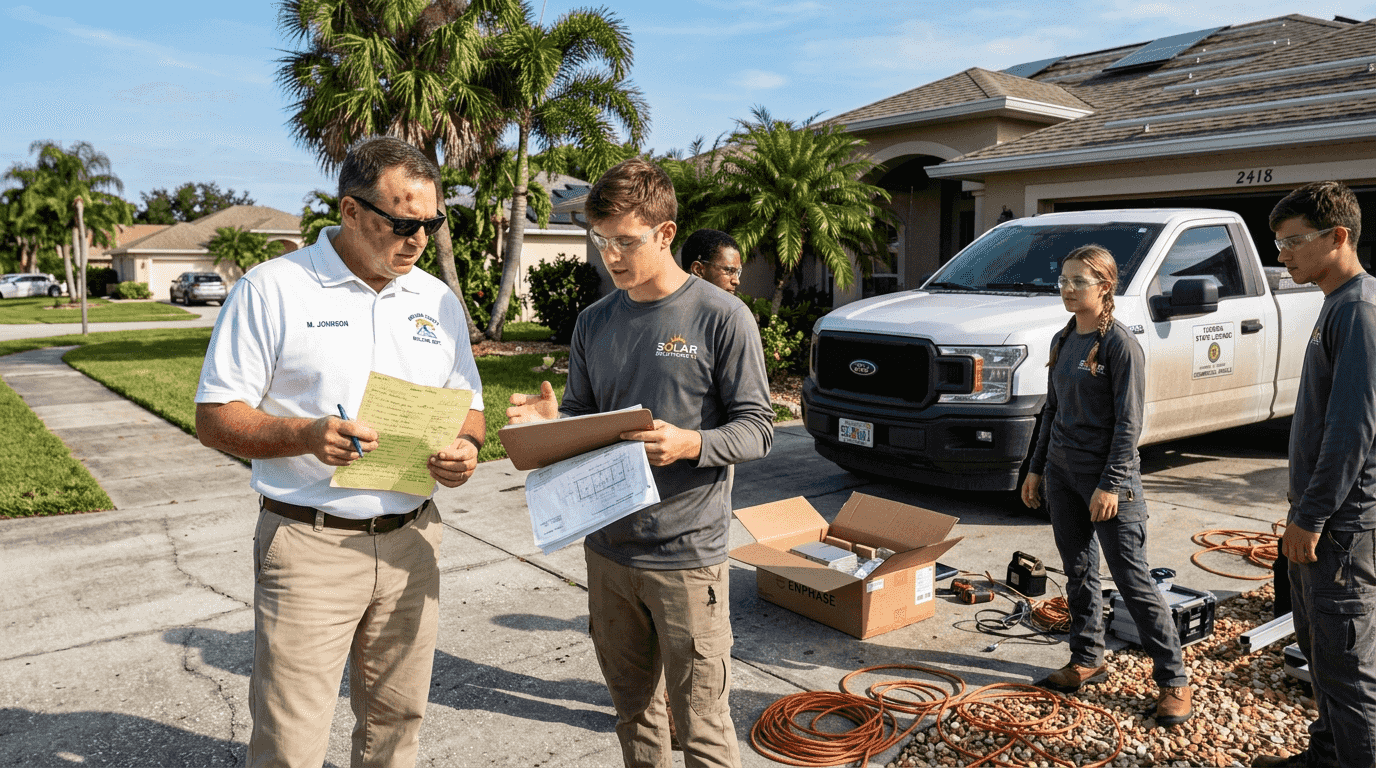
UL (Underwriters Laboratories) certification focuses on product and electrical safety rather than installer qualifications. UL certified components undergo extensive testing to prevent fire hazards, electrical failures, and performance degradation. While installers don’t hold UL credentials, they should exclusively use UL certified equipment to ensure system safety.
These certifications complement each other rather than overlap. NABCEP validates installer skills, state licensing ensures legal compliance, and UL certification confirms equipment safety. Together, they create comprehensive protection for your solar investment.
Pro Tip: Prioritize installers holding both NABCEP certification and current Florida state licenses for the strongest combination of technical expertise and legal compliance.
When vetting contractors, reference these key questions to ask solar installers to verify their qualifications. Understanding the certified solar installers florida role helps you recognize the difference between marketing claims and genuine credentials.
How certifications impact safety, quality, and system performance
Certified installers follow standardized protocols that dramatically reduce installation defects and safety hazards. Their training covers proper roof penetration techniques, waterproofing methods, electrical connections, and structural load calculations. These proven procedures prevent common problems like roof leaks, electrical fires, and premature equipment failure that plague installations by unqualified contractors.
Component safety becomes paramount in Florida’s extreme weather conditions. Certification requirements mandate use of UL certified equipment designed to withstand hurricanes, intense heat, and heavy rain. These components undergo rigorous testing for fire resistance, electrical safety, and durability that non-certified products lack. The difference becomes critical during severe weather events when inferior equipment fails.
Statistical evidence reveals striking performance gaps between certified and uncertified installations. Certified solar installers deliver 25% better system performance and experience 30% fewer defects compared to uncertified contractors. This translates to thousands of dollars in additional savings over your system’s lifespan through higher energy production and reduced maintenance costs.
Certification impacts long term reliability in measurable ways:
- Reduced warranty claims due to proper installation techniques
- Lower risk of electrical fires from code compliant wiring
- Better weather resistance through structural engineering standards
- Higher resale value from documented professional installation
Pro Tip: Always request proof of current certifications before signing contracts. Expired credentials offer no protection, and verbal claims without documentation should raise immediate red flags.
Learn more about qualification standards in our guide on choosing solar installer florida. Additional research on certification importance for safety demonstrates how credentials protect consumers across industries.
Certification’s role in Florida’s regulatory compliance and incentives
The Florida Building Code requires licensed installers for legal compliance on all solar installations. This mandate exists to protect public safety and ensure structural integrity. Installations by unlicensed contractors violate state law, potentially resulting in fines, required system removal, and liability for property damage. These legal risks make certification verification essential before starting any project.
Federal solar tax credits worth 30% of system costs depend on compliance with recognized standards. The IRS requires installations to meet electrical codes and safety standards verified through proper licensing. Uncertified work may disqualify your entire investment from these valuable incentives, eliminating thousands in potential savings.
Local Florida incentives add another layer of requirements. Many utility rebate programs and municipal incentive funds require proof of licensed installation to prevent fraud and ensure quality. Without proper credentials, you forfeit eligibility for programs that could reduce your net investment by 40% or more.
Compliance benefits extend beyond initial incentive qualification:
- Simplified permit approval through recognized credentials
- Faster inspection processes with certified documentation
- Enhanced property value from code compliant installations
- Reduced insurance complications from proper licensing
Discover available financial benefits through our solar incentives florida savings guide. Our comprehensive Florida solar incentives guide explains how certifications unlock maximum savings. Florida Building Code solar provisions detail specific requirements, while verifying installer certifications Florida ensures compliance.
Common misconceptions about solar installation certifications
Myth: All solar installers possess equal qualifications regardless of credentials. Reality reveals a stark divide between certified professionals and unlicensed contractors. Certifications require demonstrated technical knowledge, field experience, and continuing education that separate qualified experts from those simply claiming expertise. Your system’s safety and performance depend on this distinction.
Myth: Certifications add unnecessary costs without tangible benefits. The truth shows certified installers often charge comparable rates while delivering superior value. Their reduced error rates, faster installation times, and code compliance eliminate expensive rework and failed inspections. Long term savings from proper installation far exceed any minimal upfront premium.
Misunderstanding surrounds whether uncertified installations can meet safety and compliance standards. While some unlicensed contractors may produce adequate work, they lack the accountability framework protecting consumers. Without proper credentials, you have limited recourse for defects, no insurance protection, and potential liability for code violations discovered later.
Certification impacts extend to warranty coverage and insurance claims. Many equipment manufacturers require installation by licensed professionals to honor warranties. Insurance companies may deny claims for fire or property damage resulting from unlicensed work. These hidden risks make certification verification essential regardless of contractor promises.
Key realities about certification value:
- Credentials create legal accountability for installation quality
- Proper licensing protects homeowners from liability for contractor errors
- Certification ensures knowledge of current codes and best practices
- Professional standards maintain industry reputation and consumer trust
Our choosing solar installer florida resource helps separate facts from fiction when evaluating contractors.
Comparing major certifications: NABCEP vs UL vs state licensing
| Certification | Primary Focus | Requirements | Legal Status | Best For |
|---|---|---|---|---|
| NABCEP | Installer technical competency | Written exam, field experience, continuing education | Voluntary industry standard | Verifying installer expertise and commitment to excellence |
| Florida State License | Legal compliance and code knowledge | State exam, insurance, experience verification | Mandatory legal requirement | Ensuring regulatory compliance and consumer protection |
| UL Certification | Product and equipment safety | Laboratory testing, performance standards | Equipment standard, not installer credential | Confirming component quality and fire safety |
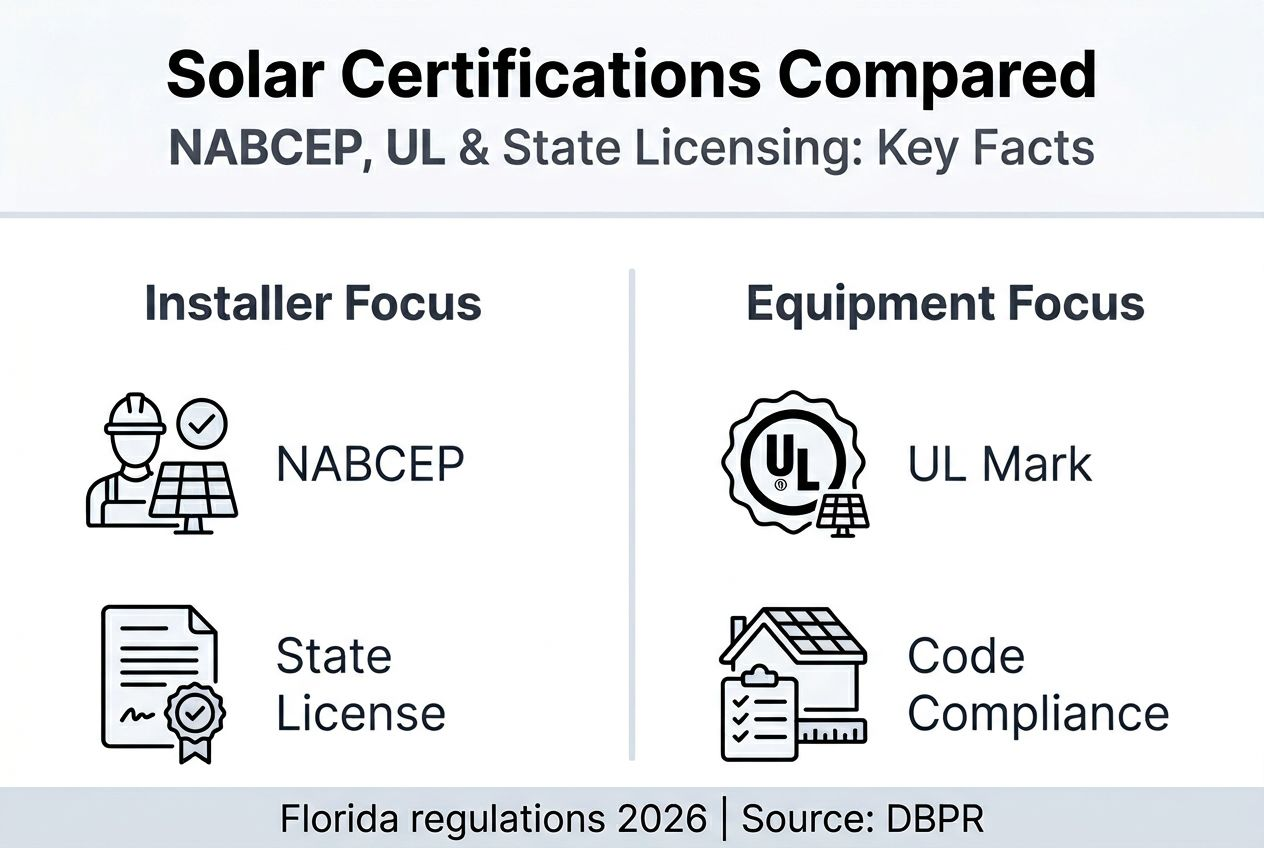
NABCEP certification demonstrates an installer’s commitment to professional excellence beyond minimum legal requirements. The rigorous examination covers system design, installation techniques, safety protocols, and troubleshooting. Continuing education requirements ensure certified professionals stay current with evolving technology and best practices. This voluntary credential signals dedication to craft mastery.
Florida state licensing serves as the legal foundation for all solar work. The mandatory credential confirms installers understand building codes, electrical standards, and structural requirements specific to Florida. State oversight provides enforcement mechanisms protecting consumers from unlicensed operators. Without this license, any solar work violates state law regardless of technical skill.
UL certification applies to equipment rather than installers. This distinction matters because even skilled installers using non-certified components create safety hazards. UL testing verifies products meet rigorous fire safety, electrical performance, and durability standards. The certification provides crucial protection in Florida’s challenging climate.
Pro Tip: Ideal contractors combine all three elements, holding NABCEP certification and state licensing while exclusively installing UL certified equipment. This combination ensures comprehensive quality, safety, and legal compliance.
How to verify and choose certified solar installers in Florida
-
Start by requesting specific certification details from potential installers. Ask for NABCEP certification numbers, Florida contractor license numbers, and proof of insurance. Legitimate professionals readily provide this information and encourage verification. Hesitation or vague responses indicate potential problems requiring immediate attention.
-
Use official verification databases to confirm credentials. The NABCEP website allows searches by installer name or certification number. Florida’s Department of Business and Professional Regulation provides license lookup confirming active status, disciplinary history, and expiration dates. Both databases update regularly and provide reliable information.
-
Cross reference installation quality through customer reviews and project references. Certifications verify technical knowledge, but customer experiences reveal practical performance. Request references from recent installations similar to your project. Contact these homeowners directly to discuss their satisfaction with quality, timeline, and professionalism.
-
Confirm certifications cover your specific project scope. Some installers hold residential certifications but lack commercial credentials, or possess electrical licenses without solar specific training. Verify credentials match your installation type and complexity. Also check certification expiration dates to ensure current validity throughout your project.
Pro Tip: Document all certification verifications in writing before signing contracts. Request copies of licenses, insurance certificates, and NABCEP credentials for your records. This documentation protects you if disputes arise and provides proof of due diligence for insurance or warranty claims.
Our comprehensive choosing solar installer florida guide provides additional evaluation criteria. The selecting solar provider florida homes resource offers specific considerations for residential projects. Always verify credentials through Florida installer certification verification before making final decisions.
Find certified solar installation experts at Pro E Solar
Pro E Solar maintains comprehensive certifications ensuring every installation meets Florida’s stringent safety and compliance requirements. Our team combines NABCEP credentials with active Florida state licensing, delivering the expertise and legal protection your investment deserves. We exclusively use UL certified equipment to guarantee long term safety and performance in Florida’s demanding climate.
Choosing certified professionals simplifies the permit process, accelerates inspections, and maximizes your eligibility for federal tax credits and local incentives. Our proven installation methods reduce defects while enhancing system efficiency, translating to greater savings over your system’s 25 year lifespan.
Explore detailed guidance in our solar panel installation guide covering every phase from planning to activation. Our solar installation steps guide walks through the process with certified professionals. Review our choosing solar installer florida resource to understand why credentials matter for your project success.
FAQ
What types of certifications should Florida solar installers have?
Florida installers need NABCEP certification demonstrating technical expertise, a valid Florida state contractor license ensuring legal compliance, and should install only UL certified equipment for safety. These three credentials work together to protect your investment through verified skills, regulatory compliance, and product quality standards. Learn more about the certified solar installers florida role in protecting homeowners.
How can I verify if a solar installer is certified in Florida?
Verification is straightforward using databases from NABCEP and Florida’s Department of Business and Professional Regulation. Visit NABCEP’s website to search certified installers by name or credential number. Check Florida DBPR’s license lookup to confirm active status and review any disciplinary history. Always request written proof before signing contracts. Our guide on choosing solar installer florida provides additional verification steps.
Does hiring a certified solar installer affect my eligibility for incentives?
Certified installations commonly qualify for federal tax credits worth 30% of system costs and local rebates requiring licensed professionals. Many incentive programs mandate proof of proper licensing to prevent fraud and ensure quality standards. Uncertified work risks disqualification from thousands in potential savings. Explore available benefits through our solar incentives florida savings guide and Florida solar incentives guide for maximum financial advantages.
What happens if I use an unlicensed solar installer in Florida?
Unlicensed installations violate Florida law, potentially resulting in fines, required system removal, and personal liability for property damage. You forfeit warranty protection, insurance coverage, and eligibility for tax credits and rebates. Code violations discovered later can prevent home sales or require expensive corrections before closing. Legal and financial risks make certification verification essential before starting any project.
