
Choosing to install solar panels in Florida can feel like a leap, especially when myths about reliability and unclear warranties cloud your decision. Homeowners often face confusion over what protections truly exist for their investment, but today’s solar warranties offer far more than many realize. By understanding the difference between product, performance, and workmanship guarantees, you gain real confidence in both your energy savings and the potential for greater property value. For many, strong warranty coverage means lasting peace of mind when making the switch to renewable power.
Table of Contents
- Defining Solar System Warranties And Myths
- Key Warranty Types For Solar Systems
- Coverage Periods And Component Protections
- Common Exclusions And How Claims Work
- Warranty Impact On Savings And Property Value
Key Takeaways
| Point | Details |
|---|---|
| Understanding Warranty Types | Florida homeowners should know the key warranty types: product, performance, workmanship, and component warranties. Each type offers different protections that impact the investment. |
| Careful Review of Terms | It is crucial to carefully examine warranty terms, including coverage limitations, maintenance requirements, and transferability. This ensures homeowners maintain their warranty’s value. |
| Performance Impact on Value | Strong warranty coverage can increase property value and reliability, making homes more attractive to buyers. Homes with solid warranties demonstrate higher resale potential. |
| Document and Maintain Records | Homeowners should maintain detailed records of installation and maintenance to support future warranty claims and ensure protection remains intact. |
Defining Solar System Warranties and Myths
Solar system warranties represent critical financial protection for Florida homeowners investing in renewable energy infrastructure. These agreements offer comprehensive coverage that safeguards your solar panel investment against potential manufacturing defects, performance degradation, and unexpected system failures.
Understanding solar system warranties requires dispelling common myths that often prevent homeowners from making informed decisions. Common misconceptions about solar reliability have historically discouraged potential adopters, but modern solar technologies have dramatically transformed the landscape of renewable energy performance and dependability.
Key aspects of solar system warranties typically include:
- Product warranties covering manufacturing defects
- Performance warranties guaranteeing minimum energy production levels
- Workmanship warranties protecting against installation-related issues
- Extended coverage for specific system components like inverters
Modern solar warranties demonstrate significant technological advancements. Peer-reviewed research confirms that contemporary solar panels maintain high efficiency and reliability far beyond previous generations, challenging outdated perceptions about solar energy sustainability.
Warranty coverage varies significantly between manufacturers and installers, making it crucial for Florida homeowners to carefully review contract details. Factors like panel type, installation quality, and regional environmental conditions can substantially impact long-term system performance and warranty validity.
Pro tip: Always request detailed warranty documentation and ask specific questions about coverage limitations, transfer conditions, and maintenance requirements before finalizing your solar installation contract.
Key Warranty Types for Solar Systems
Solar system warranties are complex legal agreements designed to protect homeowners’ significant investments in renewable energy infrastructure. Understanding the legal nuances of warranty coverage helps Florida residents make informed decisions about their solar panel systems.
Most solar warranties fall into several critical categories:
- Product Warranties: Cover manufacturing defects and panel integrity
- Performance Warranties: Guarantee minimum energy production over time
- Workmanship Warranties: Protect against installation-related issues
- Extended Component Warranties: Cover specific system elements like inverters
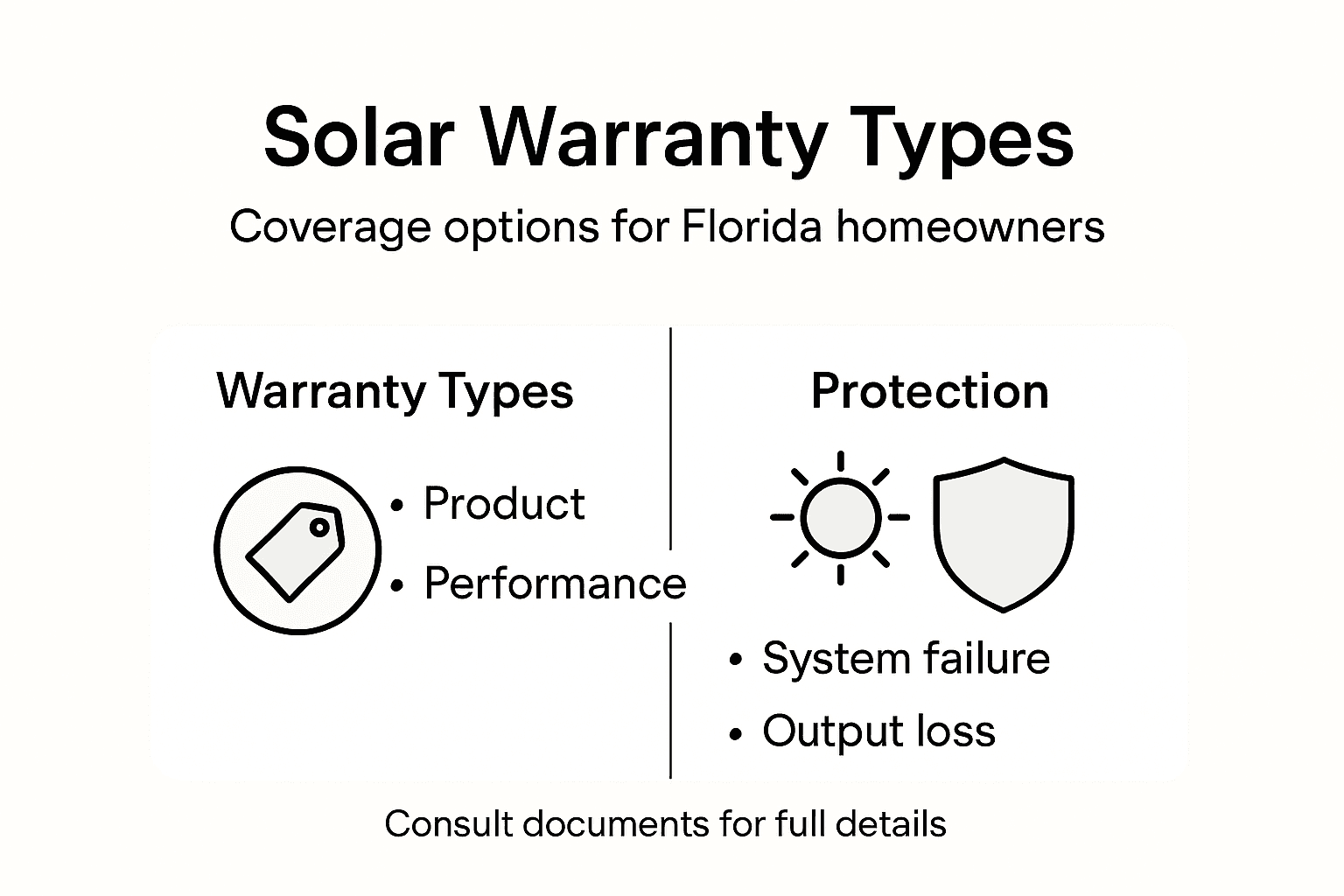
Typically, solar system warranties include distinct time-based provisions. Product warranties often range from 10-25 years, offering protection against physical defects or premature panel degradation. Performance warranties frequently guarantee 90% panel performance for the first 10 years and 80% performance for subsequent years, ensuring long-term energy generation reliability.
Homeowners should carefully examine warranty terms, paying close attention to:
- Specific coverage limitations
- Maintenance requirements
- Transferability conditions
- Exclusions and potential voidance scenarios
Understanding these details can significantly impact the long-term value and protection of your solar investment. Manufacturers and installers often have varying warranty structures, making it crucial to review documentation thoroughly before finalizing your solar system purchase.

Here’s a quick comparison of solar system warranty types and what each covers:
| Warranty Type | What It Protects | Typical Duration |
|---|---|---|
| Product Warranty | Defective panels | 10-25 years |
| Performance Warranty | Minimum energy output | 20-25 years |
| Workmanship Warranty | Installation quality | 5-10 years |
| Component Warranty | Inverters & hardware | 5-15 years |
Pro tip: Request a comprehensive written warranty document and consult with a solar professional to clarify any complex terms or potential coverage gaps before signing your solar installation contract.
Coverage Periods and Component Protections
Florida homeowners investing in solar systems must understand the intricate details of warranty coverage for different system components. Typical solar warranty periods provide critical protection for solar infrastructure across multiple critical elements.
Most solar system warranties cover key components with varying timeframes:
- Solar Panels: 10-25 years product warranty
- Inverters: 5-15 years coverage
- Mounting Systems: 10-20 years protection
- Workmanship: 5-10 years installation guarantee
Performance warranties are particularly important for Florida homeowners. These agreements typically guarantee that solar panels will maintain specific energy production levels, usually promising 90% output for the first decade and 80% output for subsequent years. Understanding solar system components helps homeowners recognize which parts are most critical to long-term system performance.
The duration and scope of warranties can significantly impact your solar investment’s financial viability. Different manufacturers offer varying levels of protection, with premium brands often providing more comprehensive coverage that extends beyond standard industry minimums. Factors like environmental conditions, installation quality, and maintenance practices can influence warranty terms and potential claims.
Homeowners should pay special attention to:
- Exact coverage start and end dates
- Specific performance degradation rates
- Conditions that might void the warranty
- Process for filing warranty claims
- Transferability of warranty to new property owners
Pro tip: Photograph and document your solar system’s initial installation condition and maintain detailed maintenance records to strengthen potential future warranty claims.
Common Exclusions and How Claims Work
Navigating warranty claims for solar systems requires understanding potential exclusions and legal protections. Federal warranty standards establish critical guidelines that protect homeowners from unfair claim denials and ambiguous warranty terms.
Common warranty exclusions typically include:
- Physical Damage: Impact, severe weather, or accidental damage
- Improper Installation: Non-certified installer modifications
- Unauthorized Repairs: Work done by uncertified technicians
- Environmental Extremes: Damage from saltwater, hurricanes, or extraordinary events
- Maintenance Negligence: Failure to perform required system upkeep
Claim processing involves several critical steps. Solar warranty claim procedures require homeowners to document issues thoroughly, including:
- Detailed photographic evidence
- Maintenance records
- Original installation documentation
- Specific performance measurement data
- Comprehensive system inspection reports
Manufacturers typically offer two primary claim resolution methods: component replacement or system repair. The specific approach depends on the warranty type, damage extent, and documented system performance. Florida homeowners should carefully review their warranty documentation to understand exact claim submission processes and potential remedies.
Most solar warranties include specific conditions that can potentially void coverage. These might involve unauthorized modifications, improper cleaning techniques, or failure to conduct recommended periodic maintenance. Understanding these nuanced requirements helps homeowners maintain their warranty’s full protection.
Pro tip: Create a dedicated digital folder with all solar system installation documents, maintenance logs, and warranty paperwork to streamline potential future warranty claims.
Warranty Impact on Savings and Property Value
Solar energy investments significantly influence home value and financial returns, with comprehensive warranties serving as crucial indicators of system quality and long-term performance potential. Strong warranty coverage demonstrates manufacturer confidence and provides Florida homeowners tangible financial protection.
Key financial benefits of robust solar system warranties include:
- Increased Property Value: Homes with reliable solar installations can see value appreciation
- Risk Mitigation: Comprehensive warranties reduce potential repair and replacement expenses
- Energy Cost Stability: Performance guarantees ensure predictable long-term electricity generation
- Investor Confidence: Strong warranties attract potential home buyers during resale
Performance warranties directly impact financial outcomes by guaranteeing minimum energy production levels. These agreements typically promise 90% output in the first decade, ensuring homeowners receive consistent electricity generation. The predictability of energy production translates into more accurate financial forecasting and reduced economic uncertainty.
Warranty quality can significantly influence home resale potential. Transferable warranties with substantial remaining coverage become attractive selling points, potentially increasing property marketability. Prospective buyers view comprehensive warranty coverage as a sign of system reliability and reduced future maintenance risks.
The table below summarizes how solar warranties can impact financial outcomes for homeowners:
| Impact Area | Financial Benefit | Long-Term Value |
|---|---|---|
| Property Value | Higher resale price | Marketability |
| Repair Costs | Lower out-of-pocket expenses | Cost predictability |
| Energy Savings | Consistent electricity generation | Reduced bills |
| Investment Security | Risk reduction for new buyers | Stronger return |
Homeowners should consider warranties as financial instruments that:
- Protect against unexpected repair costs
- Guarantee minimum energy production
- Provide predictable long-term system performance
- Enhance overall solar investment value
- Create additional property value during resale
Pro tip: Request a detailed warranty documentation breakdown during solar installation and specifically inquire about transferability clauses to maximize future property value potential.
Secure Your Solar Investment with Trusted Warranty Protection
Understanding the complexities of solar system warranties is essential for Florida homeowners who want to protect their renewable energy investment and ensure long-term savings. The challenges of navigating product warranties, performance guarantees, and workmanship coverage can feel overwhelming. At PES Solar, we specialize in guiding you through these critical details to avoid common pitfalls like limited coverage or voided warranties.
Our comprehensive solar solutions include premium panels, expert installation, and clear warranty explanations so you can feel confident about your energy future. We prioritize your peace of mind by offering residential solar installation services backed by trusted manufacturers and solid warranty terms. You deserve a solar system that not only lowers energy bills but also maintains its value with dependable warranty protection.
Take control of your solar journey today and experience worry-free energy independence.
Explore how our team supports warranty clarity and superior system quality to maximize property value and financial savings.
Ready to protect your home with expert solar installation and reliable warranties Ensure your system delivers as promised by scheduling a free consultation now at PES Solar. Don’t wait—secure your solar investment with the professionals dedicated to Florida homeowners like you.
Frequently Asked Questions
What types of warranties are available for solar systems?
Solar systems typically come with product warranties, performance warranties, workmanship warranties, and extended component warranties. Each type covers different aspects such as manufacturing defects, energy output, installation quality, and specific components like inverters.
How do performance warranties work for solar panels?
Performance warranties guarantee that solar panels will maintain a certain level of energy production over time, often promising 90% output for the first 10 years and 80% output thereafter. This ensures long-term reliability in energy generation.
What common exclusions should I be aware of in solar system warranties?
Common exclusions in solar system warranties may include physical damage from impact or severe weather, improper installation by unqualified technicians, unauthorized repairs, and neglecting maintenance requirements. Understanding these exclusions is vital to ensuring that your warranty remains valid.
How can solar system warranties affect my home’s value?
Robust solar system warranties can increase property value by providing potential homebuyers with assurance regarding the system’s reliability and future performance. Transferable warranties with remaining coverage are particularly attractive during resale, enhancing marketability and potentially leading to a higher selling price.
