
Every month, watching your Florida electricity bill spike can feel frustrating, especially when the sun shines so relentlessly overhead. For homeowners, learning how solar energy transforms that abundant sunshine into reliable, cost-effective power is more than curiosity—it’s a path toward lowering bills, raising property value, and unlocking tax savings. Get clear answers about what solar really is, the systems meant for Florida homes, and the truth behind common myths—so you can make smart decisions and see lasting financial returns.
Table of Contents
- Solar Energy Defined And Common Myths
- Types Of Solar Systems For Homes
- How Solar Panels Work In Florida
- Tax Credits And Local Incentives Explained
- Calculating Total Savings And Property Value
- Comparing Solar With Traditional Energy Options
Key Takeaways
| Point | Details |
|---|---|
| Solar Energy Advantages | Solar energy provides significant savings potential, especially in sunny regions like Florida, with many homeowners achieving payback within 5 to 12 years. |
| Myth Debunking | Common myths about solar, such as ineffective performance in cloudy weather or excessive costs, have been refuted, highlighting the real benefits and efficiencies of solar systems. |
| Incentives and Savings | Federal tax credits and local incentives can significantly reduce out-of-pocket costs, making solar installations more accessible and financially beneficial. |
| Long-Term Value | Solar installations can increase property values, making homes more attractive to buyers due to the expected reduction in energy costs over time. |
Solar energy defined and common myths
Solar energy is simply radiant energy from the sun converted into usable electricity or heat for your home. Think of it as capturing free power that’s been traveling 93 million miles just to reach your roof. Florida homeowners have a particular advantage here: with more than 230 days of sunshine annually, your state receives abundant solar radiation that photovoltaic panels can transform into electricity flowing through your home.
Understanding what solar actually is helps cut through the noise. Radiant energy from the sun powers three main technologies. Photovoltaic (PV) panels convert sunlight directly into electricity using semiconductor materials. Solar thermal systems capture heat from the sun for water heating or space heating. Solar thermal power plants concentrate sunlight to generate electricity at scale. For most Florida homeowners, photovoltaic panels are the practical choice, converting sunlight into the AC power your air conditioner and appliances need.
Now for the myths. This is where homeowners often get tripped up, and frankly, it costs them thousands in missed savings. Myth number one: Solar panels don’t work on cloudy days. Reality check: panels generate electricity even under cloud cover. They produce less than on sunny days, but they still produce. Florida’s afternoon thunderstorms won’t leave you powerless. Myth number two: Solar is too expensive. The truth is more nuanced. Yes, the upfront cost exists, but federal tax credits, Florida’s sales tax exemptions, and financing options make solar accessible. Many homeowners see positive returns within 5 to 7 years. Myth number three: Solar panels damage your roof. Properly installed systems by certified professionals actually protect your roof by shielding sections from UV exposure and weathering.
Another widespread misconception involves environmental impact and panel waste. People worry that manufacturing solar panels creates more pollution than they save, or that old panels become toxic waste. Research directly addressing false claims about solar and environmental effects shows this concern is overblown. Solar panels are recyclable, and their environmental payback period typically occurs within 1 to 4 years. After that point, every kilowatt-hour generated is pure environmental gain. The manufacturing impact is real but minimal compared to decades of clean energy generation. Florida homeowners also worry about whether solar works during hurricane season. Quality installations use reinforced racking systems designed to withstand extreme weather, and your battery backup system keeps you powered even when the grid goes down.
Pro tip: When evaluating solar for your Florida home, request documentation showing how the system performs during different weather conditions specific to your area, and ask about warranties covering hurricane-force winds and extreme weather events.
Types of solar systems for homes
When you’re looking at solar for your Florida home, you’ll encounter two primary system types, and understanding the difference matters for your decision. Grid-tied systems connect directly to the utility grid, allowing you to draw power from the grid when your panels aren’t producing enough and send excess power back when they produce more than you need. This is the most common setup for Florida homeowners because it’s simpler, more affordable, and lets you benefit from net metering programs that credit you for excess electricity. Off-grid systems operate independently, storing all generated power in batteries for use when the sun isn’t shining. These systems work best for properties far from utility infrastructure, though the battery costs make them significantly more expensive upfront. Most Florida homeowners choose grid-tied systems, but hybrid systems that combine both approaches are becoming increasingly popular.
At the core of any residential solar setup are photovoltaic panels that convert sunlight directly into electricity using semiconductors, typically silicon. Beyond the panels themselves, your system includes several critical components. The inverter is arguably the most important piece after the panels because it converts the direct current (DC) electricity your panels generate into alternating current (AC) power that runs your home’s appliances and electronics. Without an inverter, your solar panels would be useless to you. Mounting hardware secures panels to your roof or ground, angled to maximize sun exposure throughout the year. Florida installers typically position panels at angles optimized for your latitude to capture the most winter and summer sun. If you choose a hybrid or off-grid system, battery storage becomes essential, with lithium-ion batteries being the modern standard because they’re efficient, long-lasting, and require minimal maintenance compared to older lead-acid options. You might also have monitoring equipment that tracks your system’s performance in real time, showing you exactly how much electricity you’re generating and using.
The configuration of these components creates different system types with distinct advantages. A rooftop system is the most common choice for Florida homes because your roof provides free space and most Florida homes have unobstructed southern exposure. Ground-mounted systems work well for properties with available yard space and actually offer a slight efficiency advantage because air circulates underneath, keeping panels cooler. Fixed-tilt systems use stationary mounts angled toward the sun, representing the simplest and most affordable configuration. Tracking systems use motors to follow the sun’s path throughout the day, increasing energy production by 25 to 35 percent but at higher cost and with more maintenance needs. Most Florida homeowners go with fixed rooftop installations because they balance cost effectiveness with solid production.
You might also hear about solar thermal systems, which are different from photovoltaic systems. Rather than generating electricity, solar thermal systems capture heat from sunlight to warm water for your shower and household use or to heat your home during Florida’s mild winters. They’re less common than PV systems but can make sense as an addition to reduce your water heating costs. When you’re evaluating what type suits your home, consider your roof condition and orientation, your property’s layout, whether you want battery backup, and your long-term plans for staying in the home. Your shading situation matters tremendously in Florida, where oak trees and neighboring structures might block afternoon sun. A professional solar assessment will analyze all these factors specific to your address.
Here’s a concise breakdown of the main types of residential solar systems for Florida homeowners:
| System Type | Grid Requirements | Upfront Cost | Typical Use Case |
|---|---|---|---|
| Grid-Tied | Connects to utility | Moderate | Common in cities, net metering |
| Off-Grid | Independent, no grid | High | Remote areas, full energy autonomy |
| Hybrid | Grid and batteries | Higher | Balance backup and grid reliance |
| Solar Thermal | Not for electricity | Lower | Water heating, supplemental use |
Pro tip: Request a solar analysis that models your roof’s sun exposure patterns and accounts for seasonal changes, as Florida’s summer sun angle differs significantly from winter, affecting which roof sections work best for your panels.
How solar panels work in Florida
Solar panels work through a surprisingly elegant process that happens silently on your roof. When sunlight hits a solar panel, photons strike semiconductor materials, typically silicon, and transfer their energy to electrons within the material. This energy release causes electrons to break free from their atoms, creating what physicists call the photovoltaic effect. Think of it like a tiny, invisible mechanical process happening billions of times per second across your panel’s surface. Those freed electrons create an electric current that flows through the panel’s internal circuitry. This is direct current (DC) electricity, the same type a battery produces, but your home runs on alternating current (AC). That’s where the inverter enters the picture. Your inverter converts the DC power from the panels into AC power that flows through your home’s electrical system, powering everything from your refrigerator to your air conditioning unit.
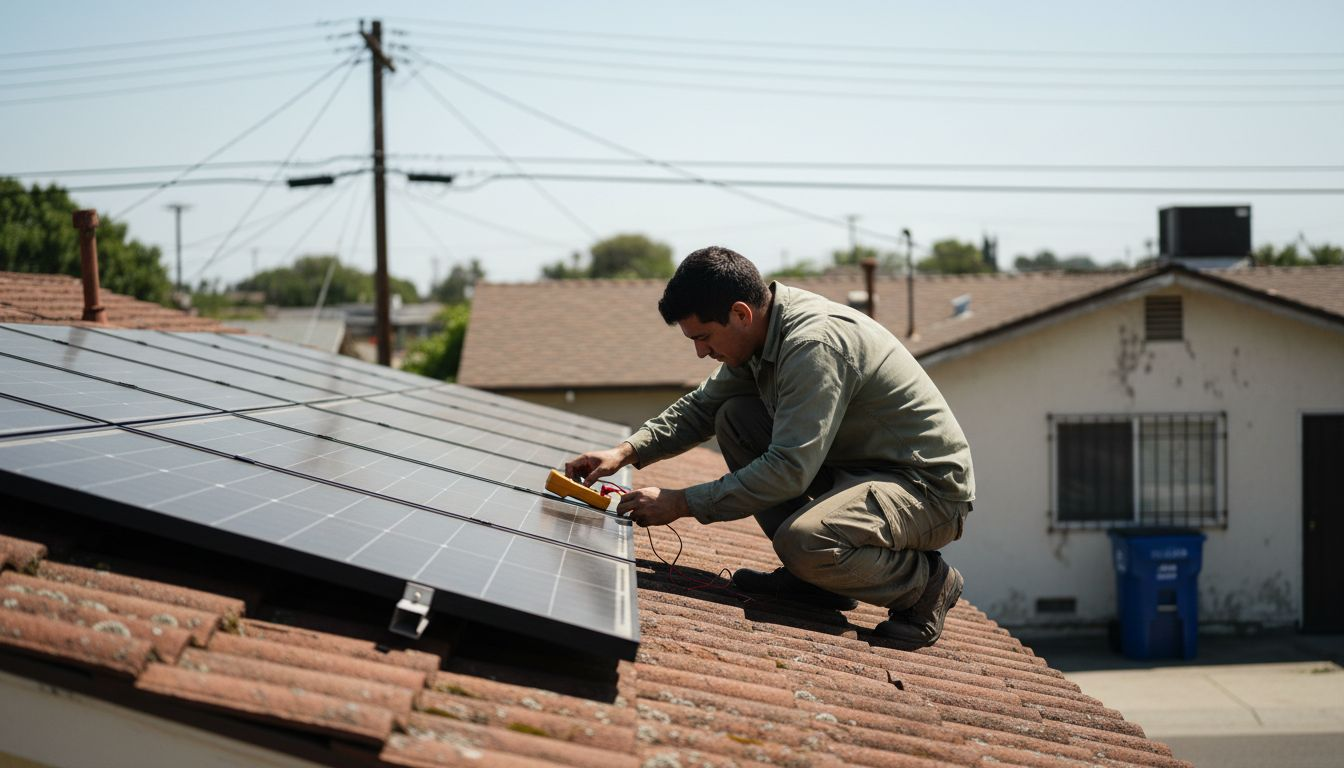
Florida’s climate actually makes solar panels work exceptionally well for most of the year. With over 230 days of annual sunshine and relatively consistent solar radiation throughout the year, your panels generate electricity even on cloudy days, though at reduced capacity. What many Florida homeowners don’t realize is that solar panels work more efficiently when cooler, which gives hot Florida summers an interesting tradeoff. While the intense sun provides abundant energy, the extreme heat causes slight efficiency losses. A properly installed system accounts for this through ventilation beneath the panels and reflective materials that minimize temperature buildup. Research from Florida’s Solar Energy Center focuses specifically on how panels perform in Florida’s hot, humid environment, testing systems to ensure they maintain durability and efficiency despite year-round heat and occasional salt spray near coastal areas. Your system’s actual electricity production will vary based on several factors specific to your location and installation.
Here’s the real world flow of energy in your Florida home. Morning sunlight begins charging your system around sunrise. Peak production typically occurs between 10 AM and 3 PM when the sun is highest and brightest. During these peak hours, your panels often produce more electricity than your home consumes, sending excess power back to the grid through net metering, which credits your account. During evening and night hours, your panels produce nothing, so you draw power from the grid. This is why grid-tied systems make sense for most Florida homeowners. If you’ve chosen a battery backup system, excess daytime power charges your batteries instead of flowing to the grid, and those batteries power your home at night. The monitoring equipment on your system lets you watch this dance in real time, showing exactly how much you’re generating, using, and storing or exporting.
Your panel’s specific output depends on several variables beyond just sunshine hours. Panel orientation matters enormously. Panels facing south capture the most total energy year-round in Florida, though southeast or southwest facing roofs still work well. Shading is the silent killer of solar production. Even partial shade from trees or neighboring structures casting shadows across your panels during key production hours can reduce output by 20 to 50 percent. Panel angle affects seasonal performance. Florida installers typically position panels at angles between 15 and 25 degrees from horizontal to capture both summer and winter sun effectively. Panel temperature is crucial. Panels lose efficiency at the rate of about 0.5 percent per degree Celsius above 25 degrees Celsius, which matters during Florida’s hot summers. Quality installation includes spacing panels slightly above your roof surface to allow air circulation underneath, keeping them cooler and more efficient. When you get a professional solar assessment for your home, installers analyze all these factors specific to your address, roof orientation, and surrounding structures to predict your realistic annual production.
Pro tip: Ask your solar installer for a production forecast that shows estimated kilowatt-hour generation broken down by month, accounting for Florida’s seasonal sun angle changes and typical weather patterns for your specific location.
Tax credits and local incentives explained
The financial incentives available for solar in Florida are substantial, and understanding them is crucial because they directly reduce what you pay out of pocket. The biggest one is the federal Investment Tax Credit (ITC), which allows you to claim 30% of your qualified solar installation costs as a tax credit through 2032. This isn’t a rebate that reduces your bill. It’s a direct credit against your federal income taxes. Here’s the practical difference: if your solar system costs $25,000 installed, you’d receive a $7,500 credit on your federal taxes. That credit covers the panels, inverters, mounting hardware, labor, and even battery storage if you add it. The credit applies to the year you install the system, so if you complete installation in December 2024, you claim it on your 2024 tax return filed in 2025. The only requirement is that you own the system outright or through a loan. If you lease your panels, you lose access to this credit because the leasing company claims it instead.
Florida doesn’t currently offer a state-level solar tax credit, which is something many residents wish existed. However, you do get relief through the state’s sales tax exemption on solar equipment. While most states charge sales tax on solar equipment purchases, Florida exempts solar panels and related components from sales tax. On that same $25,000 system, you’d save roughly $2,000 in sales tax compared to other states. Beyond state benefits, some local utilities and municipalities offer performance-based incentives or rebates for installing solar. Federal and state incentives vary significantly depending on your exact location, so it’s worth checking what your specific utility offers. Duke Energy Florida, Florida Power and Light, and Tampa Electric all have different programs. Some offer rebates per kilowatt installed, others offer performance incentives that credit your account based on actual generation. These local programs change periodically, so getting current information matters.
The timing of installation affects your tax credit eligibility. The 30% federal Residential Clean Energy Credit is locked in through 2032, giving you a solid window to move forward. Starting in 2033, the credit phases down to 26% and then 22% before expiring in 2034. This doesn’t mean you need to rush unreasonably, but it does mean that waiting ten years could cost you thousands in lost tax credits. The credit applies to residential solar installations on your primary residence or a second home. If you’re installing panels on a rental property or commercial building, different rules apply. One crucial detail: you must have enough federal tax liability to use the credit. If you owe less than $7,500 in federal taxes, you can’t claim the full credit that year, though you can carry it forward to future years. Retirees living solely on Social Security with minimal tax liability might benefit from spreading the installation over multiple years or consulting a tax professional about optimal timing.
Here’s what most Florida homeowners overlook: bundling these incentives creates genuine financial advantage. Start with the 30% federal credit, add the Florida sales tax exemption, factor in potential utility rebates, and subtract that total from your installation cost before calculating your actual investment. Many homeowners find their net cost drops by 40 to 50% after combining all available incentives. Some solar companies offer financing that accounts for the anticipated tax credit, essentially letting you access those savings immediately through lower monthly payments rather than waiting until tax time. Battery storage qualifies for tax credits too, though the credit for batteries has its own rules and caps. If you’re considering adding a Tesla Powerwall or similar battery backup, you can claim 30% of that cost as well, though there are separate aggregate limits on battery storage credits.
The incentive landscape changes as federal policy evolves, and state programs get updated annually. Getting accurate information at the time you’re ready to install matters far more than planning based on today’s rules. Your solar installer should provide a clear breakdown showing the federal credit, state tax exemption, and any local utility rebates specific to your address and utility company. If they don’t offer this analysis, ask for it before signing any contracts.
Pro tip: Gather last year’s tax returns and calculate your federal tax liability before meeting with a solar installer, so you understand exactly how much of the 30% federal credit you can claim in your specific tax situation.
Calculating total savings and property value
The real question most Florida homeowners ask isn’t just about the upfront cost. It’s about total cost of ownership over time and what happens to your property value. Let’s walk through the math because it’s more favorable than most people assume. Start with your current annual electricity bill. If you’re paying $1,200 yearly in electrical costs, that’s your baseline. A properly sized solar system typically eliminates 70 to 90 percent of that bill, leaving you with roughly $120 to $360 annually in electricity charges. That means you’re saving $840 to $1,080 per year. Over a 25-year system lifespan, that’s $21,000 to $27,000 in electricity savings without accounting for rate increases. Electricity rates historically climb 2 to 3 percent annually, which actually works in your favor. Your solar production stays flat, but the grid power you’d otherwise buy gets progressively more expensive. By year 10, your annual savings might be $1,300 instead of $1,000. By year 25, they could exceed $1,500 annually. These escalating savings compound significantly over time.
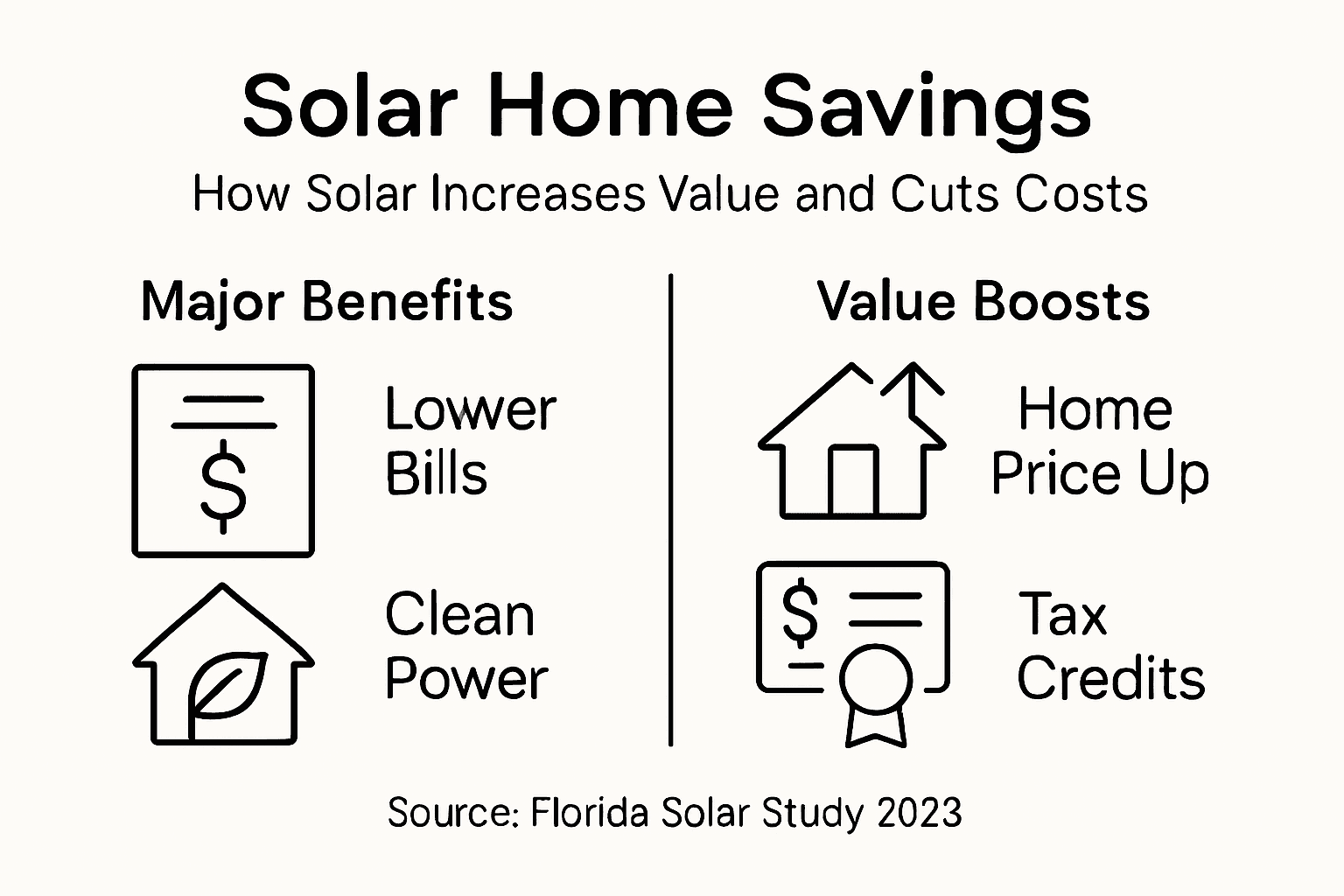
The payback period is where most conversations start. If your system costs $25,000 installed and your annual savings are $1,000, you’re looking at a 25-year payback. That sounds long until you consider the federal tax credit. Subtract the $7,500 credit from your cost, bringing it to $17,500. Add Florida’s sales tax exemption worth roughly $2,000, and your true out-of-pocket cost drops to $15,500. Now your payback period is 15 years. Many Florida homeowners complete payback in 7 to 12 years, depending on their specific system size, electricity rates, and available incentives. After that payback period, you’re generating essentially free electricity for the remaining system life. The average American home keeps solar panels producing for 25 to 30 years, though panels often function beyond that with slightly reduced efficiency. Think of it this way: you make an investment today that pays for itself by the time your youngest child finishes high school, then generates free power for the next decade.
Property value increases represent a second financial benefit that homeowners often overlook. Home solar installations can increase property values as buyers recognize the long-term energy cost savings. Real estate research consistently shows that homes with solar sell faster and often command higher prices. The increase typically ranges from $15,000 to $25,000 depending on system size and local real estate markets. Here’s the crucial part: you capture the full value when you sell. Unlike many home improvements that lose value proportional to their cost, solar systems add almost dollar-for-dollar value in hot Florida markets where electricity costs are already high. A buyer looking at two identical homes will choose the one with lower projected energy bills. They’re essentially paying for 25 years of your future savings. If you sell within 10 years, the property value increase often exceeds the remaining unpaid balance on your solar loan. Even better, Florida’s homestead exemption laws mean solar installation doesn’t trigger a property tax reassessment, so you gain value without paying increased property taxes.
Calculating your specific savings requires accounting for a few personal variables. Your current electricity usage determines system size. Your roof orientation and shading situation affect how much your panels actually produce. Your electricity rate determines the dollar value of that production. Florida’s average residential electricity rate is roughly 14 to 16 cents per kilowatt-hour, which is higher than the national average of 13 cents. That makes Florida an exceptionally good state for solar economics. If you use 1,000 kilowatt-hours monthly, that’s $1,400 to $1,600 yearly, making solar especially attractive. A professional solar assessment uses your specific address, your recent electricity bills, roof measurements, and local weather data to predict your exact annual production and annual savings. They’ll show you a year-by-year projection accounting for panel degradation (typically 0.5 percent annually) and inflation in electricity rates.
Here’s another savings mechanism many people miss: net metering credits. When your panels generate more electricity than you’re using, it flows back to the grid. Your utility company credits your account dollar-for-dollar for that power. During Florida’s sunny peak hours in spring and fall, you might generate 50 percent excess. Those credits roll over monthly, covering night and winter hours when production drops. This net metering benefit effectively acts as a free battery, storing excess value in your utility account rather than in expensive physical batteries.
Pro tip: Request a detailed 25-year cash flow projection from your solar installer that shows annual savings, accounts for Florida’s average 2.5 percent electricity rate increases, and breaks down the federal tax credit impact on your specific tax situation.
Comparing solar with traditional energy options
When you’re evaluating solar for your Florida home, the comparison isn’t just about cost per kilowatt-hour. It’s about predictability, long-term trends, and what happens to your household budget over decades. Traditional grid electricity from fossil fuels has one fundamental problem: the price never stays still. Over the past 20 years, Florida’s residential electricity rates have climbed roughly 2.5 to 3 percent annually. That means if you’re paying $150 monthly now, you’ll be paying $250 monthly in 20 years on the same usage. Solar eliminates that uncertainty. Your electricity production is flat, your payment is fixed, and you’re protected from rate increases. Utility companies have no control over the sun’s output, so they can’t charge you more for generating your own power.
Solar energy produces no greenhouse gases during operation and relies on a virtually unlimited resource, unlike fossil fuels that face supply constraints and geopolitical risks. Here’s what most homeowners don’t think about: when you buy grid electricity, you’re buying power generated somewhere else using natural gas, coal, or nuclear energy. That power travels through transmission lines with losses, and you pay for the infrastructure costs of maintaining those lines. Solar bypasses all that complexity. The sun shines on your roof, you convert it to electricity right where you use it, and you eliminate transmission losses. When power plants increase operational costs or fuel prices spike, you’re insulated. Fossil fuel prices are influenced by global markets, supply chains, and political instability. Solar’s operating costs are essentially zero once installed. No fuel to purchase, no supply chain to disrupt, no future price shocks.
Reliability often comes up as a concern with solar, and it’s worth addressing directly. Fossil fuel plants do generate power 24/7, while solar only generates during daylight hours. But here’s the practical reality: Florida’s grid already balances solar with other generation sources. During peak sunshine hours, solar reduces grid demand significantly, meaning less fossil fuel generation is needed. At night and cloudy periods, you draw from the grid or from battery backup if you’ve installed storage. The combination of grid-tied solar and smart energy storage systems provides genuinely reliable power. A home with grid-tied solar plus battery backup achieves better reliability than a home dependent solely on aging grid infrastructure. During hurricanes and storms, grid-dependent homes lose power when transmission lines fail. Solar homes with batteries keep functioning. From a Florida perspective, that reliability benefit is genuine and valuable.
The economic comparison becomes increasingly favorable for solar every year. Installation costs have dropped 70 percent in the past decade, while electricity rates continue climbing. Fossil fuel plants require constant maintenance and fuel purchases, driving operating costs that utilities pass to customers. Solar requires minimal maintenance after installation, with panel cleaning and occasional inverter servicing being the primary expenses. Renewable energy reduces dependency on imports and contributes to environmental benefits while traditional fossil fuels create ongoing extraction, transportation, and disposal costs that aren’t fully reflected in your electric bill. When you calculate the true cost including environmental impact and infrastructure maintenance, solar becomes dramatically more economical.
Here’s the timeline perspective that matters for Florida homeowners. You’re not choosing between solar and fossil fuels for just this year. You’re making a choice that affects your household budget for decades. Over 25 years, a Florida household might spend $45,000 to $60,000 on grid electricity at current rates with historical price increases factored in. With solar, that same household spends $15,000 to $20,000 after tax credits and incentives, generating most electricity themselves. That’s a $25,000 to $40,000 difference in your household’s lifetime energy spending. Even if you move in ten years, the property value increase from solar typically recovers your remaining system investment. If you stay longer, the financial advantage becomes enormous. Fossil fuel dependence locks you into increasingly expensive electricity costs. Solar locks in your energy independence and cost control.
Compare long-term costs and benefits of solar energy versus traditional fossil fuel electricity in Florida:
| Factor | Solar Energy | Traditional Electricity |
|---|---|---|
| Rate Predictability | Fixed cost after install | Rates rise 2.5–3% yearly |
| Environmental Impact | Zero operational emissions | Ongoing fossil fuel emissions |
| Maintenance Costs | Minimal, cleaning and servicing | Utility infrastructure upkeep |
| Lifetime Energy Spending | $15k–$20k (25 yrs, incentives) | $45k–$60k (25 yrs, rising rates) |
| Resilience During Storms | Battery backup enables power | Grid dependent, outages common |
Pro tip: Request a historical electricity bill analysis from your solar installer showing your rate increases over the past five years, then ask them to project your costs over the next 25 years with and without solar to visualize your true financial comparison.
Unlock the Full Potential of Solar Energy for Your Florida Home
If you are concerned about rising electricity costs, maximizing your property’s value, and securing reliable energy during Florida’s unpredictable weather, then embracing solar energy is the smart solution. This article highlights the challenges you may face like navigating confusing tax credits, understanding system types, and ensuring your solar panels withstand hurricane seasons. At PES Solar, we specialize in addressing these exact concerns by providing expertly designed solar panel installations, efficient battery backups like Tesla Powerwall, and tailored financing options that make going solar affordable for you.
Solar power is more than just an environmental choice—it is a powerful way to gain energy independence and substantial long-term savings without worrying about fluctuating utility rates. With over 230 days of sunshine annually, Florida homeowners can fully capitalize on this clean energy source. Our certified team will guide you through everything from initial free estimates to answering questions about net metering and system performance under local weather conditions.
Ready to save thousands while increasing your home’s value and safety? Discover how PES Solar can transform your energy experience today. We understand Florida’s unique solar landscape and are committed to providing personalized solutions that fit your lifestyle and budget. Take action now to lock in federal tax credits before they reduce, enjoy state sales tax exemptions, and benefit from customized systems designed for maximum output and durability.
Harness the sun where it shines brightest by visiting PES Solar and requesting your free consultation.
Don’t wait for next year’s rising electric bills to force your hand. Join thousands of Florida homeowners who have made the switch with PES Solar. Schedule your free estimate today and start your journey toward clean, affordable, and reliable solar energy.
Frequently Asked Questions
What are the main benefits of installing solar panels in Florida?
Installing solar panels in Florida can significantly reduce your electricity bills, increase your home’s value, and provide energy independence. With over 230 days of sunshine annually, Florida homeowners can maximize solar energy production, potentially eliminating 70-90% of electricity costs.
How do solar panels work during cloudy or stormy weather?
Solar panels generate electricity even on cloudy days, although their efficiency decreases. In Florida, even during afternoon thunderstorms, panels can continue producing energy, ensuring you don’t lose power entirely.
What types of solar systems are available for homes?
There are mainly two types of solar systems: grid-tied systems, which connect to the utility grid and allow for net metering, and off-grid systems, which operate independently and use battery storage. Hybrid systems combine elements of both.
How can federal tax credits and incentives reduce the cost of solar installation?
The federal Investment Tax Credit (ITC) allows homeowners to claim 30% of the installation costs as a tax credit against federal income taxes. Additionally, Florida offers a sales tax exemption on solar equipment, further lowering out-of-pocket expenses.
Recommended
- Why Go Solar In Florida: Real Savings And Value
- Solar Energy In Florida: Benefits And Costs
- Why Choose Solar Panels For Florida Homes
- Solar Power For Homes: Cost Savings And Energy Freedom
- Solar-Shark | Premium Solar-Leads kaufen | Test-Leads & Top-Qualität
- Solar Panel Installation Tampa FL
- Solar Panel Installation Orlando FL
