
Florida receives over 230 sunny days each year, yet many homeowners and business owners still question whether solar energy truly delivers on its promises. The truth is, Florida’s climate and geographic position create ideal conditions for solar power generation, translating into substantial cost savings and long-term property value gains. This article breaks down the real numbers behind solar in Florida, from regional energy output differences to financial payback periods, federal incentives, and the state’s rapidly expanding solar capacity. You’ll discover how solar systems withstand hurricanes, how net metering works to your advantage, and why Florida’s energy landscape is shifting dramatically toward renewable sources by 2034.
Table of Contents
- Florida’s Abundant Solar Potential: What Makes It Future-Ready
- Significant Cost Savings And Property Value Increases
- Incentives, Net Metering, And Resilience: Solar’s Practical Advantages In Florida
- Florida’s Solar Growth And Future Energy Landscape
- Ready To Embrace Solar Energy For Your Florida Property?
Key takeaways
| Point | Details |
|---|---|
| High solar irradiance | Florida’s climate delivers 4.5 to 5.5 peak sun hours daily, maximizing energy production year-round. |
| Significant bill savings | Homeowners reduce electricity costs by 40 to 90 percent with payback periods under 12 years. |
| Property value boost | Solar installations increase home values by approximately 4 percent on average. |
| Strong incentives | The 30 percent federal tax credit and net metering policies enhance affordability and return on investment. |
| Rapid capacity growth | Solar is projected to supply nearly 30 percent of Florida’s energy by 2034, up from 8 percent today. |
Florida’s abundant solar potential: what makes it future-ready
Florida’s geographic location and subtropical climate create exceptional conditions for solar energy generation. The state receives 230+ sunny days and 4.5 to 5.5 peak sun hours daily, with regional output variance from 1390 to 1530 kWh/kWp annually. This consistent sunlight exposure means solar panels operate at high efficiency throughout the year, converting abundant natural resources into measurable electricity savings.
Regional differences across Florida affect total energy production. Pensacola in the Panhandle sees slightly lower annual output compared to Fort Myers on the Gulf Coast, yet both locations generate enough electricity to offset most residential and commercial energy needs. Understanding these regional variations helps you set realistic expectations for system performance and financial returns.
The table below illustrates how peak sun hours and expected annual output vary across major Florida regions:
| Region | Peak Sun Hours (Daily) | Expected Output (kWh/kWp/Year) |
|---|---|---|
| Pensacola | 4.5 to 4.8 | 1390 to 1450 |
| Jacksonville | 4.7 to 5.0 | 1420 to 1480 |
| Tampa | 5.0 to 5.3 | 1470 to 1510 |
| Fort Myers | 5.2 to 5.5 | 1500 to 1530 |
Several factors beyond geography influence solar panel performance. Panel orientation, tilt angle, shading from trees or buildings, and regular maintenance all play critical roles in maximizing energy yield. Dust, pollen, and salt spray from coastal areas can accumulate on panels, reducing efficiency if not cleaned periodically.
Pro Tip: Schedule professional panel cleaning twice yearly in coastal areas and annually inland to maintain optimal energy production. Proper orientation toward true south and a tilt angle matching your latitude maximizes exposure to direct sunlight.
Florida’s solar irradiance advantage positions the state as a leader in renewable energy adoption. The combination of natural resources and technological advancements makes solar a practical, future-ready choice for homes and businesses seeking energy independence and cost reduction. As installation costs continue declining and efficiency improves, the financial case for solar strengthens further.
Understanding your specific location’s solar potential allows you to calculate expected system performance and savings accurately. Regional data, combined with your property’s unique characteristics, provides the foundation for informed decision making about solar investment. This knowledge transitions naturally into examining the concrete financial benefits solar delivers.
Significant cost savings and property value increases
Solar energy systems deliver measurable financial returns through reduced electricity bills and increased property values. Homeowners save 40 to 90 percent on bills, with payback periods ranging from 9 to 12 years and system lifespans exceeding 25 years. These numbers translate into decades of near-zero electricity costs after the initial investment recovers.
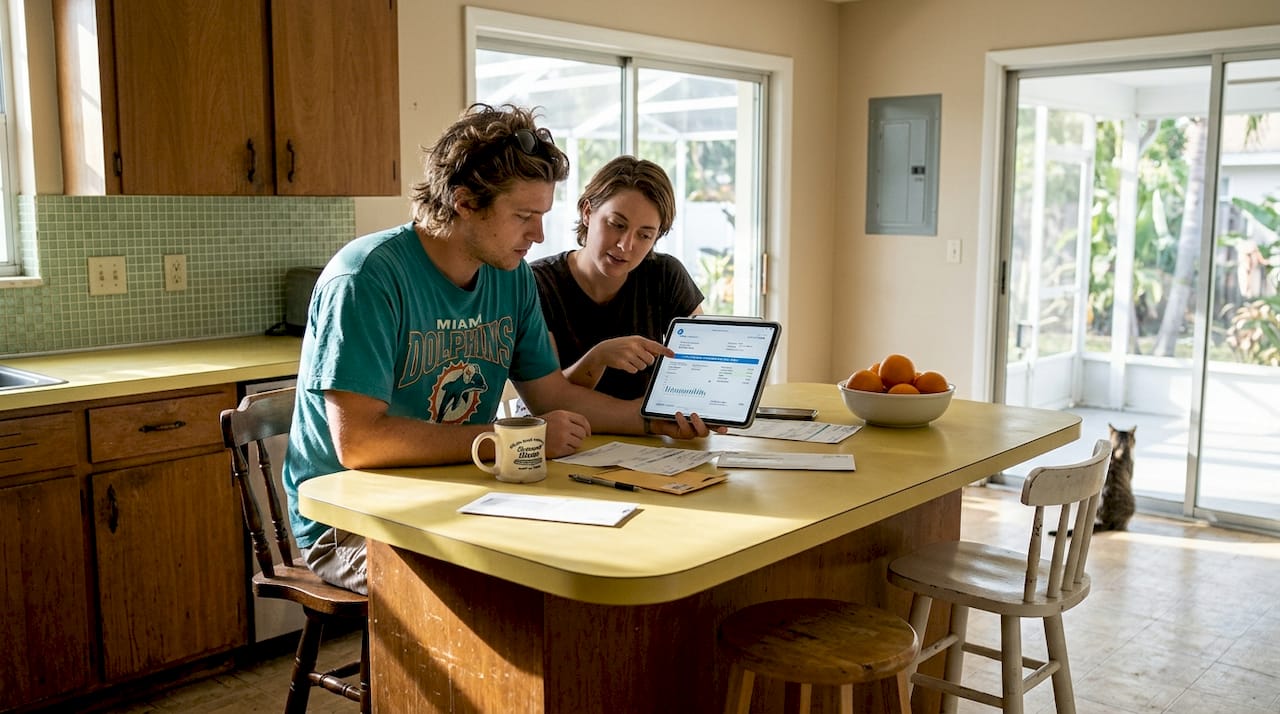
The percentage of savings depends on several variables. A larger system offsets more energy consumption, while a smaller installation provides partial coverage. Your current electricity usage, local utility rates, and system size all factor into the final savings calculation. Homes with high air conditioning demands during Florida’s long summers see particularly strong returns.
Property values receive a substantial boost from solar installations. Research shows homes with solar panels sell for approximately 4 percent more than comparable properties without solar. This increase reflects buyers’ recognition of lower operating costs and energy independence benefits. Commercial properties experience similar value appreciation, making solar an attractive investment for business owners.
Several key factors determine your actual savings and payback timeline:
- System size and capacity relative to your energy consumption patterns
- Local electricity rates and projected rate increases over time
- Available federal, state, and utility incentives reducing upfront costs
- Installation quality affecting long-term performance and maintenance needs
- Financing terms if you choose loans over cash purchases
The financial picture improves further when considering electricity rate trends. Utility costs historically increase 2 to 3 percent annually, while your solar system’s cost remains fixed after installation. This rate lock protects you from future price volatility and compounds savings over the system’s lifespan.
Solar installations in Florida typically reduce energy bills by 40 to 90 percent, achieve payback in 9 to 12 years, operate effectively for 25+ years, and increase property values by approximately 4 percent.
Maintenance costs remain minimal for solar systems. Most panels carry 25-year performance warranties, and inverters typically last 10 to 15 years before replacement. Annual inspections and occasional cleaning represent the primary ongoing expenses, far less than continued utility bills without solar.
The combination of immediate bill reduction, long-term savings, and property value gains creates a compelling financial case. For residential solar adoption, these benefits align with broader environmental goals while delivering tangible economic returns. Business owners find similar advantages, with solar systems reducing operating costs and demonstrating corporate sustainability commitments.
Calculating your specific return on investment requires analyzing your current energy usage, available roof space, and local incentives. Professional assessments provide accurate projections based on your property’s unique characteristics. This financial foundation sets the stage for exploring how incentives and resilience features enhance solar’s practical advantages.
Incentives, net metering, and resilience: solar’s practical advantages in Florida
Federal and state incentives significantly reduce the upfront cost of solar installations. The 30 percent federal Investment Tax Credit allows you to deduct 30 percent of your total system cost from federal taxes, immediately improving return on investment. Florida offers additional benefits including property tax exemptions for solar equipment value and sales tax exemptions on solar purchases.
Net metering policies create ongoing financial benefits by crediting excess electricity your system sends back to the grid. During peak production hours, your panels often generate more power than your home or business consumes. This surplus flows to the utility grid, and you receive credits applied to future bills when you draw power at night or during cloudy periods. Net metering effectively turns your meter backward, maximizing system value.
Florida’s hurricane risk requires solar installations designed for extreme weather resilience. Modern solar systems withstand hurricane-force winds when properly installed according to High Velocity Hurricane Zone standards. Panels rated for winds up to 160 mph, combined with reinforced mounting systems, ensure your investment remains protected during severe storms.
Key resilience measures for Florida solar installations include:
- Hurricane-rated panels certified for wind speeds exceeding 140 mph
- Reinforced mounting systems with additional anchoring points
- Strategic placement avoiding areas prone to debris impact
- Professional installation following HVHZ building codes
- Regular inspections before and after hurricane season
Pro Tip: Choose installers certified in Florida’s HVHZ standards who understand local building codes and wind load requirements. Proper installation makes the difference between systems that survive hurricanes and those that sustain damage.
The combination of financial incentives and engineering resilience addresses the two primary concerns Florida property owners raise about solar. Incentives make systems affordable, while proper installation ensures long-term durability. Together, these factors eliminate major barriers to solar adoption.
Federal tax credits apply to both residential and commercial installations, making solar financing options accessible across property types. State exemptions further reduce total costs, while net metering provides ongoing returns throughout the system’s lifespan. This layered benefit structure creates multiple value streams from a single investment.
Understanding available incentives and how to maximize them requires staying current with policy changes and program deadlines. Federal credits have specific expiration dates, and utility net metering policies vary by provider. Professional installers navigate these complexities, ensuring you capture all available benefits.
Resilience features provide peace of mind beyond financial returns. Knowing your solar system can withstand Category 4 hurricanes protects your investment and maintains energy production after storms when grid power may be unavailable. Battery storage systems paired with solar offer complete energy independence during outages, a valuable capability in hurricane-prone regions.
These practical advantages, combined with Florida’s solar potential and cost savings, create a comprehensive value proposition. The state’s supportive policy environment and natural resources align to make solar increasingly attractive for homes and businesses. This foundation supports Florida’s rapid solar capacity growth and evolving energy landscape.
Florida’s solar growth and future energy landscape
Florida ranks third nationally in installed solar capacity, reflecting rapid adoption across residential, commercial, and utility-scale projects. The state’s solar share is projected to grow from 8 to 29 percent of total energy generation by 2034, surpassing earlier forecasts. This expansion positions solar as a cornerstone of Florida’s energy infrastructure alongside traditional sources.
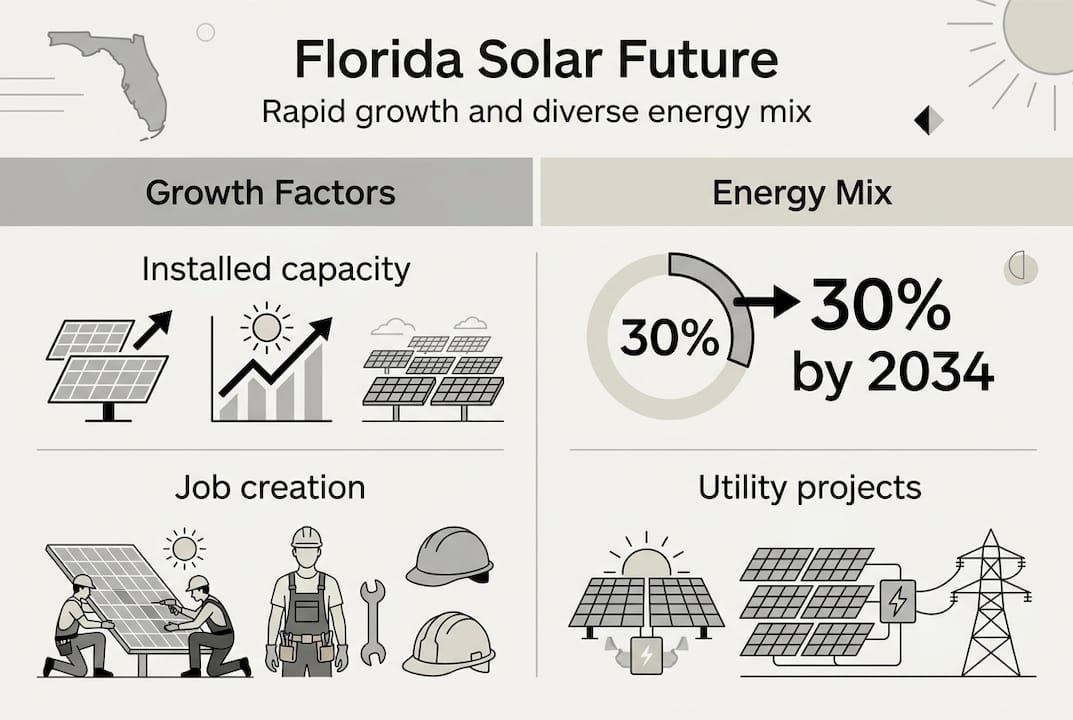
Several factors drive this accelerated growth. Solar installation costs have dropped more than 70 percent over the past decade, making systems accessible to broader markets. Public support for renewable energy continues strengthening, while technological improvements increase panel efficiency and energy storage capabilities. Policy frameworks supporting net metering and tax incentives further accelerate adoption.
Key reasons behind Florida’s solar expansion include:
- Dramatic cost reductions making solar competitive with conventional energy sources
- Strong public demand for clean energy and sustainability initiatives
- Supportive policies including federal tax credits and state exemptions
- Technological advances improving efficiency, storage, and system reliability
- Utility-scale projects adding gigawatts of capacity annually
Comparing solar to other energy sources reveals distinct advantages and complementary roles. Nuclear power offers baseload generation but requires decades to plan and construct new facilities. Natural gas provides flexible generation but exposes users to fuel price volatility. Solar deploys rapidly, scales efficiently, and locks in energy costs for 25+ years.
The table below contrasts solar with nuclear and natural gas across critical factors:
| Factor | Solar | Nuclear | Natural Gas |
|---|---|---|---|
| Deployment Speed | Months to 2 years | 10 to 15 years | 2 to 4 years |
| Cost Stability | Fixed after installation | Stable but high capital | Variable fuel costs |
| Scalability | Highly modular | Large, centralized | Moderate flexibility |
| Environmental Impact | Minimal emissions | Low emissions, waste concerns | Moderate emissions |
Florida’s energy future involves a diversified mix rather than single-source dependence. Solar’s rapid scalability and declining costs make it ideal for meeting growing demand while reducing carbon emissions. Nuclear and natural gas continue providing baseload and backup generation, creating a balanced, resilient grid.
Utility companies increasingly invest in solar projects to meet renewable energy targets and customer demand. Large-scale solar farms generate hundreds of megawatts, while distributed rooftop systems add capacity across thousands of properties. This dual approach maximizes solar’s contribution to Florida’s overall energy mix.
Projections showing solar reaching nearly 30 percent of generation by 2034 reflect conservative estimates based on current growth rates. Continued cost declines and efficiency improvements could accelerate this timeline further. Battery storage integration enhances solar’s reliability, addressing intermittency concerns and enabling 24-hour renewable energy availability.
The shift toward solar creates economic opportunities beyond energy savings. Installation jobs, manufacturing facilities, and maintenance services generate employment across Florida. Property owners benefit from reduced operating costs, while utilities meet regulatory requirements and customer preferences for clean energy.
Understanding Florida’s energy trajectory helps you make informed decisions about solar adoption in 2026. The state’s commitment to expanding renewable capacity, combined with favorable economics and natural resources, ensures solar remains a smart long-term investment. This growth pattern transforms solar from an alternative energy source into a mainstream solution.
Florida’s solar expansion demonstrates how policy support, technological progress, and market forces align to reshape energy systems. The transition benefits individual property owners through lower costs while advancing broader environmental and economic goals. This convergence of interests drives continued momentum toward a solar-powered future.
Ready to embrace solar energy for your Florida property?
The evidence clearly shows solar delivers substantial financial returns, environmental benefits, and energy independence for Florida homes and businesses. Taking the next step requires understanding installation processes, financing options, and available incentives specific to your situation. Comprehensive resources help you navigate these decisions with confidence.
Detailed installation guides for homeowners walk you through system design, permitting, and contractor selection. Understanding the installation process helps you ask informed questions and make smart choices about system size, equipment quality, and warranty coverage. Professional installers handle technical complexities while you focus on maximizing long-term value.
Exploring financing options reveals multiple paths to solar ownership, from cash purchases to loans and leases. Each approach offers distinct advantages depending on your financial situation and goals. Comparing options helps you select the structure that optimizes tax benefits, cash flow, and total return on investment.
Maximizing available incentives requires understanding federal tax credits, state exemptions, and utility programs. These benefits significantly reduce upfront costs and accelerate payback periods. Staying current with program requirements and deadlines ensures you capture every available dollar of savings.
FAQ
What factors affect solar savings in Florida?
Savings vary based on system size, energy consumption patterns, installation quality, available incentives, and your specific geographic location within Florida. Proper panel orientation, minimal shading, and regular maintenance optimize efficiency and maximize financial returns. Local utility rates and net metering policies also significantly impact total savings over the system’s lifespan.
How does net metering work for Florida homeowners?
Net metering credits excess electricity your system generates back to the utility grid, reducing your monthly bills. When your panels produce more power than you consume, the surplus flows to the grid and you receive credits applied during periods of lower production or higher usage. This arrangement effectively allows you to bank solar energy, enhancing overall system value and return on investment.
Can solar panels withstand Florida hurricanes?
Solar panels designed for Florida installations meet High Velocity Hurricane Zone wind ratings up to 160 mph when properly installed. Certified installers use reinforced mounting systems with additional anchoring points to ensure panels remain secure during extreme weather events. Regular inspections and adherence to local building codes provide confidence your system will survive hurricane-force winds.
What is the typical lifespan of a solar energy system?
Solar panels typically last 25 years or more with proper maintenance, often continuing to produce electricity at reduced efficiency for decades beyond warranty periods. Inverters and battery components generally require replacement after 10 to 15 years of operation. Most manufacturers provide performance warranties guaranteeing specific output levels throughout the panel’s rated lifespan.
How is solar energy expected to shape Florida’s energy future?
Solar capacity is rapidly expanding and projected to provide nearly 30 percent of Florida’s total energy generation by 2034, up from approximately 8 percent currently. This growth reflects solar’s competitive costs, scalability, and clean energy benefits. Solar complements other energy sources in creating a diversified, resilient grid that meets growing demand while reducing environmental impact.
