
Solar energy vs grid electricity: Florida cost savings & independence 2026
Florida receives more sunshine than almost any other state, yet many homeowners and business owners continue paying rising electricity bills without tapping into this abundant resource. The confusion about upfront costs, net metering rules, and actual savings keeps countless residents locked into grid-only power, missing opportunities for energy independence and long-term financial benefits. This article delivers a clear, evidence-based comparison between solar energy and grid electricity specifically for Florida conditions in 2026. You’ll discover real costs, savings potential, permitting requirements, and practical steps to make an informed energy decision that aligns with your financial goals and independence priorities.
Table of Contents
- Solar Energy Vs Grid Electricity: Florida Cost Savings & Independence 2026
- Understanding Solar Energy And Grid Electricity In Florida
- Comparing Costs: Solar Installation Versus Grid Electricity Expenses
- Energy Independence And Reliability: What Florida Solar Users Should Know
- Steps To Choose Between Solar Energy And Grid Electricity In Florida
- Explore Professional Solar Solutions With PES Solar
Key takeaways
| Point | Details |
|---|---|
| Installation costs | Solar installation costs average $10,400 to $13,000 after federal tax credit for typical Florida homeowner systems. |
| Net metering benefits | FPL’s net metering credits excess solar energy at full retail rates, aiding savings. |
| Minimum monthly bill | Despite solar generation, a mandatory $25 minimum monthly bill with FPL applies. |
| Long-term value | Solar energy offers potential for long-term savings and energy independence compared to grid-only. |
| Permitting essentials | Knowing permitting and interconnection requirements is critical for solar installation success. |
Understanding solar energy and grid electricity in Florida
Solar panels convert Florida’s abundant sunshine into electricity that powers your home or business while potentially reducing your monthly utility bills. Florida homeowners typically pay approximately $2.18 to $2.71 per watt of solar installed as of 2025, with an average around $2.45 per watt. A typical residential system in Florida ranges from 6 to 8 kilowatts, sized to match your energy consumption patterns and roof space.
Grid electricity comes from Florida Power & Light and other utilities through traditional power plants, delivered via transmission lines to your property. You pay for every kilowatt-hour you consume, with rates subject to fuel adjustments and regulatory changes. Most Florida residents rely exclusively on grid power, paying monthly bills that fluctuate with usage and seasonal demand.
FPL operates a full retail net metering program that credits excess solar generation at retail rates. When your panels produce more electricity than you use, the surplus flows back to the grid and appears as a credit on your bill. These credits roll forward month to month and reconcile annually in January, helping offset electricity costs during periods when your system produces less energy.
Even with solar panels generating all your electricity needs, FPL customers still pay a mandatory $25 minimum monthly bill that solar cannot offset. This charge covers grid connection, infrastructure maintenance, and administrative costs. Understanding this non-offsettable fee helps you calculate realistic savings when comparing solar to grid-only scenarios.
Before your solar system can generate power, you must navigate Florida’s permitting and interconnection process. This includes obtaining FPL pre-approval, securing building permits from your local jurisdiction, passing electrical and structural inspections, and completing an interconnection agreement. Only after these steps can your system legally connect to the grid and begin producing energy credits under rules for solar panels in Florida.
Key terms you’ll encounter:
- Net metering: A billing mechanism crediting solar system owners for electricity they add to the grid
- Interconnection: The physical and contractual connection between your solar system and the utility grid
- Tax credit: A dollar-for-dollar reduction in federal income taxes owed based on solar installation costs
Pro Tip: Size your system to produce slightly less than your annual consumption to maximize net metering benefits without generating excess credits that expire at true-up. Work with your installer to analyze 12 months of usage data and account for future consumption changes.
The federal solar incentives in Florida significantly reduce upfront costs, making solar more accessible to homeowners and businesses evaluating energy alternatives. This 30% investment tax credit applies to the total system cost including equipment, labor, and permitting fees, delivering substantial savings that improve your return on investment.
Comparing costs: solar installation versus grid electricity expenses
A typical 6.84 kilowatt residential solar system in Florida costs between $14,900 and $18,500 before incentives, based on the $2.18 to $2.71 per watt range. This upfront investment covers panels, inverters, mounting hardware, electrical components, labor, permitting, and interconnection fees. The price varies depending on equipment quality, roof complexity, and installer experience.
After applying the 30% federal solar tax credit, the effective cost drops to around $10,400 to $13,000 for a 6.84 kW system. This tax credit reduces your federal income tax liability dollar for dollar, not as a deduction but as a direct credit. You claim it when filing taxes for the year your system becomes operational, significantly improving the financial case for solar adoption.
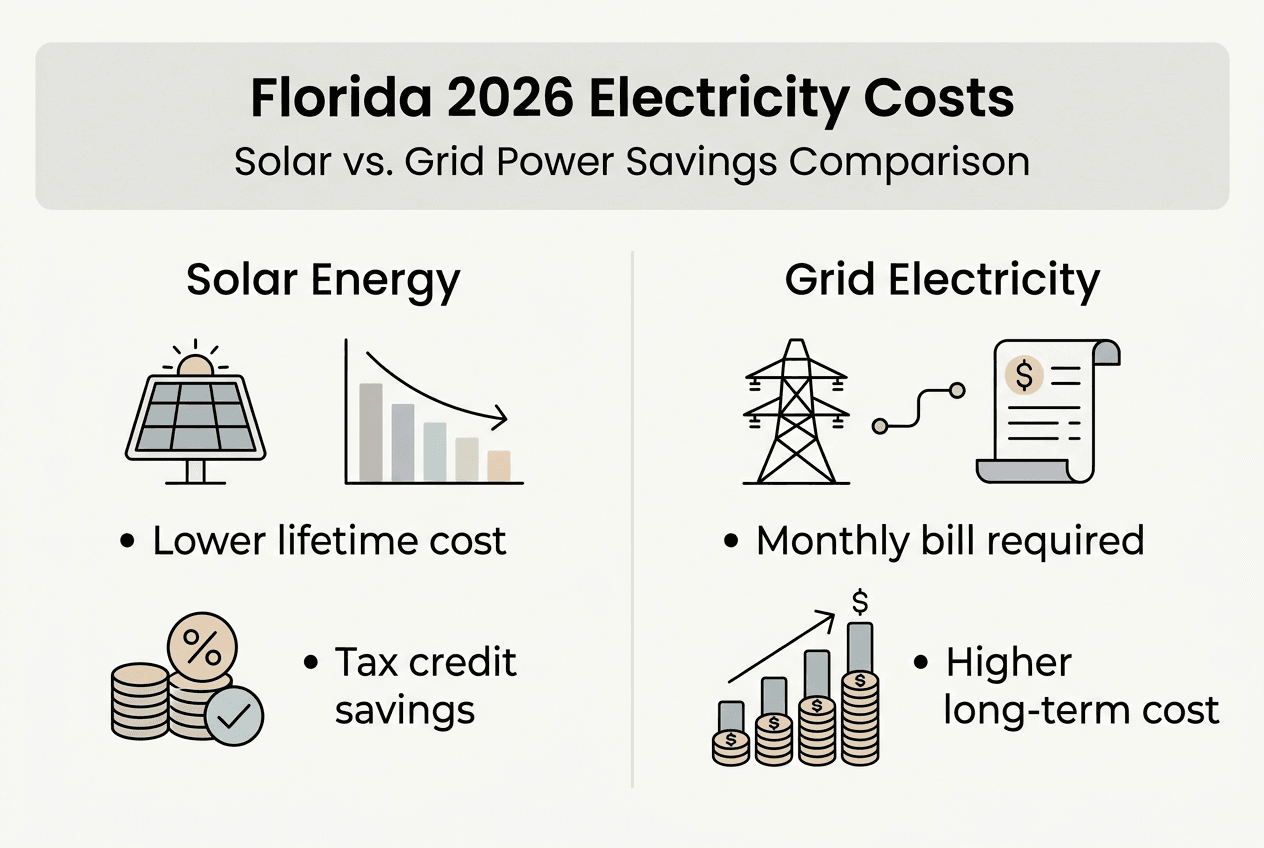
Grid electricity costs in Florida average $0.12 to $0.14 per kilowatt-hour depending on your utility, rate plan, and consumption tier. A typical Florida household consuming 1,100 kilowatt-hours monthly pays approximately $130 to $155 in electricity charges before taxes and fees. Over 25 years, the typical lifespan of solar panels, grid-only electricity costs total $39,000 to $46,500 without accounting for rate increases.

All FPL customers face a minimum monthly bill of $25 that solar cannot offset, regardless of generation levels. This mandatory charge means even perfect solar production leaves you with $300 annually in unavoidable utility costs. Factor this into your savings calculations when comparing solar to grid-only scenarios over your system’s lifetime.
Here’s how costs compare over a 25-year period:
| Scenario | Upfront Cost | Annual Electricity Cost | 25-Year Total | Notes |
|---|---|---|---|---|
| Grid only | $0 | $1,560 to $1,860 | $39,000 to $46,500 | Assumes no rate increases |
| Solar with net metering | $10,400 to $13,000 | $300 (minimum bill) | $17,900 to $20,500 | Includes upfront cost plus minimum bills |
| Solar with 3% rate increases | $10,400 to $13,000 | $300 (minimum bill) | $17,900 to $20,500 | Grid savings increase with rate hikes |
The payback period for solar in Florida typically ranges from 7 to 10 years depending on your electricity usage, system size, and financing method. After payback, your system generates essentially free electricity minus the $25 monthly grid connection fee. Homeowners who stay in their properties long-term realize the greatest financial benefits from solar investment.
Pro Tip: Calculate your specific payback period by dividing your net system cost after tax credits by your annual electricity savings. If you pay $12,000 after incentives and save $1,500 yearly on electricity, your payback period equals 8 years. Everything beyond that point represents pure savings.
Financing options affect your total cost and monthly cash flow. Cash purchases deliver the best return but require significant upfront capital. Solar loans spread costs over time while preserving tax credit eligibility, though interest adds to total expense. Leases and power purchase agreements require no money down but transfer tax credits and long-term savings to the financing company.
Understanding solar panel installation costs in Florida helps you budget accurately and compare quotes from multiple installers. Request detailed proposals breaking down equipment, labor, permitting, and warranty costs. Verify that quotes include the federal solar tax credit Florida residents can claim to reduce effective system price.
Energy independence and reliability: what Florida solar users should know
Full retail net metering supports partial energy independence by crediting surplus solar output at the same rate you pay for grid electricity. During sunny days when your panels produce more than you consume, excess energy flows to the grid and builds credits. At night or on cloudy days, you draw from the grid using accumulated credits, effectively storing energy financially rather than physically.
FPL customers still pay a minimum monthly fee which limits full grid independence even with perfectly sized solar systems. You remain connected to the utility infrastructure, bound by interconnection agreements and subject to net metering policy changes. True energy independence requires battery storage to disconnect from the grid entirely, though this dramatically increases upfront costs and complexity.
Solar battery storage systems like Tesla Powerwall store excess daytime production for use during evening hours or power outages. Batteries provide backup power when the grid fails, something standard grid-tied solar cannot deliver due to safety requirements that shut down panels during outages. Adding batteries increases your self-consumption ratio, reducing reliance on grid electricity and net metering credits.
Here’s how different configurations compare:
| Configuration | Energy Independence | Backup Power | Grid Reliance | Cost Level |
|---|---|---|---|---|
| Grid only | None | None during outages | Complete | Lowest upfront |
| Solar with net metering | Partial (credits offset usage) | None during outages | High (for nighttime) | Medium upfront |
| Solar with battery | High (stores excess production) | Yes during outages | Low (emergency only) | Highest upfront |
| Off-grid solar with battery | Complete | Yes (system dependent) | None | Highest plus oversizing |
Key reliability factors for Florida solar users:
- Weather impacts: Cloudy days and storms reduce solar production, requiring grid backup or stored energy
- Power outages: Standard grid-tied systems shut down during outages for safety, eliminating solar power unless you have batteries
- FPL policies: Net metering rules can change, affecting credit values and payback calculations
- System maintenance: Panels require occasional cleaning and inverters may need replacement after 10 to 15 years
- Hurricane resilience: Modern panels withstand high winds, but falling debris and extended outages challenge solar-only setups
Pro Tip: Set realistic expectations about solar’s ability to provide off-grid functionality in Florida. Without batteries, you remain dependent on the grid for nighttime power and backup during outages. Budget for battery storage if energy security during hurricanes and grid failures ranks high in your priorities.
Grid electricity offers guaranteed availability regardless of weather, time of day, or equipment failures. Utilities maintain infrastructure, handle repairs, and provide customer service without requiring homeowner involvement. This convenience comes at the cost of perpetual monthly bills and vulnerability to rate increases beyond your control.
Exploring options like adding batteries to grid-tied solar enhances energy independence while maintaining grid connection for extended cloudy periods. The Tesla Powerwall for Florida provides 13.5 kilowatt-hours of storage, enough to power essential loads during typical outages or shift solar production from day to night.
Steps to choose between solar energy and grid electricity in Florida
Making an informed energy decision requires systematic evaluation of your current situation, available options, and long-term goals. Follow these steps to determine whether solar, grid electricity, or a hybrid approach best serves your needs.
-
Assess your current electricity usage and monthly costs by reviewing 12 months of utility bills to identify consumption patterns, seasonal variations, and total annual kilowatt-hours. Calculate your average monthly payment and note any rate tier changes or time-of-use charges that affect your bill.
-
Research solar installation options, costs, and local contractors by requesting quotes from at least three certified installers in your area. Compare equipment brands, warranty terms, installation timelines, and customer reviews to identify reputable providers with Florida-specific experience.
-
Apply for FPL pre-approval and understand permitting requirements before signing any installation contract. Your installer typically handles this process, but verify that all necessary applications, inspections, and interconnection agreements are included in your contract.
-
Evaluate available federal tax credits and financing options in Florida to determine how incentives affect your net cost and cash flow. The 30% federal tax credit significantly reduces upfront investment, while loans, leases, and power purchase agreements offer different financial structures suited to various situations.
-
Calculate estimated payback period using solar energy savings projections based on your actual consumption data and local electricity rates. Factor in the $25 monthly minimum bill, potential rate increases, and system degradation over time to create realistic financial models.
-
Decide on adding battery storage for greater energy independence if backup power during outages or maximizing self-consumption ranks high in your priorities. Compare costs and benefits of battery systems against your budget and energy security needs.
The legal and practical steps from application through activation involve multiple parties and checkpoints. Your installer submits pre-approval paperwork to FPL, applies for local building permits, schedules inspections after installation, and coordinates final interconnection approval. This process typically takes 4 to 12 weeks depending on jurisdiction workload and inspection availability.
Understanding your home solar installation guide helps you prepare for each phase and set realistic expectations about timelines and requirements. Familiarize yourself with solar financing options Florida residents can access to fund installation without depleting savings or taking on unfavorable loan terms.
Verify that your chosen installer handles all aspects of the solar panel rules Florida requires, including structural engineering certifications for roof-mounted systems, electrical permits for inverter and panel connections, and interconnection agreements with your utility. Mistakes or omissions in this process delay activation and create frustration.
Consider your long-term plans for the property when deciding between solar and grid-only electricity. If you plan to sell within 5 years, solar may not reach payback before you move, though it can increase property value and appeal to buyers. Homeowners planning to stay 10 or more years typically realize the greatest financial benefits from solar investment.
Explore professional solar solutions with PES Solar
Navigating Florida’s solar landscape requires expertise in system design, permitting, installation, and utility interconnection. PES Solar brings comprehensive knowledge of Florida conditions, FPL requirements, and proven installation practices to help you transition from grid dependence to energy independence. Our team handles every detail from initial site assessment through final system activation.
Access our detailed solar panel installation guide to understand each phase of the process and what to expect during your solar journey. Explore solar financing options explained to identify payment structures that maximize your savings while fitting your budget. Our solar installation steps guide walks you through permitting, inspection, and interconnection requirements specific to Florida installations. Take the next step toward lower energy bills and greater energy independence by partnering with experienced professionals who understand Florida’s unique solar opportunities and regulatory environment.
FAQ
Is solar better than grid electricity for homeowners in Florida?
Solar offers long-term savings and energy independence despite upfront costs, with typical payback periods of 7 to 10 years in Florida. After payback, you generate essentially free electricity for 15 or more years minus the $25 monthly grid connection fee. Grid electricity requires no upfront investment but costs $39,000 to $46,500 over 25 years without rate increases, making it more expensive long-term for homeowners staying in their properties.
How does net metering work with FPL for solar customers?
Excess solar energy is credited at retail rates and carried forward monthly under FPL’s full retail net metering program. Credits accumulate when your system produces more than you consume, then offset usage during periods of lower production. Credits are reconciled annually at a true-up in January, with any remaining balance expiring rather than being paid out, which helps reduce electricity bills but does not eliminate fixed monthly charges.
What permits and approvals are needed before installing solar in Florida?
FPL pre-approval is mandatory before installation begins, and all permitting, inspections, and interconnection agreements must be submitted before system activation. Local building permits verify structural and electrical safety, while utility interconnection approval ensures your system meets grid connection standards. These requirements protect homeowners and utility infrastructure, making professional installer assistance valuable for navigating the process efficiently.
Can solar panels power my home during a power outage?
Standard grid-tied solar systems shut down during power outages for safety reasons, preventing your panels from energizing utility lines while repair crews work. Adding battery storage enables backup power during outages by storing excess daytime production and disconnecting from the grid when it fails. Battery systems like Tesla Powerwall provide 13.5 kilowatt-hours of storage, enough to power essential loads for several hours or days depending on your consumption and solar production during the outage.
