
Sorting through stacks of electricity bills can feel tedious, but every line reveals part of your home’s energy story. For Florida homeowners, understanding how local weather swings, utility rates, and solar incentives shape your consumption opens the door to smarter savings. This guide walks you through gathering usage data, discovering available incentives, and using trusted tools like the PVWatts Calculator to plan a solar system that fits your needs and maximizes financial returns.
Table of Contents
- Step 1: Gather Your Home’s Energy Usage Details
- Step 2: Research Local Solar Rates And Incentives
- Step 3: Calculate Projected Solar System Output
- Step 4: Compare Estimated Solar Bills With And Without Panels
- Step 5: Verify Your Solar Savings With Reliable Tools
Quick Summary
| Key Insight | Explanation |
|---|---|
| 1. Collect 12 Months of Bills | Gather electricity bills from the past year to analyze consumption patterns accurately. |
| 2. Research Incentives Thoroughly | Understand available state, federal, and utility-specific solar incentives to optimize savings. |
| 3. Use PVWatts for Estimates | Input your consumption data into the PVWatts Calculator to project solar energy output accurately. |
| 4. Compare Costs with and without Solar | Analyze annual savings by comparing projected electricity bills post-solar installation. |
| 5. Verify Using Multiple Tools | Cross-check estimates with different calculators to ensure accuracy and reliability before proceeding. |
Step 1: Gather your home’s energy usage details
Your electricity bills are the goldmine for this step. They contain everything you need to understand your household’s energy consumption patterns. Spend a few minutes collecting your last 12 months of utility bills so you can see the full picture of your energy use across seasons.
Look for these key numbers on each bill:
- Kilowatt-hours (kWh) used during the billing period
- Total electricity cost for that month
- Peak usage months (typically summer in Florida due to air conditioning)
- Year-to-date consumption if your utility company lists it
Why 12 months? Florida’s weather varies dramatically between seasons. Summer months push your AC to maximum, while winter barely touches heating costs. This seasonal variation is critical for accurate solar planning.
Write down or photograph the monthly kWh usage for each bill. Calculate your average monthly consumption by adding all 12 months and dividing by 12. This number will become your baseline for solar system sizing.
Your average monthly kWh usage is the single most important number for estimating solar savings and determining system size.
If you don’t have a full year of bills, grab whatever you can find. Even 6 months gives you useful data, though 12 months is genuinely more reliable for Florida homes since cooling needs swing so dramatically with seasons.
Florida utilities like Duke Energy, FPL, and Tampa Electric all format bills slightly differently, but they all show the critical kWh number prominently. Some newer utilities offer online portals where you can download historical usage data instantly. Check your utility provider’s website to see if you can pull this information digitally.
Here’s a quick comparison of Florida’s major utility providers and their solar program features:
| Utility Provider | Net Metering Structure | Solar Rebates | Bill Access Options |
|---|---|---|---|
| Duke Energy | Credit for excess kWh sent | Occasional rebates | Online portal & mailed bills |
| Florida Power & Light | Annual billing rollover | Limited rebates | Online data downloads |
| Tampa Electric | Monthly credit applied | Local incentives | Digital and paper access |
This summary makes it easy to understand how solar benefits and utility support differ by provider.
Once you have your historical data, you’re ready to use tools like the NREL’s PVWatts calculator to estimate how much solar can offset. The calculator converts your consumption patterns into realistic solar production estimates based on Florida’s specific sunlight conditions.
You can also assess your electrical loads more thoroughly by reviewing your usage patterns and identifying which appliances and systems consume the most power. This groundwork helps your installer right-size the solar system.
Pro tip: Don’t just eyeball this—write the numbers down or take clear photos of each bill. Small errors in consumption data can swing your savings estimates by thousands of dollars, so accuracy matters here.
Step 2: Research local solar rates and incentives
Now that you understand your energy consumption, it’s time to uncover the financial incentives that can dramatically reduce your solar investment. Florida offers multiple programs designed to make solar more affordable, and missing even one can cost you thousands in savings.
Start by visiting the Database of State Incentives for Renewables & Efficiency, which provides comprehensive information on all available solar incentives, tax credits, rebates, and net metering policies specific to Florida. This resource breaks down federal, state, and utility-level programs in one searchable location.
Here’s what to specifically research:
- Federal Investment Tax Credit (ITC) currently allows you to deduct a percentage of your system cost from your federal taxes
- Net metering policies in your area, which credit you for excess electricity your system sends back to the grid
- Utility rebates offered by your specific electricity provider
- Property tax exemptions for solar installations in Florida
- State and local financing programs that may offer lower rates
Your electricity provider matters significantly here. Duke Energy, Florida Power & Light, and Tampa Electric each have different rate structures and incentive programs. Contact your utility directly or check their website for solar-specific rebates and net metering details.
Florida’s net metering policy is one of your biggest financial levers, so understanding exactly how credits work with your utility is crucial before sizing your system.
Don’t overlook the Florida Solar Energy Center research hub, which provides detailed information on solar policies and local incentives tailored to Florida homeowners. They offer guidance on navigating regional benefits and applying for programs.
Write down the key incentive amounts and eligibility requirements. Calculate your effective system cost by subtracting available incentives from the total price. This adjusted number is what actually determines your payback period and long-term savings.
Incentives change frequently, so verify information from official sources rather than relying on outdated articles. Most utility websites update their programs annually, and federal tax credit percentages can shift based on legislation.
Pro tip: Screenshot or download any incentive information you find, since programs change and website content gets updated or removed. Having documentation proves your eligibility if questions arise during installation or when claiming credits.
Step 3: Calculate projected solar system output
This step transforms your energy consumption data into realistic production estimates. Understanding how much electricity your solar system will actually generate is essential for predicting your annual savings and payback timeline.
Start with the PVWatts Calculator, which NREL designed specifically for homeowners like you. Enter your address, system size, and installation angle to get localized production estimates based on Florida’s solar irradiance patterns. The calculator accounts for seasonal variations, weather patterns, and system losses automatically.
Here’s what you’ll need to input:
- Your location (street address or coordinates)
- Estimated system size in kilowatts (start with your current kWh usage divided by your average peak sun hours)
- System orientation (roof tilt angle and direction)
- Equipment specifications like inverter efficiency and module type
- Expected system losses due to wiring, dirt, and temperature effects
The calculator shows you monthly and annual energy production projections. This output is crucial because it reveals seasonal production patterns. Florida’s winter sun angle differs from summer, affecting generation throughout the year.
Your projected system output, combined with your actual energy consumption, determines whether you’ll achieve full energy independence or partial offset.
Once you have the production estimate, compare it to your average monthly consumption. If your system produces 800 kWh monthly and you use 900 kWh, you’ll need grid electricity for about 100 kWh most months. This gap matters for sizing decisions.
For more detailed sizing calculations, review resources on solar PV system sizing methodology, which walk through factoring in local solar resources, system efficiency, and your specific energy needs.
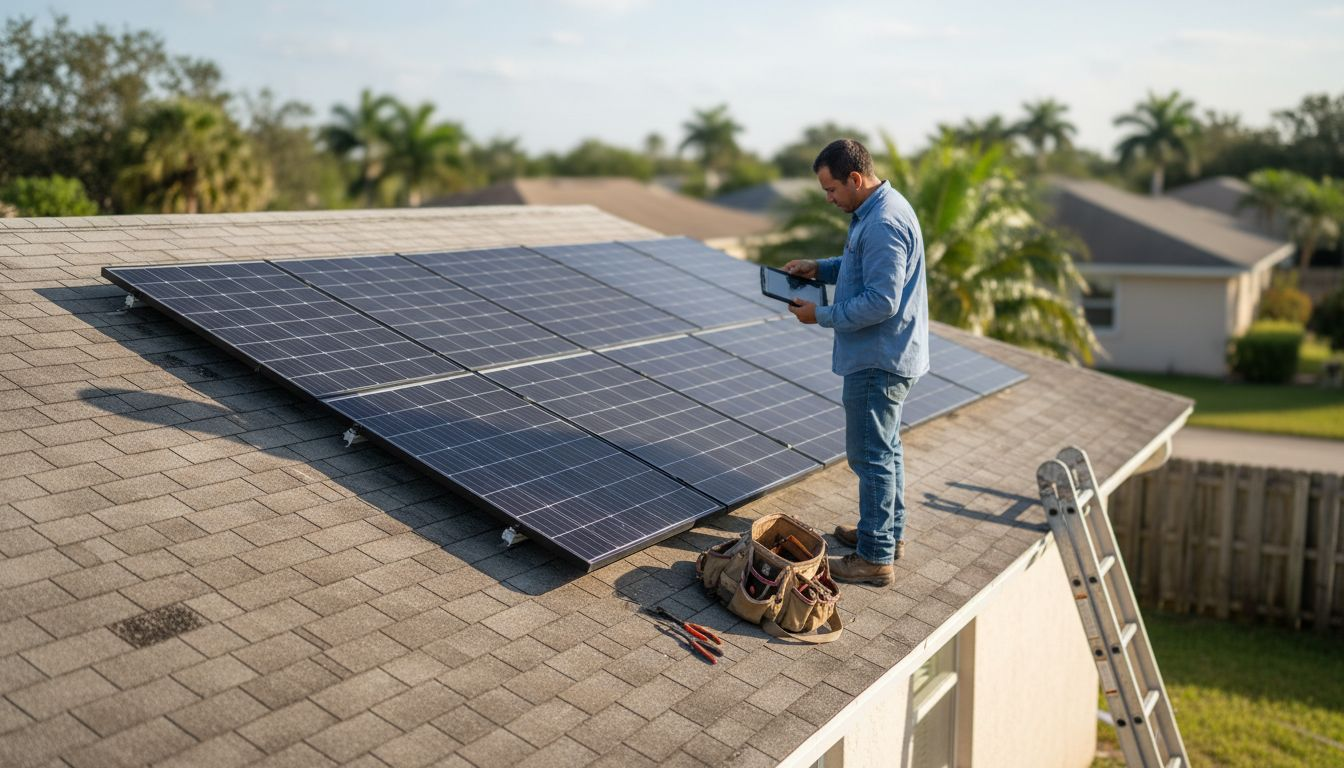
Write down both your projected output and the system size needed to achieve it. These numbers form the foundation for your final savings calculations and help your installer propose the right system configuration.
The table below highlights key factors influencing solar system sizing and savings projections:
| Factor | Impact on Sizing | Impact on Savings |
|---|---|---|
| Seasonal Energy Usage | Larger system in summer | More savings in peak |
| Roof Orientation | Higher efficiency | Increased production |
| Utility Rates | Affects payback period | Long-term savings grow |
| Incentives Available | Reduces upfront cost | Accelerates ROI |
Reviewing these influences helps set realistic expectations for your solar investment.
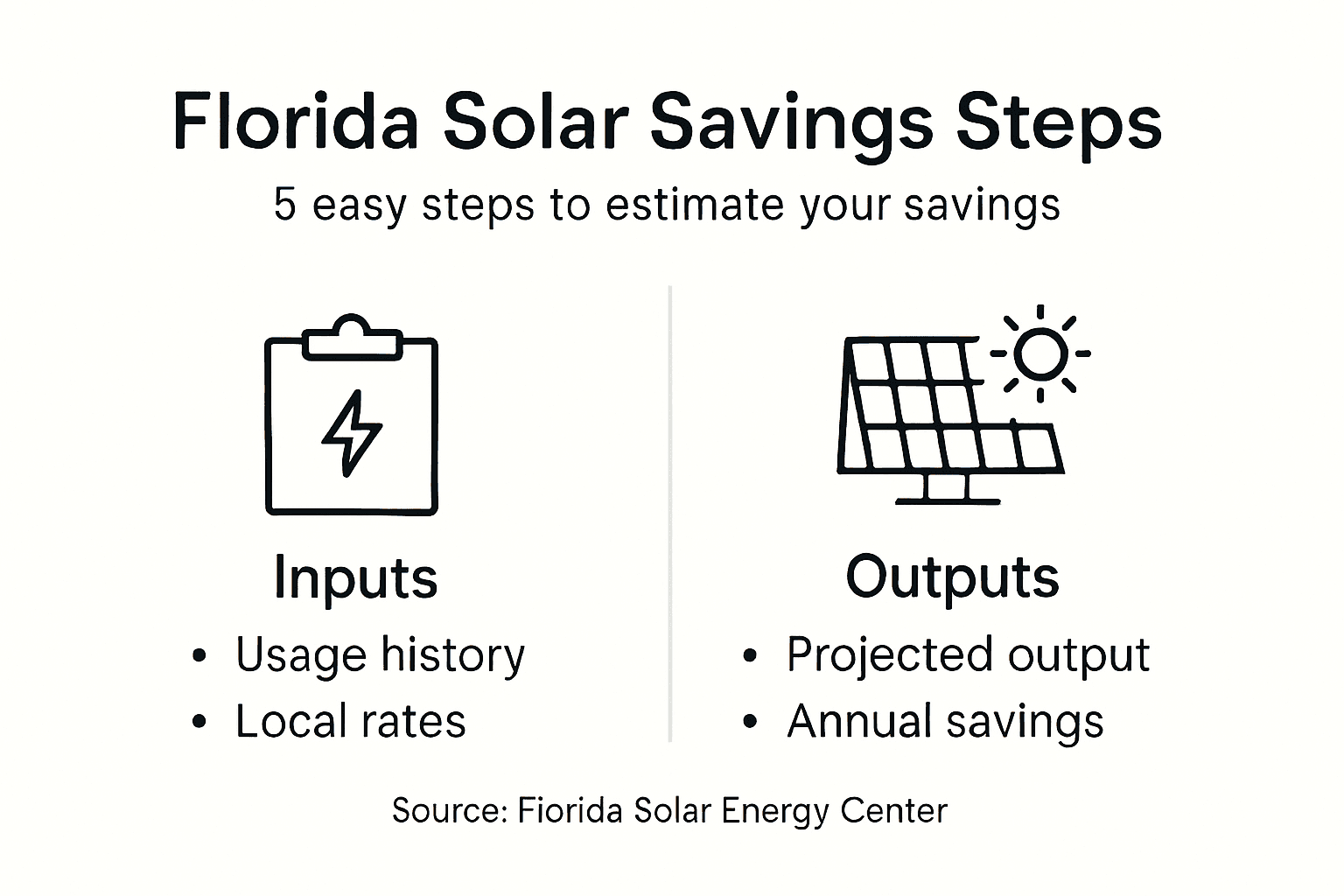
Pro tip: Run the PVWatts calculator multiple times with different system sizes—5 kW, 6 kW, 7 kW—to see how production scales and identify the sweet spot between investment cost and energy offset for your home.
Step 4: Compare estimated solar bills with and without panels
This is where the numbers become real. By comparing your current electricity bills to your projected costs after solar installation, you’ll see exactly how much money you’ll save each year and how quickly your investment pays back.
Start by using the PVWatts calculator’s cost savings feature to generate side-by-side comparisons. Input your average electricity rate from your utility bills, and the tool calculates your annual expenses both with and without solar. This comparison accounts for net metering credits, system degradation over time, and electricity rate inflation.
Here’s what to document:
- Current annual electricity cost (multiply your average monthly bill by 12)
- Projected annual cost with solar after system production offsets your usage
- Annual savings (the difference between these two figures)
- System payback period (initial cost divided by annual savings)
- 25-year lifetime savings at your projected system size
Don’t just look at the first year. Electricity rates in Florida typically increase 2 to 3 percent annually, which means your savings grow over time. A system that saves $1,200 today might save $1,400 in year five as utility rates climb.
The payback period reveals when your solar investment becomes completely free electricity, and everything after that is pure profit.
Compare multiple scenarios. Run the calculator for 5 kW, 6 kW, and 8 kW systems to see how system size affects your bottom line. Larger systems cost more upfront but generate proportionally more savings. The goal is finding the system size that maximizes your financial return within your budget constraints.
Consider the financial investment analysis for solar panels to understand whether solar makes sense as a long-term investment for your specific situation. This evaluation factors in your location, energy usage, and available incentives.
Write down your final comparison with these key numbers: current annual bill, projected annual bill with solar, annual savings, payback period, and 25-year total savings. These figures form the foundation of your decision to move forward with installation.
Pro tip: Request your utility’s historical rate increases over the past five years—this helps you project future electricity costs more accurately and reveals whether solar becomes an even better investment down the road.
Step 5: Verify your solar savings with reliable tools
Before committing to solar installation, cross-check your estimates using multiple trusted calculators. This verification step ensures your savings projections are grounded in accurate data rather than optimistic assumptions.
Use the PVWatts calculator as your primary verification tool. This NREL resource provides dependable estimates using accurate solar irradiance data and real system parameters. Run your numbers through it again, paying special attention to any variables you may have initially overlooked like roof shading or system degradation rates.
Here’s your verification checklist:
- Cross-reference at least two independent calculators to spot discrepancies
- Verify your electricity rate matches your current utility bill exactly
- Confirm system size assumptions align with your consumption data
- Check seasonal production patterns to understand month-to-month variability
- Review any assumptions about efficiency losses due to wiring, temperature, or soiling
The Florida Solar Energy Center offers region-specific simulation tools like EnergyGauge that account for Florida’s unique climate patterns. These tools help you confirm savings estimates using localized data rather than national averages.
Discrepancies between calculators often reveal important factors you missed, making verification your last line of defense against inflated savings promises.
If estimates differ significantly between tools, investigate why. One calculator might account for roof shading while another assumes full sun exposure. These details matter enormously in Florida where afternoon thunderstorms and seasonal cloud cover affect production.
Document your verification results alongside your initial calculations. This record shows you’ve done your due diligence and provides a baseline to compare against your actual results after installation.
Consider whether you want real-time solar monitoring capabilities after installation. Monitoring systems let you track actual production versus projected figures, revealing how accurate your pre-installation estimates truly were.
Once verified, your savings estimates become your decision foundation. You now have confidence that the numbers represent realistic expectations rather than sales projections.
Pro tip: Save screenshots and PDFs of all calculator outputs with timestamps and your input values clearly visible, creating an audit trail that proves you followed a rigorous verification process.
Unlock the Full Potential of Solar Savings for Your Florida Home
Estimating your solar savings accurately is the first crucial step toward gaining energy independence and reducing utility bills. If you found the detailed approach to gathering energy data and calculating your system output insightful but overwhelming, PES Solar is here to help simplify the journey. We understand that homeowners like you want clear, reliable numbers before committing. That is why we combine expert analysis with the latest tools to tailor a solar solution that maximizes your returns and leverages Florida’s unique incentives.
Don’t let complex calculations hold you back from cleaner, cheaper energy. Our team guides you through everything from system sizing using real consumption data to navigating utility rebates and net metering policies that directly impact your payback period. With PES Solar, you gain trusted local expertise supported by top-tier products like REC solar panels and Tesla Powerwall batteries. Experience financial peace of mind while increasing your property value and contributing to a sustainable future.
Ready to see how much you can save? Visit PES Solar to get a personalized quote. Learn more about solar panel installation options and how to take advantage of Florida’s incentives with confidence.
Start your solar savings journey today.
Take the first step toward smart energy investment. Contact PES Solar now for your free estimate and expert consultation tailored exclusively for Florida homeowners.
Frequently Asked Questions
How can I determine my average monthly energy consumption for solar savings estimates?
To find your average monthly energy consumption, collect your last 12 months of electricity bills and note the kilowatt-hours (kWh) used each month. Sum these numbers and divide by 12 to get your average, which will be essential for estimating solar system size and savings.
What financial incentives should I look for when estimating solar savings in Florida?
When estimating solar savings, research the Federal Investment Tax Credit, net metering policies, utility rebates, and property tax exemptions available in your area. Gathering this information can help significantly reduce your effective system cost, potentially saving you thousands.
How can I calculate projected solar system output for my home?
You can calculate your projected solar system output by using a solar production calculator that factors in your location, estimated system size, and roof orientation. Inputting your average monthly energy consumption will help you estimate how much energy your solar system is likely to generate.
What are the key factors that influence solar system sizing and savings?
Key factors include seasonal energy usage, roof orientation, utility rates, and available incentives. Assessing how these elements interact will help you determine the right system size for maximizing savings and ensuring long-term benefits.
How do I compare my current electricity bills with projected costs after installing solar panels?
To compare costs, begin by calculating your current annual electricity expenses and then use a production calculator to estimate your projected annual costs after solar installation. This will allow you to see potential savings and determine your payback period based on the reduced energy costs.
What steps can I take to verify my solar savings calculations?
Verify your solar savings calculations by cross-referencing results from multiple solar production calculators and checking your electricity rates. Document the outputs and assumptions used for calculations to pinpoint discrepancies, ensuring your estimates are accurate before making a commitment.
