
Florida’s solar market offers compelling financial returns, yet many property owners struggle to understand their true investment value. Between net metering credits, upfront costs, and incentive programs, calculating your actual solar return can feel overwhelming. This guide breaks down the numbers, clarifies Florida’s unique policies, and shows you how to maximize every dollar you invest in solar energy.
Table of Contents
- Understanding Solar Return On Investment (ROI) Basics
- How Florida’s Net Metering Policies Affect Your Solar ROI
- Calculating Your Solar ROI: Real-World Florida Examples
- Maximizing Your Solar Investment Return In Florida
- Why Choose PES Solar For Your Florida Solar Investment
- Frequently Asked Questions
Key takeaways
| Point | Details |
|---|---|
| Net metering impact | Florida’s net metering policies significantly influence your solar ROI by crediting excess energy production. |
| Cost and savings factors | Understanding upfront equipment costs, installation expenses, and ongoing electricity savings is essential for accurate ROI calculations. |
| Typical payback periods | Solar systems in Florida generally achieve payback between 5-10 years depending on system size and energy consumption. |
| ROI optimization strategies | Maximizing energy output through proper placement, financing options, and regular maintenance improves your investment return. |
Understanding solar return on investment (ROI) basics
Solar ROI measures the financial return you receive relative to your system costs and ongoing savings. This calculation forms the foundation for determining whether solar makes financial sense for your property.
Your upfront investment includes equipment costs like panels, inverters, and batteries, plus professional installation. A typical residential system in Florida ranges from $15,000 to $25,000 before incentives. These costs vary based on system size, panel quality, and installation complexity.
Yearly electricity cost reduction represents your primary savings mechanism. Most Florida homeowners see monthly electric bill reductions of 70-90% after going solar. With average Florida electricity rates around $0.12-0.15 per kilowatt-hour, a properly sized system can save $1,500-2,500 annually.
Net metering credits serve as a crucial Florida-specific factor. When your panels produce more electricity than you use, your utility credits that excess production against future bills. This mechanism significantly reduces your payback period and boosts overall ROI.
Several variables influence your final return:
- System size and capacity relative to your energy needs
- Your property’s solar exposure and panel efficiency
- Local utility rates and rate structure
- Available federal, state, and utility incentives
- Your financing method and interest rates
Understanding these fundamentals helps you make informed decisions and estimate solar savings accurately for your specific situation.
How Florida’s net metering policies affect your solar ROI
Net metering transforms your solar panels from a simple electricity generator into a powerful financial tool. When your system produces excess electricity during sunny periods, that surplus flows back to the grid. Your utility company then credits your account, effectively running your meter backward.
These credits offset electricity you draw from the grid during evenings, cloudy days, or high-consumption periods. Instead of losing excess production value, you bank it for later use. This mechanism reduces electricity bills substantially and accelerates your investment payback.
Florida utilities apply net metering differently, creating ROI variations across the state. Some providers offer retail rate credits matching what you pay per kilowatt-hour. Others apply wholesale rates or time-of-use structures that value daytime production differently than evening consumption.

Your specific utility’s net metering agreement determines actual savings. Duke Energy Florida, Florida Power & Light, and Tampa Electric each maintain distinct policies affecting credit calculations, rollover provisions, and billing cycles. These differences can shift your payback period by 1-2 years.
Pro Tip: Request your utility’s complete net metering agreement before finalizing system design, paying special attention to credit valuation methods, monthly rollover rules, and annual true-up provisions that determine unused credit handling.
Recent policy discussions in Florida may affect future net metering structures. While current programs remain robust, staying informed about regulatory changes helps you plan for long-term returns. Some utilities are exploring updated compensation structures that could modify how excess production gets valued.
Maximizing net metering benefits requires aligning your system size with consumption patterns. Oversized systems may generate credits you cannot fully utilize within billing periods, while undersized installations leave savings on the table.
Calculating your solar ROI: real-world Florida examples
Calculating your solar ROI follows a straightforward framework that accounts for costs, savings, and incentives. Walking through actual examples clarifies how different factors combine to determine your investment return.
Follow these steps to estimate your solar ROI:
- Calculate total system cost after applying federal tax credits and state incentives
- Estimate annual electricity savings based on your current bills and system production
- Factor in net metering credits from excess production
- Divide net system cost by annual savings to determine payback period
- Project cumulative savings over 25-year system lifespan for total ROI
Consider these comparison scenarios for a typical Florida homeowner:
| Scenario | System Cost | Annual Savings | Payback Period | 25-Year Return |
|---|---|---|---|---|
| 6kW with net metering | $12,600 | $1,800 | 7 years | $32,400 |
| 6kW without net metering | $12,600 | $1,350 | 9.3 years | $21,150 |
| 8kW with net metering | $16,400 | $2,400 | 6.8 years | $43,600 |
| Financed 6kW system | $14,200 | $1,650 | 8.6 years | $27,050 |
The numbers reveal how net metering substantially improves returns. A 6kW system with robust net metering policies generates $11,250 more over its lifetime compared to scenarios without these credits.
Solar incentives dramatically affect upfront costs and ROI calculations. The federal solar Investment Tax Credit (ITC) reduces system costs by 30% in 2026. A $18,000 system drops to $12,600 after this credit. Additional state rebates or financing options can further reduce initial investment.
Pro Tip: Factor in annual electricity rate increases of 2-3% when projecting long-term savings, since your solar production locks in today’s energy costs while grid rates continue climbing over decades.
Commercial solar installations typically achieve faster payback than residential systems. Businesses consume more electricity during peak production hours, utilize accelerated depreciation benefits, and often secure better financing terms. A small Florida business might see 5-6 year payback compared to 7-8 years for residential.
Your solar savings estimation should account for your specific electricity consumption patterns, roof characteristics, and local utility rates to ensure accurate projections.
Maximizing your solar investment return in Florida
Optimizing your solar ROI extends beyond initial installation. Strategic decisions about system design, financing, and maintenance compound returns over your system’s 25-30 year lifespan.
System efficiency improvements directly boost energy production and savings. Start with these optimization strategies:
- Remove tree branches or obstacles creating shade on panels during peak sun hours
- Clean panels quarterly to remove pollen, dust, and debris reducing output by 5-15%
- Install panels at optimal angles (typically 28-30 degrees in Florida) for maximum exposure
- Use microinverters or power optimizers to minimize production losses from partial shading
- Monitor system performance through apps to catch issues quickly
Financing choices profoundly impact your net ROI. Cash purchases deliver the highest returns by eliminating interest costs. Solar loans spread payments over time while maintaining ownership benefits and tax credits. Leases and power purchase agreements reduce or eliminate upfront costs but provide lower overall returns.
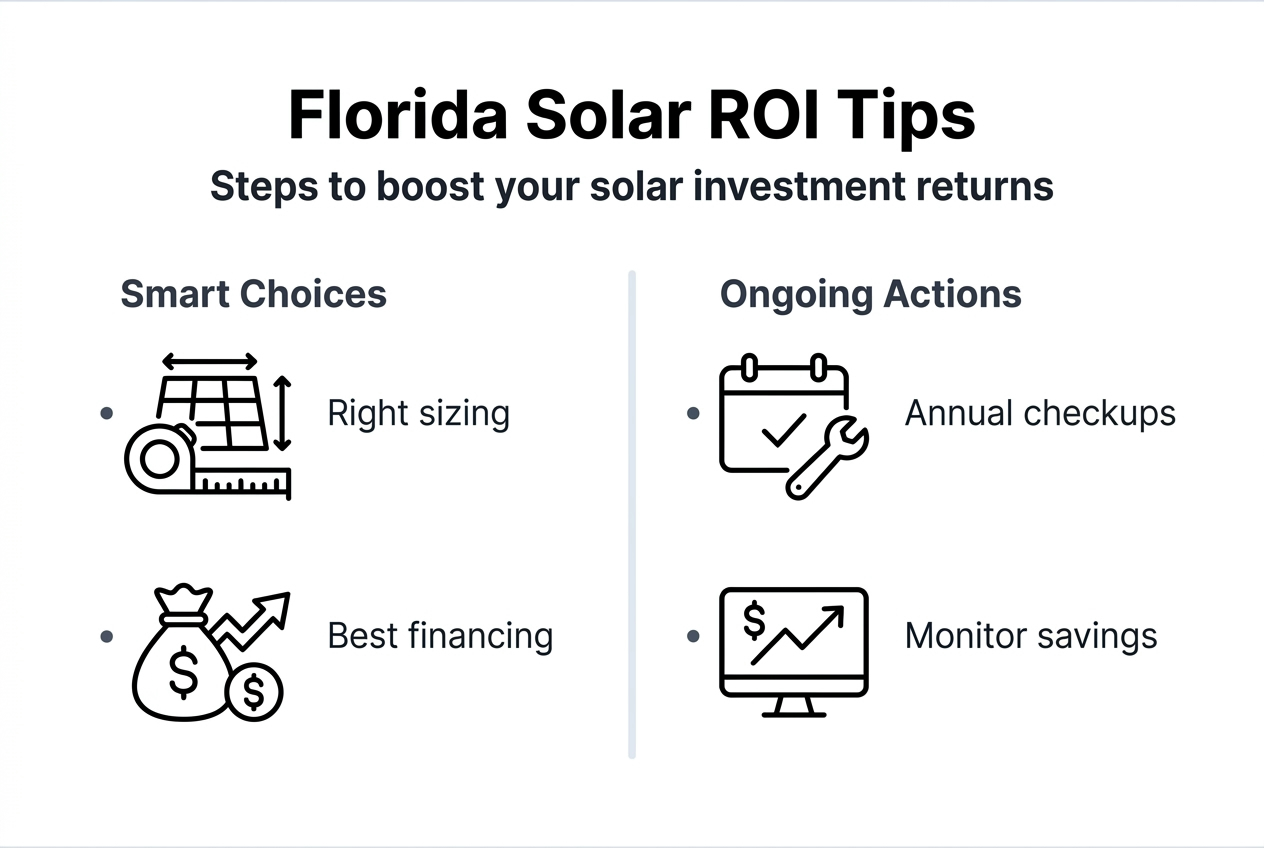
A $15,000 cash purchase might yield $35,000 in 25-year savings. The same system financed with a 5% loan costs $18,500 total but still generates $31,500 net savings. Exploring solar financing options helps you balance immediate affordability with long-term returns.
Regular maintenance ensures your system performs optimally throughout its lifespan. Annual professional inspections catch potential issues before they reduce production. Inverter replacements around year 10-15 maintain conversion efficiency. Proper panel maintenance prevents gradual degradation that erodes savings.
Pro Tip: Review your utility’s net metering agreement annually since policy changes can affect credit values, and contact your provider immediately if terms shift to understand impacts on your projected savings.
Monitoring tools provide real-time visibility into energy production and consumption. Most modern inverters include apps showing daily output, historical trends, and system health alerts. Tracking this data helps you verify expected performance and maximize solar output by identifying underperforming components.
Staying informed about evolving net metering policies protects your investment value. While grandfathering provisions typically protect existing systems from policy changes, understanding potential shifts helps you make proactive adjustments.
Why choose PES Solar for your Florida solar investment
Maximizing solar ROI requires expert guidance tailored to Florida’s unique climate, policies, and utility landscape. PES Solar brings specialized knowledge that transforms technical complexity into clear financial value for your property.
Our team designs systems optimized for Florida’s specific conditions, from hurricane-rated mounting to salt-air resistant components. This expertise ensures your investment delivers projected returns throughout its lifespan. We handle permitting, utility interconnection, and net metering enrollment, removing obstacles that delay your savings.
Flexible financing solutions make solar accessible regardless of your budget situation. We connect you with competitive loan programs, help maximize available incentives, and structure payments that align with your cash flow. Our installation process prioritizes quality and efficiency to get your system producing quickly.
Ongoing support protects your investment value after installation. We provide monitoring assistance, maintenance guidance, and rapid response to performance issues. Our team stays current on policy changes affecting your ROI and helps you adapt when regulations shift. Ready to calculate your specific solar ROI and start saving? Let’s maximize your solar output together.
Frequently asked questions
What are the main factors that affect my solar ROI in Florida?
Your solar ROI depends primarily on system cost, electricity consumption patterns, net metering policies, and available incentives. Local utility rates and your property’s solar exposure also significantly influence returns. Florida’s robust sunshine and supportive solar policies generally deliver strong ROI compared to many other states.
How does net metering reduce my solar payback period?
Net metering credits excess electricity your panels produce back to your utility account, offsetting power you draw during non-production hours. This arrangement essentially uses the grid as a battery, ensuring you capture value from every kilowatt-hour your system generates. The credits typically shorten payback periods by 2-3 years compared to systems without net metering benefits.
Are solar incentives still available in Florida in 2026?
Yes, the federal Investment Tax Credit continues offering 30% cost reductions for solar installations in 2026. Florida provides additional benefits including property tax exemptions for solar equipment value and sales tax exemptions on system purchases. Some utilities also offer rebate programs, though availability varies by service territory.
What is a typical payback period for Florida solar systems?
Most Florida residential solar systems achieve payback between 5-10 years depending on system size, electricity rates, and financing method. Commercial installations often see faster returns due to higher daytime consumption and additional tax benefits. Strong net metering policies and abundant sunshine help Florida outperform many states for solar investment returns.
