
If you’re a Florida homeowner or small business owner looking to go solar without the upfront costs, you’ve likely heard about solar leases. But what exactly is a solar lease, and how does it differ from buying panels outright or other financing options? Many Floridians are confused by the terminology and trade-offs involved. A solar lease lets you use solar panels installed on your property while a third-party company owns them, and you pay a fixed monthly fee. This guide breaks down how solar leases work in Florida, their pros and cons, and practical tips to help you decide if leasing is the right path for your energy goals.
Table of Contents
- Key takeaways
- What is a solar lease and how does it work in Florida?
- Pros and cons of solar leases for Florida homeowners and small businesses
- Comparing solar leases with other solar financing options in Florida
- Practical considerations and tips for choosing a solar lease in Florida
- Explore expert solar leasing solutions with PES Solar
- Frequently asked questions
Key Takeaways
| Point | Details |
|---|---|
| Ownership without purchase | A solar lease lets you use panels owned by a third party and pay a fixed monthly fee. |
| Long term commitment | Contracts run 20 to 25 years with annual payments escalating 1 to 3 percent. |
| Zero upfront costs | You avoid the upfront payment and still reduce your utility bill, though savings may be affected by rising lease payments. |
| Maintenance included | The leasing company handles maintenance and repairs at no extra cost. |
| Sale implications | Leases can complicate home sales because third party ownership requires credit checks and transfer steps. |
What is a solar lease and how does it work in Florida?
A solar lease is a financing arrangement where a third-party solar company installs and owns solar panels on your property. You agree to pay a fixed monthly fee to use the system and benefit from the electricity it generates. In Florida, this model has become popular because it removes the barrier of high upfront costs, which can range from $15,000 to $30,000 for a typical residential system.
Here’s how the mechanics work. The solar company retains ownership of the panels and handles maintenance and repairs. You sign a long-term contract, typically 20 to 25 years, agreeing to pay a monthly lease payment. These payments usually start between $75 and $200 per month, depending on system size and your energy needs. The solar panels generate electricity that offsets your utility bill through net metering benefits in Florida, where excess energy produced is credited back to your account.
One critical detail is the annual payment escalation clause. Most solar leases include a provision that increases your monthly payment by 1% to 3% each year. While your initial lease payment might be lower than your current electric bill, this escalation can erode savings over time, especially if utility rates don’t rise as quickly as projected. Over a 20-year lease, a 2.5% annual escalator can increase your total payments by more than 60% compared to the first year.
Solar leases differ fundamentally from ownership and power purchase agreements. With ownership, you buy the system outright or finance it through a loan, gaining full control and tax benefits. A PPA charges you per kilowatt-hour of electricity produced rather than a fixed monthly fee. However, Florida restricts most PPAs for residential use, making leases the primary alternative for those seeking no-money-down solar.
The solar company benefits by claiming the federal Investment Tax Credit and depreciation benefits, which they use to reduce the lease cost. You benefit from immediate energy savings without capital investment or maintenance responsibilities. Understanding step-by-step solar financing options helps you compare leases against other paths.
Pro Tip: Before signing, carefully review the escalation clause and production guarantees in your lease contract. Ask what happens if the system underperforms and whether you can buy out the lease early without penalties.
Pros and cons of solar leases for Florida homeowners and small businesses
Solar leases offer distinct advantages and drawbacks that vary based on your financial situation, property plans, and energy goals. Let’s examine both sides to help you make an informed decision.
Benefits of solar leases:
- Zero upfront costs: You can start using solar energy immediately without paying thousands of dollars, making solar accessible even if you lack savings or have poor credit.
- Predictable energy costs: Fixed monthly payments provide budget certainty, and initial savings can reach $100 to $200 per month compared to utility bills.
- Maintenance included: The leasing company handles all repairs, monitoring, and system upkeep at no additional cost to you.
- Immediate savings: You start reducing energy costs from day one without waiting to recoup an investment.
Drawbacks of solar leases:
- Escalating payments: Annual increases of 1% to 3% mean your lease payment rises over time, potentially exceeding utility rate growth and reducing long-term savings.
- No property value increase: Unlike owned systems that can boost home value by 3% to 4%, leased panels typically add no equity and may deter some buyers.
- Complicated home sales: Transferring a lease requires the buyer to meet credit score requirements (usually 650 to 720 minimum) and pass debt-to-income checks, which can narrow your buyer pool.
- No tax benefits: You forfeit the federal Investment Tax Credit and any state incentives, which the leasing company claims instead.
- Long-term commitment: Breaking a 20 to 25 year lease early often involves buyout fees or penalties.
“Solar leases can be a smart entry point for homeowners who want immediate savings without upfront investment, but the escalating payments and transfer complications mean you need to plan carefully. If you’re likely to sell within 10 years, ownership or a loan may serve you better long-term.” — Florida solar financing expert
Solar leases work best for homeowners and small business owners who plan to stay in their property for at least 10 to 15 years, don’t have the capital or tax appetite to benefit from ownership incentives, or prefer predictable monthly costs over managing system performance. Understanding the role of solar in homes and solar depreciation benefits can clarify whether ownership might offer better financial returns for your situation.
Comparing solar leases with other solar financing options in Florida
To truly understand whether a solar lease fits your needs, compare it against the primary alternatives available in Florida: outright ownership through cash purchase or loans, and power purchase agreements where allowed.
Ownership through cash or loan:
When you own your solar system, you pay the full cost upfront or finance it through a solar loan. This gives you complete control, and you receive the federal Investment Tax Credit, which covers 30% of system costs through 2032 before stepping down. Owned systems also increase property value by an average of 3% to 4%, adding $15,000 to $20,000 to a typical Florida home’s resale price. You’re responsible for maintenance, but modern panels require minimal upkeep. Over 25 years, ownership typically delivers the highest total savings, often $30,000 to $50,000 or more depending on system size and energy usage.
Solar leases:
Leases eliminate upfront costs and maintenance responsibilities. You pay a fixed monthly fee that escalates annually. The leasing company claims the ITC and depreciation benefits, passing some savings to you through lower lease rates. However, you don’t build equity, and lease transfers can complicate sales. Total savings over 25 years are typically lower than ownership, often $15,000 to $25,000, due to escalating payments and lack of tax benefits.

Power purchase agreements (PPAs):
PPAs charge you per kilowatt-hour of solar electricity produced rather than a fixed monthly fee. This can offer more flexibility if your energy use varies. However, Florida bans most residential PPAs, limiting them primarily to commercial properties. Where available, PPAs share similar pros and cons with leases but tie costs directly to production.
| Feature | Solar Lease | Ownership (Cash/Loan) | PPA (Limited in FL) |
|---|---|---|---|
| Upfront Cost | $0 | $15,000-$30,000 or financed | $0 |
| Monthly Payment | Fixed, escalates 1-3%/year | Loan payment or none | Per kWh produced |
| Tax Credits | No (company claims) | Yes, 30% ITC | No (company claims) |
| Property Value | No increase | +3-4% ($15k-$20k) | No increase |
| Maintenance | Included | Your responsibility | Included |
| Transfer/Sale | Buyer approval required | Transfers with home | Buyer approval required |
| Total 25-Year Savings | $15,000-$25,000 | $30,000-$50,000+ | $15,000-$25,000 |
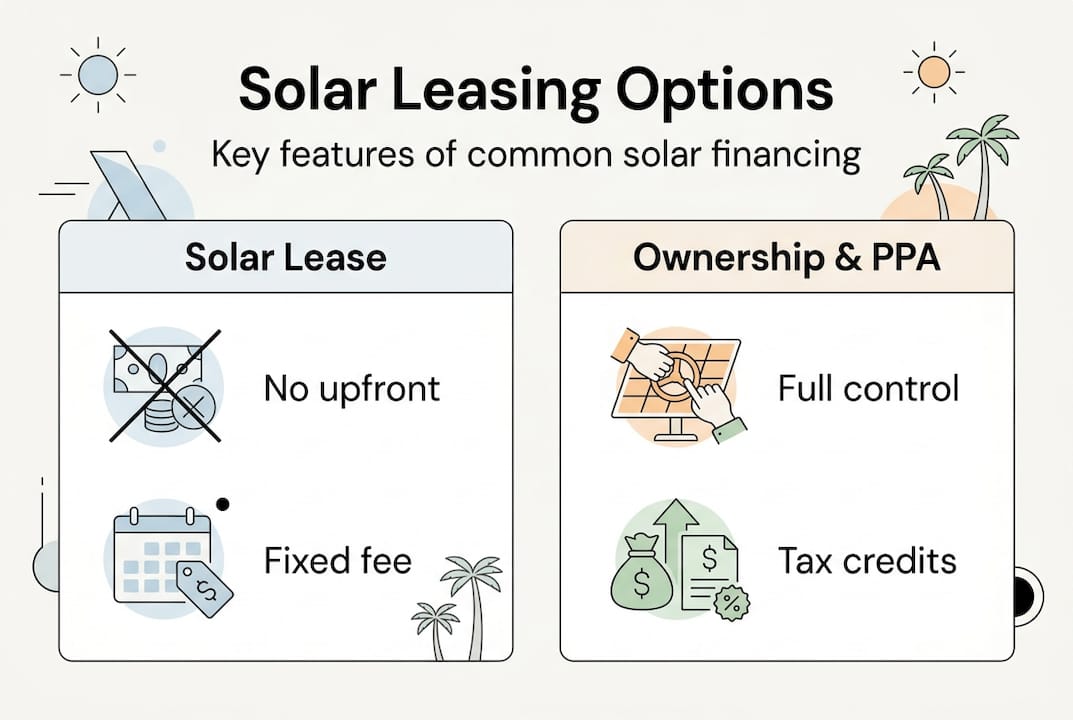
Florida’s restriction on PPAs makes solar leases the go-to option for homeowners seeking no-money-down solar. However, solar financing examples show that loans with low interest rates can deliver ownership benefits with manageable monthly payments. Commercial property owners may access different tax incentives that change the calculation.
Pro Tip: Compare the total cost of a lease over 25 years against a solar loan’s total payments. Factor in the ITC you’d receive with ownership and potential property value gains. Often, a loan costs less overall despite higher monthly payments in early years.
Practical considerations and tips for choosing a solar lease in Florida
If you’re leaning toward a solar lease, follow these steps and tips to ensure you get the best deal and avoid common pitfalls:
-
Evaluate the lease agreement thoroughly: Read every clause, especially those covering escalation rates, production guarantees, and what happens if the system underperforms. Ask whether the company guarantees a minimum energy production level and what compensation you receive if panels don’t meet projections.
-
Check transfer and buyout terms: Understand exactly what’s required to transfer the lease to a buyer if you sell your home. Confirm the minimum credit score and debt-to-income requirements, which typically range from 650 to 720. Ask about buyout options and costs if you want to purchase the system or terminate the lease early.
-
Compare multiple lease offers: Don’t accept the first proposal. Get quotes from at least three solar companies, comparing monthly payments, escalation rates, contract length, and included services. Some companies offer more favorable transfer terms or lower escalators.
-
Negotiate key terms: Lease agreements aren’t always fixed. Try negotiating a lower escalation rate, longer initial payment lock, or more flexible transfer terms. Companies competing for your business may offer concessions.
-
Plan for long-term occupancy: Solar leases deliver the best value if you stay in your property for at least 10 to 15 years. If you anticipate moving sooner, ownership or waiting until you’re settled may be smarter financially.
-
Leverage Florida solar incentives: While you can’t claim the federal ITC with a lease, explore other Florida solar incentives like local rebates, property tax exemptions, or utility programs that might supplement your savings.
-
Consult a solar expert: Before signing, have an independent solar consultant or attorney review your contract. They can identify red flags and ensure terms align with your goals. This small investment can save thousands over the lease term.
-
Understand the impact on home sales: Be realistic about how a lease might affect your ability to sell. Some buyers view leases negatively or can’t qualify for the transfer. Budget extra time for marketing and be prepared to offer incentives or consider buying out the lease if it becomes a deal breaker.
Pro Tip: Always get a full contract review from a solar expert familiar with Florida-specific regulations and market conditions. They can spot unfavorable clauses that generic reviews might miss.
By following these steps, you’ll position yourself to maximize the benefits of a solar lease while minimizing risks and ensuring the arrangement aligns with your broader solar financing strategy.
Explore expert solar leasing solutions with PES Solar
Now that you understand how solar leases work, their trade-offs, and practical selection tips, you’re ready to take the next step toward affordable solar energy. PES Solar specializes in helping Florida homeowners and small businesses navigate the full range of solar financing options, including leases tailored to your specific energy needs and financial situation. Our team provides expert guidance on contract terms, system sizing, and maximizing savings to ensure your solar investment delivers lasting value.
Whether you’re exploring leases or considering ownership, PES Solar offers transparent advice and comprehensive support from initial consultation through installation and beyond. Visit our detailed guides on solar financing options in Florida to compare paths, learn how to install solar panels for your property, and discover what maintenance solar panels require to keep your system performing optimally. Let PES Solar turn your solar goals into reality with solutions designed for Florida’s unique climate and regulatory environment.
Frequently asked questions
What is a solar lease?
A solar lease is a financing arrangement where a third-party company installs and owns solar panels on your property. You pay a fixed monthly fee to use the system and benefit from the electricity it generates, typically for 20 to 25 years. The leasing company handles all maintenance and repairs while claiming tax credits.
How much does a solar lease cost per month in Florida?
Monthly solar lease payments in Florida typically range from $75 to $200, depending on system size and your energy consumption. Most leases include annual escalation clauses that increase payments by 1% to 3% each year, so your cost rises over the contract term.
Can I sell my home if I have a solar lease?
Yes, but the buyer must qualify to assume the lease by meeting credit score requirements (usually 650 to 720 minimum) and passing debt-to-income checks. This can narrow your buyer pool and potentially delay or complicate the sale. Some sellers choose to buy out the lease to avoid transfer issues.
Do solar leases increase home value in Florida?
No, solar leases typically do not increase property value because you don’t own the system. In contrast, owned solar systems can boost home value by 3% to 4%, adding $15,000 to $20,000 or more to resale prices. Some buyers may even view leases as a liability due to transfer requirements.
What happens if I want to end my solar lease early?
Ending a solar lease early usually requires buying out the remaining contract value or paying termination fees specified in your agreement. Buyout costs can be substantial, often equaling the remaining lease payments or the system’s fair market value. Review buyout terms carefully before signing to understand your options and costs.
