
Buying solar panels for the first time is one of the biggest home improvement decisions you’ll make, and Florida’s unique mix of intense sunshine, hurricane seasons, and evolving utility policies makes it even more complex. Get it right and you could slash your electricity bill, boost your home’s value, and lock in energy independence for decades. Get it wrong and you’re looking at costly repairs, missed incentives, or a system that underperforms. Before you sign anything, review 12 months of utility bills to understand exactly how much power you need to replace.
Table of Contents
- 1. Review your home’s solar fit and energy profile
- 2. Understand solar panel types and their benefits
- 3. Get credible quotes and check installer credentials
- 4. Compare costs, incentives, and financing options in Florida
- 5. Plan for hurricanes, batteries, and Florida-specific needs
- Need help making the right solar decision?
- Frequently asked questions
Key Takeaways
| Point | Details |
|---|---|
| Assess your home first | Review roof age, shading, and energy usage before starting your solar journey. |
| Choose efficient panels | Select high-efficiency, hurricane-rated panels to maximize Florida’s solar potential and resilience. |
| Verify installers | Always hire NABCEP-certified pros for safe, reliable installations. |
| Use all incentives | Stack federal, state, and net metering incentives for the best financial outcome. |
| Plan for Florida needs | Consider batteries for outages, and know your rights under Florida’s solar laws. |
1. Review your home’s solar fit and energy profile
Before you compare panels or request quotes, you need to know whether your home is actually ready for solar. Not every roof is a good candidate, and skipping this step leads to expensive surprises down the road.
Here’s what to check before moving forward:
- Roof condition and age: Evaluate roof condition and age before installation. If your roof is older than 10 to 15 years, plan to replace it first. Installing panels on a failing roof means removing and reinstalling them later, which adds significant cost.
- Orientation and shading: South-facing roofs capture the most sunlight in Florida. Significant shade from trees or neighboring structures can reduce your system’s output by 20% or more.
- Energy usage: Pull your last 12 months of electricity bills and calculate your average monthly kilowatt-hour (kWh) usage. This number directly determines the system size you need.
- System sizing tools: Use a free tool like PVWatts from the National Renewable Energy Laboratory to estimate how much a given system size will produce at your specific address.
Understanding your panel lifespan in Florida also helps you plan the long-term value of your investment. Most quality panels last 25 to 30 years, so a roof replacement now protects that entire timeline.
Pro Tip: If your roof has multiple angles or dormers, a professional site assessment will give you far more accurate production estimates than any online calculator.
2. Understand solar panel types and their benefits
Once you confirm your home’s readiness and energy needs, it’s vital to understand your panel options. The type of panel you choose affects efficiency, cost, durability, and how well the system performs in Florida’s specific climate.
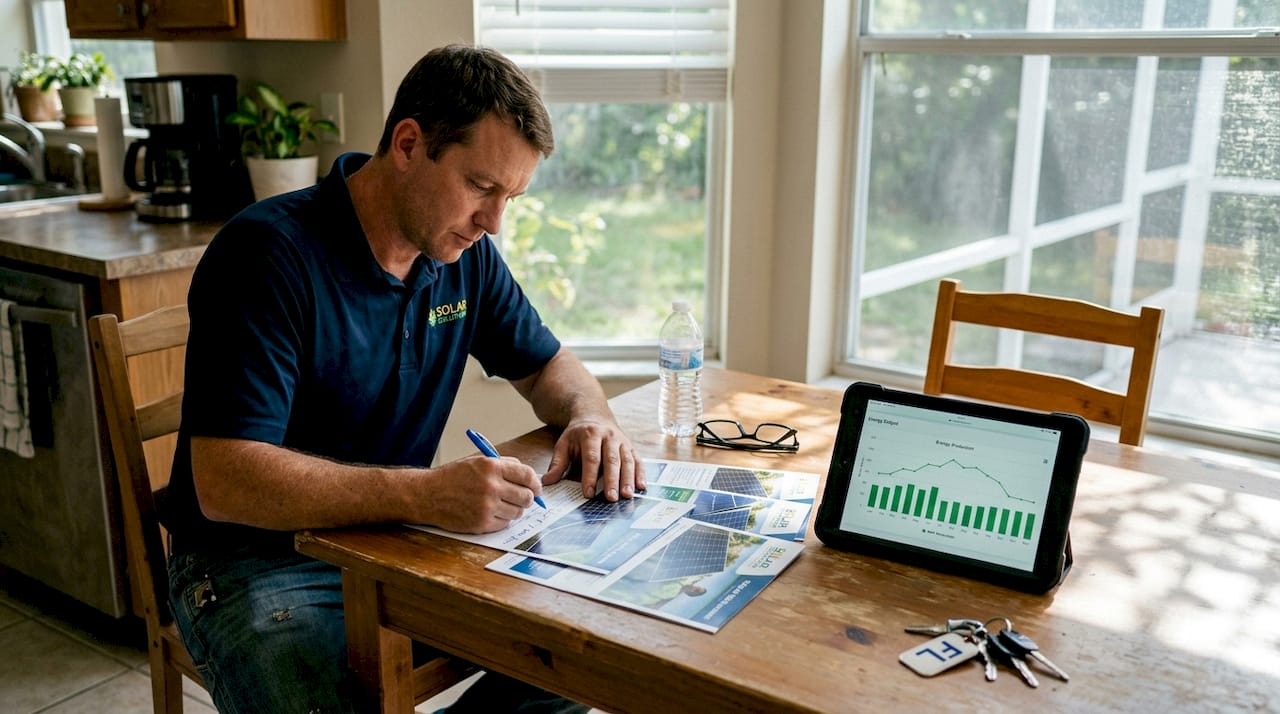
The three main types available for residential installations are monocrystalline, polycrystalline, and thin-film. Here’s how they compare:
| Panel type | Efficiency | Cost | Best for |
|---|---|---|---|
| Monocrystalline | 20% to 23% | Higher | Limited roof space, max output |
| Polycrystalline | 15% to 17% | Moderate | Larger roofs, budget-conscious buyers |
| Thin-film | 10% to 13% | Lower | Flexible surfaces, commercial use |
For Florida homeowners, panel types explained in detail show that monocrystalline panels are typically the strongest choice. Florida’s intense sun means a panel efficiency above 20% pays off faster because you generate more power per square foot of roof space.
Key features to prioritize when shopping:
- Wind resistance rating: Look for panels tested to withstand at least 130 mph winds, which is critical in hurricane-prone Florida.
- Temperature coefficient: Florida heat can reduce panel output. A lower temperature coefficient (closer to -0.3% per degree Celsius) means less performance loss on hot days.
- Warranty terms: A 25-year product and performance warranty is the industry standard. Anything shorter is a red flag.
- Certifications: Look for UL listing and IEC 61215 certification as baseline quality markers.
Pro Tip: REC solar panels, which PES Solar installs, are known for high efficiency and strong wind resistance ratings, making them a particularly good fit for Florida conditions.
3. Get credible quotes and check installer credentials
Having chosen a panel type, it’s time to ensure your installation will be safe and to code. The quality of your installer matters just as much as the quality of your panels.
Follow these steps when vetting installers:
- Collect at least 2 to 3 quotes: Each quote should include a detailed project scope, equipment specifications, labor costs, and a projected production estimate. Vague quotes are a warning sign.
- Verify licensing and insurance: Florida requires solar contractors to hold a valid electrical or solar contractor’s license. Ask for the license number and verify it with the Florida Department of Business and Professional Regulation.
- Look for NABCEP certification: The North American Board of Certified Energy Practitioners (NABCEP) certification is the gold standard for solar installers. Get quotes from NABCEP-certified installers to protect yourself from poor workmanship.
- Ask for references: Specifically ask for references from customers who had hurricane-rated installations. Florida’s weather demands a higher standard of mounting and racking.
A word of caution: Unusually low bids often mean the installer is cutting corners on equipment quality, permitting, or labor. A system that isn’t properly permitted can create serious problems when you sell your home or file an insurance claim.
Also confirm that your installer handles all permitting and utility interconnection paperwork. In Florida, this process involves your local building department and your utility company, and it can take several weeks. An experienced installer manages this for you.
4. Compare costs, incentives, and financing options in Florida
Now that you have quotes, see how incentives and payment options impact your project’s affordability and return on investment (ROI). Florida is one of the best states in the country for solar economics, but only if you take full advantage of what’s available.
Here’s a breakdown of the major incentives and their current status:
| Incentive | Value | Notes |
|---|---|---|
| Federal Investment Tax Credit (ITC) | 30% of system cost | Steps down after 2025; act soon |
| Florida sales tax exemption | 6% savings on equipment | Applies at point of sale |
| Florida property tax exemption | Varies | Added home value not taxed |
| Net metering | Full retail credit | Policy changes possible |
The 30% federal ITC and Florida exemptions stack together, meaning a $25,000 system could effectively cost you closer to $17,500 after the federal credit alone. That’s a significant difference.
For financing, your main options are:
- Cash purchase: Maximum long-term savings and full Florida solar tax credit eligibility. Payback period is typically 6 to 9 years in Florida.
- Solar loan: You own the system and keep all incentives. Monthly loan payments are often less than your current electricity bill.
- Lease or PPA (Power Purchase Agreement): Lower upfront cost, but leases forfeit the ITC, meaning the leasing company claims the tax credit, not you.
Net metering currently gives you full retail credit for excess power you send back to the grid, which dramatically improves your solar bill reduction ROI. However, Florida utilities have been pushing for policy changes, so locking in your system now protects your rate structure. You can also explore the full picture of available solar savings incentives and review a detailed tax deductibility guide to understand every dollar you can recover.
Pro Tip: If you’re financing, ask your installer to show you a side-by-side comparison of your projected loan payment versus your current average electric bill. In most Florida cases, the numbers favor going solar immediately.
5. Plan for hurricanes, batteries, and Florida-specific needs
It’s also critical to consider Florida’s extreme weather and unique legal factors before deciding. A solar system that isn’t built for Florida’s conditions is a liability, not an asset.
Here’s what Florida homeowners specifically need to address:
- Hurricane-rated panels and mounts: Choose panels and racking systems tested for high wind loads. Hurricane panel performance data shows that properly installed systems survive major storms with minimal damage. Cheap mounting hardware is where most storm damage originates.
- Battery backup: A standard grid-tied solar system shuts off automatically during a power outage to protect utility workers. That means no power for you even when the sun is shining. Adding a battery like the Tesla Powerwall keeps your critical loads running during outages.
- HOA restrictions: Florida’s Solar Rights Law prohibits homeowners associations from blocking solar installations. If your HOA has tried to stop you, they are legally in the wrong. You have the right to install.
- Permitting requirements: Every Florida county has its own permitting process. Your installer should be familiar with local requirements and handle all submissions on your behalf.
Exploring your solar battery choices early in the process lets you size your system correctly from the start. Adding a battery later is possible but more expensive than planning for it upfront. Durable panels and batteries for outages are not optional extras in Florida. They are practical necessities given the state’s storm history.
Pro Tip: Ask your installer to design your system with a dedicated backup circuit for essentials like your refrigerator, lights, and phone charging. This costs less than backing up your whole home and covers your most critical needs during an outage.
Need help making the right solar decision?
With these tips, you’re ready to take the next steps toward a smarter, more sustainable home energy setup. But knowing the criteria is one thing. Applying them to your specific home, budget, and utility situation is where expert guidance makes a real difference.
At PES Solar, we’ve helped thousands of Florida homeowners navigate every step of this process, from initial site assessment to final utility interconnection. Our NABCEP-certified team handles the details so you don’t have to guess. Whether you want to understand the step-by-step solar installation process, learn about panel maintenance tips, or walk through the full installation process from start to finish, we have the resources and the experience to guide you. Contact us today for a free, no-pressure estimate tailored to your home.
Frequently asked questions
How do I know if my roof is good for solar panels in Florida?
A structurally sound roof under 15 years old, with strong sun exposure and minimal shading, is your best starting point. Roof condition and orientation are the two factors that most directly affect how much power your system will actually produce.
Are solar incentives and net metering still available in Florida?
Yes, the 30% federal ITC and Florida exemptions are currently active, along with full-retail net metering credits. Policy changes are being discussed at the utility level, so installing sooner locks in better terms.
Should I buy or lease solar panels in Florida?
Buying gives you full access to the federal tax credit and maximizes your long-term savings. Leases forfeit the ITC to the leasing company, which significantly reduces the financial benefit to you as the homeowner.
How do hurricanes affect solar panel systems?
Panels rated for high wind loads and installed by certified professionals hold up well in major storms. Adding a battery ensures you keep power during grid outages, since grid-tied systems shut off automatically when the utility goes down.
