
Florida homeowners and business owners are leaving thousands of dollars on the table every year by missing or mishandling solar incentives. The state offers a layered system of federal, state, and local benefits that can dramatically cut your installation costs and speed up your payback period. But these incentives require the right timing, the right paperwork, and the right sequence to capture fully. Some key credits have already changed heading into 2026, making it more urgent than ever to act strategically. This guide walks you through every step, from understanding what’s available to filing correctly and avoiding the most costly mistakes.
Table of Contents
- Understanding the solar incentive landscape in Florida
- What you need before you start: paperwork, eligibility, and timing
- Step-by-step: How to stack and claim your solar incentives
- Local rebates, net metering, and special financing: Going beyond the basics
- Troubleshooting and common pitfalls: How to avoid missed savings
- Calculating your payback and ROI: What to expect
- Ready to maximize your solar incentives?
- Frequently asked questions
Key Takeaways
| Point | Details |
|---|---|
| Stack multiple incentives | Combine state, utility, and local solar programs to maximize savings and speed up your payback. |
| Act before program changes | Install now to secure current net metering and federal credits before potential policy shifts or expirations. |
| Verify eligibility and timing | Double-check requirements, deadlines, and paperwork for each incentive to avoid costly mistakes. |
| Calculate real ROI | Use realistic benchmarks including exemption, net metering, and home value boost for your decision. |
Understanding the solar incentive landscape in Florida
Florida’s solar incentive structure works in layers, and knowing each layer is the foundation of any smart solar strategy. You have federal programs, state-level exemptions, and local or utility-specific rebates, and each one has different rules, timelines, and application requirements.
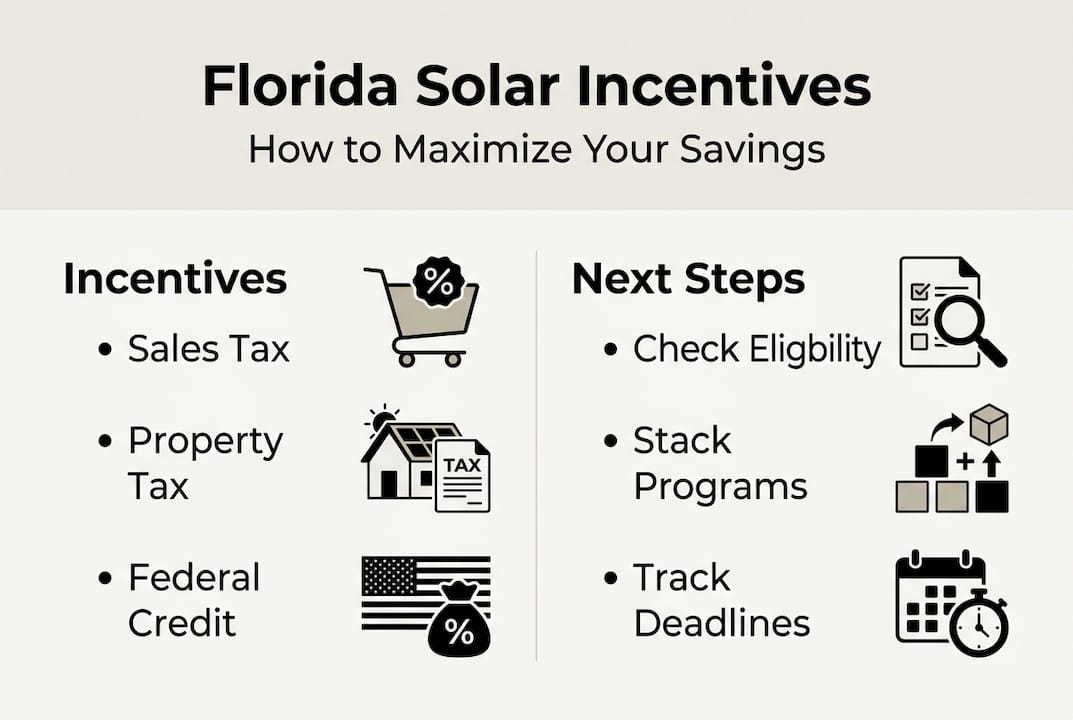
At the state level, Florida stands out with two automatic benefits. The sales tax exemption covers the full 6% sales tax on solar equipment, and the property tax exemption shields 100% of the added home value from your tax bill. Both apply automatically without any application, which means every Florida solar customer gets them by default.
At the federal level, the Residential Clean Energy Credit (commonly called the ITC, or Investment Tax Credit) was a 30% credit on system costs for homeowners. That credit expired at the end of 2025 for residential purchases. Businesses, however, retain a 30% ITC through 2032. You can explore the full Florida solar incentives overview to see how these layers interact.
Net metering is another major benefit. Florida’s investor-owned utilities credit your bill at the full retail rate for every kilowatt-hour you send to the grid, which translates directly into real dollar savings each month. Check current Florida incentives to see what your specific utility offers.
Key incentive types at a glance:
- Sales tax exemption: 6% savings on equipment purchase price
- Property tax exemption: 100% of solar-added value excluded from assessment
- Federal ITC: 30% for businesses through 2032 (expired for homeowners in 2025)
- Net metering: Full retail credit for excess power sent to the grid
- Local/utility rebates: Vary by county and utility provider
| Incentive | Who qualifies | Application required? |
|---|---|---|
| Sales tax exemption | Homeowners and businesses | No |
| Property tax exemption | Homeowners and businesses | No |
| Federal ITC (30%) | Businesses only (2026+) | Yes, via tax filing |
| Net metering | All utility customers | Yes, via utility |
| Local rebates | Varies by location | Yes, varies |
The solar savings guide breaks down how stacking these benefits affects your total out-of-pocket cost.
What you need before you start: paperwork, eligibility, and timing
Knowing what incentives exist is only half the battle. You also need to confirm your eligibility and gather the right documents before installation day.
For homeowners, the core requirements are proof of property ownership, your utility account number, and a copy of your recent electric bills. For businesses, you will also need your federal tax ID, financial statements, and documentation of your tax liability to confirm you can use the ITC. Explore business solar incentives for a full breakdown of what commercial applicants need.
Eligibility checklist:
- Confirm property ownership (deed or mortgage statement)
- Verify your utility provider offers net metering
- Check your federal tax liability if claiming ITC (businesses)
- Review HOA rules, which are limited by Florida Statute §163.04
- Confirm local rebate windows with your county or utility
Timing matters more than most people realize. The 30% ITC expired at the end of 2025 for homeowner-purchased systems, though leasing arrangements can still pass the business ITC through to lower your payments. Net metering rules may also shift after 2026, so interconnecting your system as soon as possible locks in current favorable rates. Review eligibility in Florida to confirm your specific situation.
Pro Tip: Local utility and city rebates often have limited funding windows. Call your utility’s renewable energy department before installation to confirm current availability and deadlines. These programs can close mid-year without public notice.
New construction and low-tax-liability households have special considerations. If you owe little in federal taxes, you may not be able to use the full ITC in one year, but carryforward rules allow you to apply unused credits in future years. Review tax deductibility rules to understand how this works for your situation.
Step-by-step: How to stack and claim your solar incentives
With your documents ready and deadlines confirmed, here is the sequence that captures the most value.
- Get your system sized correctly. Oversizing wastes money; undersizing leaves net metering credits on the table. Aim for 100% to 115% of your annual usage.
- Apply for local and utility rebates first. These often have limited funding and close fast. Secure your spot before installation.
- Schedule installation and interconnection together. The sooner your system connects to the grid, the sooner net metering credits begin.
- File for the federal ITC (businesses). Use IRS Form 3468 and attach it to your business tax return for the year of installation.
- Verify property tax exemption with your county assessor. It applies automatically, but confirming it prevents billing errors.
- Document everything. Keep copies of your interconnection agreement, utility applications, and all tax filings.
For businesses, the strategy goes deeper. Stacking exemptions with net metering and local rebates, then adding the ITC and depreciation (MACRS, or Modified Accelerated Cost Recovery System), can push your internal rate of return well above 15%. Owning the system outright captures more value than leasing, but leasing still passes ITC savings through lower monthly payments.
“Layer incentives: Stack exemptions plus net metering plus local rebates and PACE financing; businesses add ITC and depreciation for a significant IRR boost.”
Pro Tip: Size your system for self-consumption first. Panels that offset your own usage save at the full retail rate (often 12 to 16 cents per kWh), while excess sent to the grid earns the avoided cost rate (3 to 5 cents per kWh) at annual true-up. See commercial solar tax savings for business-specific sizing strategies.
Solar also adds measurable value to your property. Research shows solar boosts home value by 4 to 5%, and Florida’s property tax exemption means that increase costs you nothing extra in taxes. Check official incentive details for the most current program terms.

Local rebates, net metering, and special financing: Going beyond the basics
Florida’s major investor-owned utilities, including FPL, Duke Energy, TECO, and FPU, offer full retail net metering at a 1:1 kilowatt-hour credit ratio. Credits roll over monthly, with an annual true-up where any remaining surplus is paid at the avoided cost rate of roughly 3 to 5 cents per kWh. Residential systems can be sized up to 115% of annual usage; commercial systems up to 2 megawatts.
| Utility | Net metering rate | System size limit |
|---|---|---|
| FPL | Full retail (1:1) | 115% annual use (residential) |
| Duke Energy Florida | Full retail (1:1) | 115% annual use (residential) |
| TECO | Full retail (1:1) | 115% annual use (residential) |
| Commercial (all IOUs) | Full retail (1:1) | Up to 2 MW |
Beyond net metering, PACE (Property Assessed Clean Energy) financing lets you fund your system through your property tax bill with no upfront cost. SELF loans (State Energy Loan Program) offer low-interest financing for qualifying homeowners. Both integrate cleanly with incentives since they don’t affect your eligibility for exemptions or credits. See net metering and rebate details for current program specifics.
Solar’s impact on your home extends beyond the utility bill. Understanding solar’s impact on homeowner value and how property tax effects work together helps you see the full financial picture.
Troubleshooting and common pitfalls: How to avoid missed savings
Even well-prepared homeowners and businesses run into problems. Here are the most common ones and how to avoid them.
- Low tax liability: The ITC is non-refundable, meaning it reduces what you owe but won’t generate a refund. If your liability is low, plan for carryforward over multiple years.
- HOA restrictions: Florida law under §163.04 limits HOA power to block solar, but some associations still try. Know your rights before installation.
- County assessor variability: The property tax exemption applies statewide, but some county offices process it inconsistently. Follow up directly with your assessor’s office.
- Interconnection delays: Net metering credits only begin after your system is officially interconnected. Delays mean lost savings. Push your installer to submit paperwork immediately after installation.
- Non-IOU utilities: Municipal utilities and rural cooperatives are not required to offer the same net metering terms as investor-owned utilities. Confirm your utility’s specific policy before sizing your system.
These edge cases catch many customers off guard, especially the carryforward issue for ITC and the county-level variation in property exemptions.
“Keep copies of every filing, every utility application, and every interconnection agreement. If a credit or exemption doesn’t show up, you need documentation to dispute it.”
Pro Tip: Set a calendar reminder to check your property tax bill the year after installation. Confirm the solar exemption is reflected. If it isn’t, contact your county assessor with your installation permit and invoice. See how solar affects increase in Florida home value to understand what’s at stake.
Monitor net metering guidance for any policy updates, especially heading into 2027 when current rules may be revisited.
Calculating your payback and ROI: What to expect
With incentives properly layered, the numbers become compelling. A typical 10kW residential system costs around $32,000 before incentives. The 6% sales tax exemption saves $1,920 upfront. The property tax exemption saves $250 or more per year. With Florida’s strong sun averaging 5 or more peak hours per day, net metering payback runs 5 to 7 years. And solar boosts home value by 4 to 5%, adding $15,000 to $25,000 for a median-priced Florida home.
| Scenario | System cost | Key incentives | Est. payback |
|---|---|---|---|
| 10kW home (no ITC) | $32,000 | Sales tax + property tax + net metering | 6 to 7 years |
| 20kW business (with ITC) | $64,000 | ITC + MACRS + net metering + rebates | 4 to 5 years |
| 10kW home with PACE | $32,000 | Sales tax + property tax + net metering | 7 to 8 years |
For businesses, adding the 30% ITC and MACRS depreciation can cut effective system cost by more than 50%, pushing payback well under 5 years in many cases. Revisit the Florida incentive ROI page to run numbers specific to your system size and usage.
- Calculate your annual electricity spend
- Estimate system size needed to offset 100% of usage
- Subtract sales tax savings and any local rebates from total cost
- Apply ITC if eligible (businesses)
- Divide net cost by annual utility savings to get payback years
- Add property value gain to total return calculation
Ready to maximize your solar incentives?
Understanding the incentive landscape is powerful, but executing it correctly is where real savings happen. At PES Solar, we handle the full process for you, from system sizing and permit filing to utility interconnection and incentive documentation. Our team knows Florida’s incentive programs inside and out, so nothing gets missed.
Whether you’re a homeowner ready to lock in net metering before rules change or a business owner looking to stack ITC, depreciation, and local rebates, we can build a strategy around your specific situation. Explore our step-by-step solar install guide or learn about pairing your system with Florida Powerwall energy options for maximum energy independence. When you’re ready to see your personalized numbers, contact PES Solar for a free consultation.
Frequently asked questions
Are Florida solar incentives taxable?
Florida’s sales and property tax exemptions are not taxable income since they reduce what you pay rather than adding money to your pocket. Some utility rebates may count as taxable income, so confirm with a tax professional before filing.
Can you still get the 30% federal solar credit in 2026?
For homeowners, the 30% Residential Clean Energy Credit ended in 2025, so new residential purchases no longer qualify. Businesses can still claim the full 30% ITC on purchased systems through 2032.
What happens if net metering rules change in Florida?
Customers already interconnected are grandfathered under current rules, meaning their full retail credit rate is protected. New installations after any policy change may earn less for power sent to the grid, which is why connecting now matters.
How does solar affect my property value and taxes?
Solar boosts home value by 4 to 5% on average, adding significant equity for Florida homeowners. Florida’s 100% property tax exemption on solar-added value means that increase won’t raise your annual tax bill.
Can I still claim incentives if I have low federal tax liability?
Yes. If your federal tax liability is lower than your ITC amount, unused credits carry forward to future tax years until fully used. Florida’s sales and property tax exemptions apply regardless of your tax situation.
Recommended
- How To Maximize Solar Benefits For Florida Homes
- Maximize Savings: Florida Solar Incentives Guide | PES Solar
- How To Maximize Solar Savings For Florida Homes
- Solar Incentives In Florida: Boosting Savings And Value
- Are Solar Panel Grants Worth It? When They Make Sense And If Paying Upfront Works Out Best / Naijatipsland
