
Florida homeowners face a real dilemma right now. Energy bills keep climbing, hurricane season never takes a break, and the rules around solar incentives shifted significantly heading into 2026. You want to know if solar actually pays off for your property, not just in theory but in real dollars and real resilience. This guide walks you through every step of that evaluation, from understanding what incentives still apply this year to calculating your actual payback period, assessing your roof, and weighing the risks that most guides gloss over. By the end, you’ll have a clear, Florida-specific framework to make a confident decision.
Table of Contents
- Understand Florida’s solar incentives and policies
- Assess your site and needs: the essentials checklist
- Calculate payback, ROI, and post-policy savings
- Weigh the risks, rewards, and local realities
- Our take: why a small tweak in your approach makes all the difference
- Next steps: trusted solar solutions for Florida
- Frequently asked questions
Key Takeaways
| Point | Details |
|---|---|
| Verify Florida incentives | Check current sales tax and property tax exemptions since incentive rules change often. |
| Assess site fit | Evaluate your roof, shading, and storm readiness before investing. |
| Accurate ROI math | Use recent rates and local policy changes for realistic payback timelines. |
| Hedge energy prices | Solar protects you from energy bill hikes and boosts property value, even after the ITC ends. |
| Stay policy aware | Monitor Florida utility policies and incentives since they can shift your investment outcomes. |
Understand Florida’s solar incentives and policies
Before you run the numbers, you need to know what incentives actually apply this year. The landscape changed meaningfully in 2025 and 2026, and using outdated assumptions will give you a payback estimate that’s way off.
Here’s what’s currently in play according to Florida solar tax benefits:
- Sales tax exemption: Florida exempts solar equipment from the state’s 6% sales tax. On a $20,000 system, that’s roughly $1,200 back in your pocket at purchase.
- Property tax exemption: The added home value from your solar system is excluded from your property tax assessment. That’s a real annual savings that compounds over time.
- No state income tax credit: Florida does not offer a state-level solar tax credit. Don’t let any contractor tell you otherwise.
- Federal ITC: The 30% federal Investment Tax Credit expired for residential installations at the end of 2025. Commercial projects may still qualify under different timelines, so check with a tax professional.
- Net metering: Systems installed before 2024 receive retail-rate credits for excess power sent to the grid. Systems installed after that date receive credits at the lower “avoided cost” rate, which is significantly less generous.
| Incentive | Benefit | Applies in 2026? |
|---|---|---|
| Sales tax exemption | ~$1,200 saved on avg. system | Yes |
| Property tax exemption | No tax on added home value | Yes |
| State income tax credit | N/A | No |
| Federal ITC (30%) | Expired residential | No (residential) |
| Net metering (retail) | Full credit for excess power | Pre-2024 installs only |
The shift in net metering policy is the biggest wildcard right now. If you’re a new installer in 2026, your Florida solar incentives picture looks different than it did two years ago. You’ll earn less per kilowatt-hour exported, which extends your payback period. Understanding solar panel tax deductions that still apply helps you focus on what actually moves the needle. And if you want to squeeze every dollar out of what remains, a solid plan for maximizing solar savings is worth building before you sign anything.
Policy volatility is real. Florida’s legislature has adjusted solar rules multiple times in recent years. Build your investment case on today’s rules, not hoped-for future benefits.
Assess your site and needs: the essentials checklist
With a grasp of incentives, the next step is to see if your property is a good fit for solar. Not every roof or location delivers the same results, and skipping this step leads to expensive surprises.
Here’s a numbered checklist every Florida property owner should complete before requesting a quote:
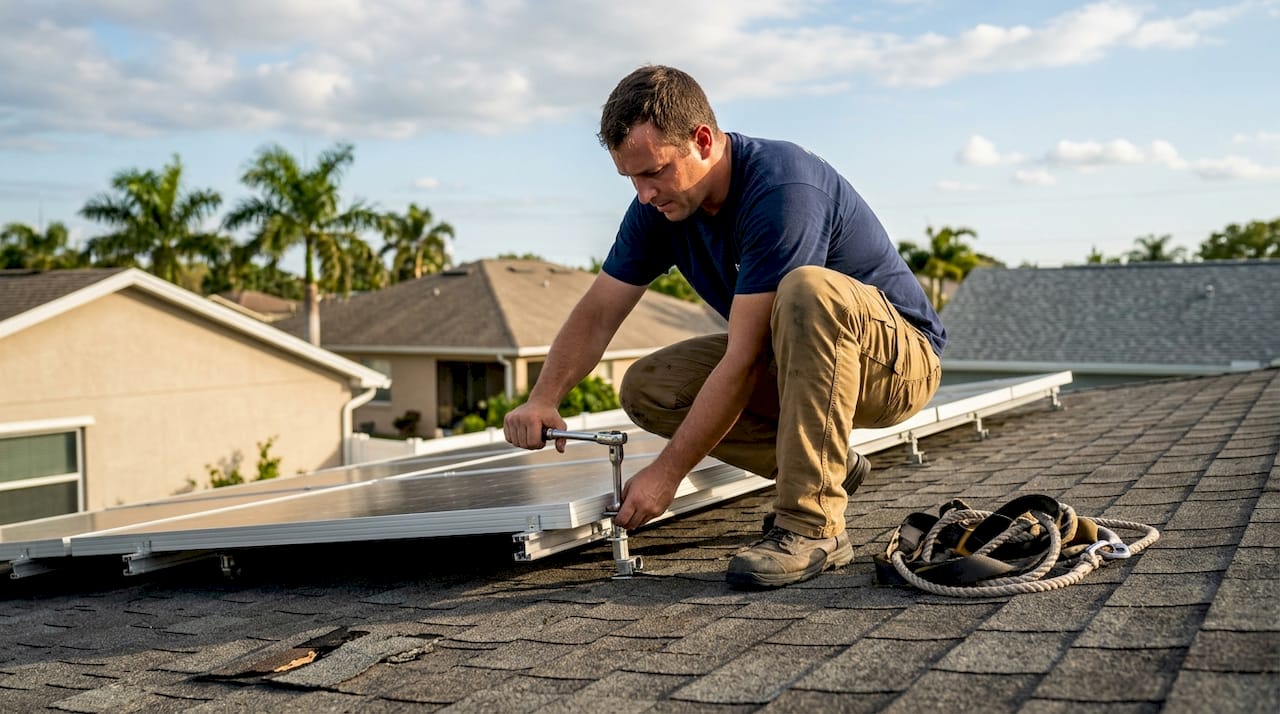
- Check your roof age and condition. If your roof is over 15 years old or needs repairs within 5 years, address that first. Removing and reinstalling panels adds cost.
- Evaluate roof orientation. South-facing roofs produce the most energy in Florida. Southeast and southwest are acceptable. North-facing roofs are rarely worth it.
- Map your shading. Trees, neighboring buildings, and chimneys reduce output significantly. Even partial shading on one panel can drag down an entire string.
- Review your energy bills. Pull 12 months of usage data. Higher average bills mean faster payback. If you use less than 500 kWh per month, the math gets tighter.
- Confirm hurricane compliance. Florida Building Code (FBC) requires panels to withstand specific wind loads. In Miami-Dade and Broward counties, look for the Miami-Dade NOA (Notice of Acceptance) label on any panel system you consider.
- Decide on battery backup. Grid-tied systems go dark during outages. A battery like the Tesla Powerwall keeps essentials running when the grid fails.
Pro Tip: Ask your installer specifically whether the racking system carries a Miami-Dade NOA label. This certification means the mounting hardware is tested for Florida’s most extreme wind conditions, not just the panels themselves.
For context on solar performance in hurricanes, FBC-compliant panels withstand 180mph winds and add real resilience when paired with battery storage. That resilience has a dollar value that standard payback calculators ignore. You should also review how solar panels and roof condition interact before committing.
| Setup | Storm resilience | Added upfront cost | Best for |
|---|---|---|---|
| Grid-tied only | None during outage | Lower | Low storm-risk areas |
| Grid-tied + battery | High, keeps essentials on | $8,000-$15,000 more | Hurricane-prone zones |
Calculate payback, ROI, and post-policy savings
Now, you’re ready to plug your specifics into the numbers that matter most. Here’s a straightforward process for estimating your payback period in 2026.
Steps to calculate rough payback:
- Get your total system cost after the sales tax exemption.
- Subtract any remaining incentives (property tax savings are annual, not upfront).
- Estimate your annual electricity savings using your 12-month average bill and your system’s projected output.
- Divide net system cost by annual savings. That’s your basic payback period in years.
- Adjust for your net metering type. Post-2024 installs earn less per exported kWh, so reduce your savings estimate accordingly.
With the federal ITC gone for residential, payback periods now run 7 to 11 years for most Florida homeowners. That’s longer than the 6 to 8 years many people expected a few years ago. But here’s what changes the math: electricity rates in Florida have been rising at 2 to 4 percent per year, and solar locks in your cost of generation. Every year utility rates climb, your solar savings grow.
Key variables that shift your Florida ROI:
- System size vs. actual usage: Oversizing wastes money under the new net metering rules.
- Shading losses: Even 10% shading can cut annual output by more than you’d expect.
- Utility rate trajectory: A 3% annual rate increase over 20 years dramatically improves your long-term return.
- Net metering type: Retail-rate vs. avoided-cost credits can mean thousands of dollars difference over a system’s life.
- Financing costs: A loan at 7% interest changes your net savings significantly compared to a cash purchase.
Pro Tip: Recalculate your ROI any time your utility raises rates or announces policy changes. A Florida solar ROI guide built on current numbers is far more useful than a generic estimate. You can also use tools to estimate solar savings based on your actual address and usage profile.
For a broader look at the Florida solar investment benefits beyond just payback, consider property value, energy independence, and long-term rate protection as part of the full picture.
Weigh the risks, rewards, and local realities
Beyond the dollars and cents, here’s what every Florida investor must balance. Solar is not a risk-free investment, and pretending otherwise sets people up for disappointment.
Rewards worth noting:
- Property value increases of roughly 4 percent on average
- Proven storm resilience with FBC-compliant systems
- A natural hedge against utility rate inflation
- Reduced carbon footprint with measurable environmental impact
Real risks to plan for:
- Net metering policy could tighten further, reducing future export value
- Upfront costs are higher without the federal ITC
- Grid curtailment (utilities limiting solar exports during peak generation) is a growing issue in some Florida markets
- Installer quality varies widely. A poor installation can void warranties and reduce performance for decades
“Florida ranks third in U.S. solar capacity, yet policy shifts and net metering changes mean the investment case requires more scrutiny than ever. Post-storm resilience is proven, but ongoing monitoring of utility policy is essential for every solar owner.”
To understand why solar still makes sense in Florida despite these headwinds, you need to look at the full picture, not just the payback number. The renewable energy benefits for Florida homeowners extend well beyond the first decade of ownership.
Watch for utility rate case filings, legislative sessions that touch net metering, and any changes to interconnection rules. These are the signals that tell you whether your investment thesis is holding or needs adjustment.
Our take: why a small tweak in your approach makes all the difference
Most solar guides hand you a payback formula and call it done. We think that’s the wrong frame entirely. After working with Florida homeowners and businesses across the state, the investors who get the most value from solar aren’t the ones who found the lowest price. They’re the ones who treated it as an ongoing strategy, not a one-time purchase.
Conventional payback math tells you when you break even. It doesn’t tell you what happens when a hurricane knocks out the grid for a week, or when your utility files for a 12% rate increase. Those events happen in Florida. Regularly. A holistic solar ROI strategy accounts for resilience, policy shifts, and system flexibility from day one.
The investors who regret solar usually made one of two mistakes: they bought based on outdated ITC assumptions, or they ignored net metering changes until it was too late to adjust. The ones who thrive stay engaged with policy updates, choose installers who offer monitoring and support, and size their systems to actual usage rather than maximum output.
Demand Florida-specific numbers. Demand current policy context. And treat battery backup not as an optional upgrade but as a core part of your storm-state investment.
Next steps: trusted solar solutions for Florida
If you’re ready to move forward with your solar investment, here’s how to get expert help and protect your results.
At PES Solar, we work exclusively in Florida, which means our estimates reflect current net metering rules, local utility rates, and real hurricane compliance standards. Whether you’re still exploring solar financing options or ready to review the solar installation steps for your property, we bring up-to-date numbers and honest guidance to every conversation. We also help you evaluate whether solar battery backup makes sense for your specific situation and budget. Contact us for a free, no-pressure estimate built on 2026 Florida realities.
Frequently asked questions
What is the average payback period for solar in Florida in 2026?
Most homeowners and businesses see payback times between 7 and 11 years, depending on utility rate, system size, and site conditions. The expiration of the residential federal ITC is the primary reason payback periods are longer now than in prior years.
Does solar still increase my property’s value in Florida?
Yes, homes with solar see a property value boost of roughly 4 percent on average. Florida’s property tax exemption means that added value won’t raise your annual tax bill.
Is solar a good investment after the federal ITC expired?
While paybacks are longer without the ITC, lower energy bills, property value increases, and protection against utility rate hikes of 2 to 4 percent per year still make solar attractive for many Florida property owners.
How do hurricanes affect the value of my solar system?
FBC-compliant panels withstand up to 180mph winds and add real resilience when paired with battery storage, but you should verify your specific installation meets Miami-Dade NOA standards if you’re in a high-wind zone.
