
Skipping a proper budget before going solar is one of the most expensive mistakes Florida homeowners make. A poorly-planned budget can lead to overspending and missing out on maximum energy savings, leaving thousands of dollars on the table before your first panel is even installed. Between fluctuating hardware prices, local permitting fees, and a stack of available incentives most people never fully use, the gap between a well-budgeted project and a rushed one can easily exceed $10,000. This guide walks you through every stage of the solar project budgeting process so you can move forward with confidence and get the most out of your investment.
Table of Contents
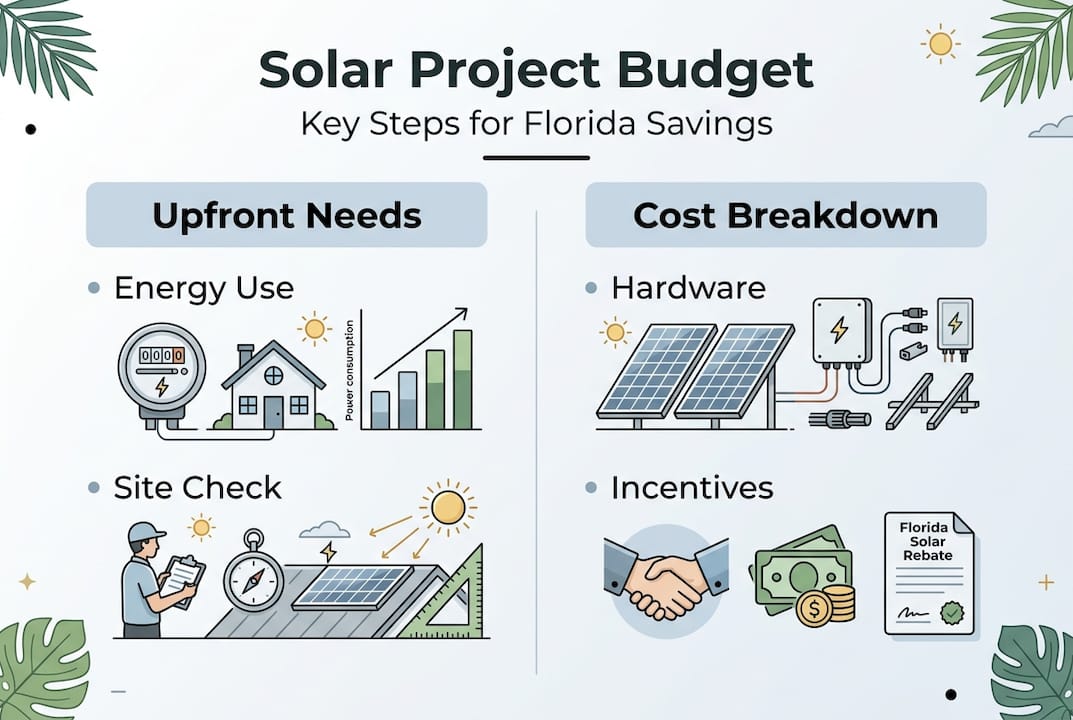
- Understand your energy needs and site potential
- Break down the costs: hardware, soft costs, and typical totals
- Factor in incentives: federal, state, and local
- Step-by-step budgeting process for solar projects in Florida
- Calculating your savings and payback period
- Ready to build your solar budget with a Florida expert?
- Frequently asked questions
Key Takeaways
| Point | Details |
|---|---|
| Assess your needs first | Review 12 months of utility usage to accurately size your system and forecast savings. |
| Budget for all costs | Include hardware, soft costs, permitting, and interconnection to avoid budget surprises. |
| Maximize incentives | Claim the 30% federal ITC (if available), Florida’s tax exemptions, and net metering for best financial results. |
| Get detailed quotes | Request at least three itemized bids and look for quality warranties to protect your investment. |
| Project long-term savings | Most Florida systems deliver $25,000–$80,000 net savings over 25 years, with a payback in under a decade. |
Understand your energy needs and site potential
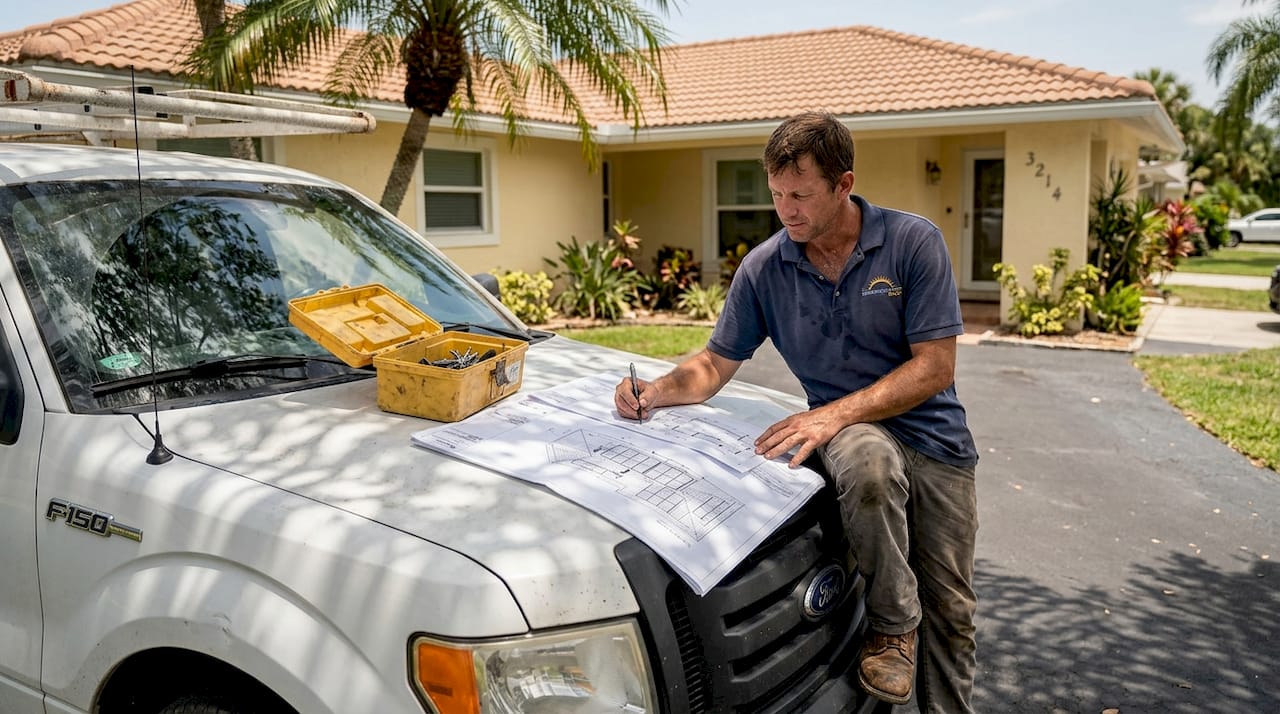
Before you request a single quote, you need to know exactly how much electricity your home or business uses. Pull together your last 12 months of utility bills and add up your total kilowatt-hour (kWh) consumption. That annual number is the foundation of everything else.
Once you have your annual usage, size your system for 100 to 115% of that amount to maximize your offset. Florida averages roughly 1,446 kWh of solar production per kilowatt of installed capacity each year, which you can verify using the free PVWatts calculator from the National Renewable Energy Laboratory. That tool lets you plug in your address and get a realistic production estimate based on your roof’s angle and local sun data.
Several site factors will shape what your system can actually produce:
- Roof angle and orientation: South-facing roofs at a 15 to 25 degree tilt perform best in Florida.
- Shading: Even partial shade from trees or neighboring structures can cut output significantly.
- Roof condition: A roof needing replacement in the next five years should be addressed before installation.
- Future energy needs: Planning to add an EV charger or a pool heater? Size up now rather than later.
- Ownership timeline: Solar rarely makes financial sense if you plan to sell within three years.
Understanding solar panel installation cost starts with knowing your system size, and that starts with your energy data. When choosing a solar installer, look for one who performs a detailed site assessment before quoting.
Pro Tip: If you recently added a pool, hot tub, or plan to buy an electric vehicle, factor that extra load into your sizing now. Undersizing your system means buying grid power at retail rates for years.
Break down the costs: hardware, soft costs, and typical totals
With your energy needs established, it’s time to break down exactly where your money will go. Solar project costs fall into two broad categories: hardware and soft costs.
Hardware accounts for 55 to 65% of total project expenses and includes solar panels, inverters, racking systems, and wiring. Soft costs cover the remaining 35 to 45% and include permitting, labor, financing fees, and sales overhead. Permitting alone can run anywhere from $100 to $1,000 depending on your county, and it directly affects how quickly your system gets activated.
Here is what the 2026 Florida market looks like by system size:
| System size | Estimated cost (before incentives) |
|---|---|
| 6 to 7 kW | $15,000 to $18,000 |
| 8 to 9 kW | $22,000 to $28,000 |
| 10 kW | $28,000 to $34,000 |
The 2026 Florida benchmark sits at $2.20 to $2.80 per watt installed. A 6.84 kW system costs roughly $15,000 to $18,000, while a 10 kW system can reach $34,000 before any incentives are applied.
Key cost components to confirm in every quote:
- Panel brand, wattage, and efficiency rating
- Inverter type (string, microinverter, or power optimizer)
- Racking and mounting hardware
- Labor and installation timeline
- Permitting and inspection fees
- Warranty terms for equipment and workmanship
“The biggest budget surprises come from soft costs that installers don’t always itemize upfront. Always ask for a line-by-line breakdown before signing anything.”
Review the full installation process breakdown to understand what each phase involves, and use our cost for a 2,500 sq ft house guide as a real-world reference point.
Factor in incentives: federal, state, and local
Budgeting for solar isn’t just about spending; it’s about taking advantage of every dollar you can save. Florida residents have access to a meaningful stack of incentives that can dramatically reduce your net project cost.
Here is what is currently available:
- Federal Investment Tax Credit (ITC): The 30% federal ITC applies to the full installed cost of your system. On a $25,000 project, that is $7,500 back on your federal taxes. The 2026 status of this credit is subject to legislative changes, so confirm current eligibility with your installer or tax advisor.
- Florida sales tax exemption: Solar equipment is exempt from Florida’s 6% sales tax, saving you hundreds to over a thousand dollars depending on system size.
- Property tax exemption: The added home value from solar is excluded from your property tax assessment, so your taxes won’t increase after installation.
- Net metering: Florida utilities offer annual true-up net metering, meaning excess power you send to the grid earns you credits. Those credits offset future bills, though the per-kWh rate is typically lower than retail.
Pro Tip: The federal ITC is a tax credit, not a rebate. You need to owe at least that amount in federal taxes to use it in full. If you don’t, you can carry the unused portion forward to the next tax year.
Explore the full list of Florida solar incentives and check whether solar panels are tax deductible for your specific situation before finalizing your budget.
Step-by-step budgeting process for solar projects in Florida
Now let’s put it all together. Here is a detailed, actionable budgeting process you can follow from start to finish.
- Audit your energy use: Collect 12 months of bills and calculate your annual kWh total.
- Complete a site assessment: Evaluate roof condition, shading, orientation, and structural capacity.
- Gather at least three quotes: Each quote should be fully itemized, covering hardware, labor, permits, and warranties.
- Apply for financing pre-approval: Know your financing options before committing. Solar loans, leases, and PPAs each carry different long-term cost implications.
- Finalize financing and schedule installation: Lock in your rate and confirm the installation timeline with your chosen installer.
- Pass inspections and activate: Your system must pass local utility and building inspections before it can go live.
The solar budgeting process is sequential for a reason. Skipping the site assessment, for example, can result in a system that underperforms because shading wasn’t accounted for.
| What to compare | Red flag to watch for |
|---|---|
| Itemized quote vs. lump sum | Lump-sum quotes hide soft costs |
| Warranty length and coverage | Less than 10 years on workmanship |
| Panel efficiency rating | Below 20% efficiency on premium quotes |
| Installer certifications | No NABCEP certification listed |
Compare your solar vs. grid savings to understand the true long-term value, and check what the average solar bill in Florida looks like after installation.
Calculating your savings and payback period
With your budget built and process mapped, the next step is to forecast the true financial impact. This is where the numbers get motivating.
Florida electricity rates currently run between 14 and 16 cents per kWh. A well-sized system eliminates most of your consumption from the grid, but you will still pay a minimum utility charge, typically around $25 per month, even with solar. Factor that into your annual savings estimate.
Here is a savings snapshot based on common Florida system sizes:
| System size | Est. annual savings | 25-year savings estimate |
|---|---|---|
| 6 kW | $800 to $1,100 | $20,000 to $40,000 |
| 9 kW | $1,200 to $1,600 | $25,000 to $80,000 |
| 12 kW | $1,600 to $2,200 | $35,000 to $90,000 |
A typical 9 kW system saves $1,200 to $1,600 per year, with total lifetime savings ranging from $25,000 to $80,000 depending on utility rate increases over time. Most Florida homeowners reach their payback point in 7 to 10 years, after which every year of production is pure financial gain.
Net metering credits accumulate throughout the year and settle at your annual true-up date. Track those credits monthly so you can adjust usage habits and maximize what you earn back.
Pro Tip: Florida utility rates have increased an average of 3 to 4% per year historically. Every rate hike makes your solar system more valuable. Build a conservative 3% annual rate increase into your 25-year savings projection for a realistic picture.
Review the full breakdown of solar benefits and costs and consider timing your solar purchase carefully to lock in current incentive levels before any policy changes take effect.
Ready to build your solar budget with a Florida expert?
PES Solar has helped hundreds of Florida homeowners and business owners move from confusion to confidence in their solar investment. We provide detailed, itemized quotes with no hidden fees, full warranty coverage, and a team that walks you through every step of the budgeting and installation process.
Whether you are sizing a system for a single-family home or a commercial property, our team uses real site data and current Florida incentive information to build a budget that actually reflects your situation. We carry NABCEP certifications, offer flexible financing options, and back every installation with industry-leading workmanship warranties. Get your free estimate today and find out exactly what solar will cost and save for your specific property.
Frequently asked questions
How do I estimate solar system size for my Florida home?
System sizing starts with your annual energy usage from utility bills. Review your last 12 months of bills to find your total kWh, then size your system for 100 to 115% of that amount.
What are typical all-in solar installation costs in Florida for 2026?
Expect $2.20 to $2.80 per watt installed. That works out to roughly $15,000 to $18,000 for a 6.8 kW system, or $28,000 to $34,000 for a 10 kW system, before any incentives are applied.
Which incentives and exemptions lower solar costs in Florida?
The 30% federal ITC, Florida’s 6% sales and property tax exemptions, and net metering credits all reduce your net cost. Combined, these incentives can cut your out-of-pocket expense by thousands of dollars.
How long is the typical payback period for solar panels in Florida?
Most Florida solar projects break even in 7 to 10 years. A 9 kW system saves $1,200 to $1,600 per year, with $25,000 to $80,000 in total savings over 25 years.
What should I watch out for when requesting solar quotes?
Always get at least three itemized quotes and avoid any deal that lacks clear warranty terms or prices suspiciously below the $2.20 per watt market floor.
