
Installing the wrong-size solar system is one of the most expensive mistakes Florida homeowners make. Go too small and you keep paying high utility bills. Go too large and you generate power the utility won’t credit you for, wasting thousands of dollars. Incorrect sizing means lost savings and a wasted solar investment. Florida’s intense sun, high air conditioning loads, and strict utility interconnection rules make precise sizing more important here than almost anywhere else in the country. This guide walks you through a proven, step-by-step process with real numbers so you can size your system right the first time.
Table of Contents
- What you need before you start: data, tools, and Florida-specific requirements
- Step-by-step solar system sizing process for Florida
- Common pitfalls and expert tips for Florida solar sizing
- Fine-tuning your solar system for maximum value
- Ready to go solar? Get expert help every step of the way
- Frequently asked questions
Key Takeaways
| Point | Details |
|---|---|
| Accurate annual data | Gather 12 months of utility bills for precise sizing calculations. |
| Florida-specific adjustments | Use peak sun hours and derate for heat to determine your ideal system size. |
| Avoid oversizing | Target 60–85% energy offset to bypass utility minimum bills and maximize savings. |
| Future-proof your investment | Factor in planned EVs, pools, or batteries before finalizing your solar design. |
What you need before you start: data, tools, and Florida-specific requirements
Before diving into calculations, make sure you have all the key information and tools required for success. Skipping this prep step is where most sizing errors begin.
Start with your utility bills. You need 12 months of kWh data to capture seasonal swings, especially the summer air conditioning spike that can double your usage. A single month’s bill will mislead you every time.
Next, find your local peak sun hours. Florida averages 5.0 to 5.7 peak sun hours per day depending on your location, and the NREL PVWatts calculator lets you enter your exact address for a precise figure. Miami gets more sun than Tallahassee, and that difference changes your system size.
You also need to understand your utility’s rules. Most Florida providers cap net metering at 115% of your annual peak demand, and some impose a minimum monthly bill regardless of how much solar you produce. Knowing these limits before you size prevents a costly mismatch.
Finally, Florida Building Code requires solar panels to meet hurricane wind load ratings. This affects panel selection and racking, so factor it in early when assessing solar needs for your property.
Key data to gather before sizing:
- 12 months of utility bills (kWh per month, not just dollars)
- Your utility’s net metering policy and export cap
- Local peak sun hours from PVWatts
- Roof orientation, tilt angle, and any shading sources
- Florida Building Code wind zone for your county
- Any planned future loads (EV charger, pool heater, battery storage)
| Data point | Where to find it | Why it matters |
|---|---|---|
| Annual kWh usage | Utility account portal | Sets your baseline system size |
| Peak sun hours | NREL PVWatts | Determines daily production potential |
| Net metering cap | Utility interconnection agreement | Limits maximum useful system size |
| Wind zone rating | Florida Building Code map | Affects panel and racking selection |
| Roof specs | Site audit or satellite tool | Impacts available array space |
Use the system selection guide to match your data to the right equipment before you run any numbers.
Step-by-step solar system sizing process for Florida
Armed with your data, follow this step-by-step process tailored for maximum Florida performance.
- Add up 12 months of kWh usage. Total your annual consumption. A typical Florida home uses 14,000 to 17,000 kWh per year, well above the national average, largely because of air conditioning.
- Find your peak sun hours. Use PVWatts for your zip code. Most of Florida falls between 5.0 and 5.5 hours per day.
- Calculate your raw DC system size. Divide your annual kWh by peak sun hours multiplied by 365. For example: 15,000 kWh divided by (5.2 hours x 365 days) = 7.9 kW DC.
- Apply a Florida derate factor. Heat and system losses reduce real-world output. Florida-specific derate factors run 0.85 to 0.86. Divide your raw size by 0.85: 7.9 kW / 0.85 = 9.3 kW DC.
- Adjust for shading and roof constraints. If your best roof faces southeast or has partial shading, add 5 to 10% to compensate.
- Check against your utility’s interconnection cap. Florida utility interconnection caps often limit systems to 10 to 11.7 kW AC. Convert your DC size using a 0.96 inverter efficiency factor to confirm you stay within limits.
Pro Tip: Run your numbers through the PVWatts tool after completing step 4. Enter your address, system size, tilt, and azimuth to get a simulated annual output. Compare that to your actual usage to confirm your sizing before buying a single panel.
| Scenario | Annual kWh | Peak sun hours | Raw DC size | After derate (0.85) |
|---|---|---|---|---|
| Small home | 10,000 | 5.5 | 4.97 kW | 5.85 kW |
| Average home | 15,000 | 5.2 | 7.90 kW | 9.29 kW |
| Large home | 20,000 | 5.0 | 10.96 kW | 12.89 kW |
| Business (light) | 30,000 | 5.3 | 15.50 kW | 18.24 kW |
Review your solar consultation guide to understand how a professional walks through these same steps with your actual utility data. The installation process guide also shows how sizing decisions flow directly into equipment selection and permitting.

Common pitfalls and expert tips for Florida solar sizing
Even the best-laid plans can go awry. Learn how to avoid common pitfalls and supercharge your results with expert strategies.
The biggest mistake Florida homeowners make is sizing purely for 100% offset without checking the utility’s minimum bill rule. Oversizing past net metering caps means you generate excess power the utility buys back at a fraction of retail rate. You pay more upfront and earn less back. The math rarely works in your favor.
High air conditioning use is another trap. Florida homes can see summer bills two to three times higher than winter bills. If you size based on a summer month alone, you’ll overbuild. If you use only a winter month, you’ll underbuild. Always use the full 12-month average.
Common mistakes to avoid:
- Sizing from a single month’s bill instead of annual average
- Ignoring the utility’s minimum monthly bill (often $25 to $50 regardless of solar output)
- Skipping a site audit and relying on generic square-footage rules
- Forgetting to account for hurricane wind load ratings on panels and racking
- Failing to plan for future loads like an EV charger or pool heater
“Generic rules of thumb like ‘1 kW per 1,000 square feet’ ignore your actual usage, your roof’s orientation, and your utility’s specific rules. Site-specific modeling consistently outperforms any shortcut.”
Pro Tip: Before finalizing your system size, call your utility and ask specifically about their net metering export cap and minimum bill policy. These two numbers alone can shift your ideal system size by 2 to 3 kW. You can also explore ways to maximize solar output through panel placement and inverter selection once your size is locked in.
Understanding panel efficiency in Florida also matters here. Higher-efficiency panels let you fit more production into a smaller roof footprint, which is critical when shading or limited space constrains your array.
Fine-tuning your solar system for maximum value
Once you’ve built your plan, here’s how to refine it and ensure you maximize your long-term savings.
The 60 to 85% offset sweet spot is real. Targeting this range typically delivers the best return on investment because you avoid the utility’s minimum bill cliff while still dramatically cutting your energy costs. Going above 85% offset often adds cost without adding proportional savings.
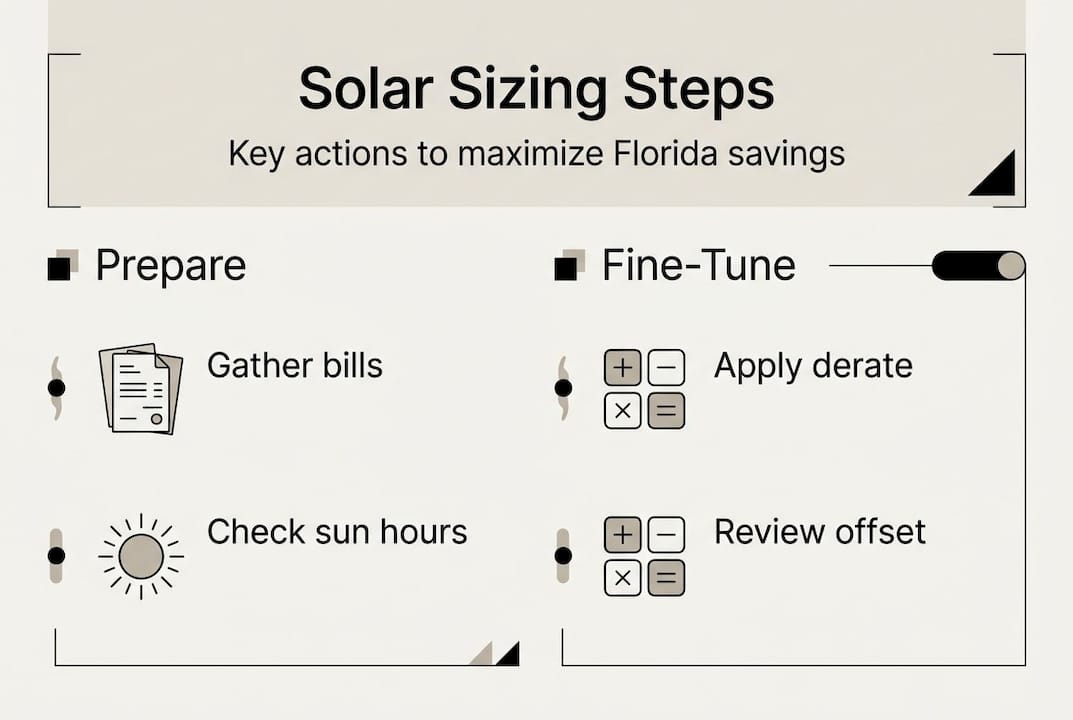
If you plan to add an EV or a pool heater in the next few years, size for those loads now. An EV adds roughly 2,500 to 4,000 kWh per year depending on how much you drive. A pool heater can add a similar amount. Adding panels later costs more per watt than including them in the original install.
Fine-tuning checklist before you commit:
- Run a PVWatts simulation with your finalized system size and compare output to annual usage
- Confirm your offset lands between 60% and 85% of annual consumption
- Add estimated kWh for any planned future loads before locking in size
- If adding battery storage, increase your array by 15 to 30% to cover both home use and battery charging
- Validate the full plan with a licensed Florida solar installer before signing anything
| Offset target | Typical system size | Best for |
|---|---|---|
| 60% offset | 6 to 8 kW | Budget-conscious, smaller homes |
| 75% offset | 9 to 11 kW | Most Florida homeowners |
| 85% offset | 12 to 14 kW | High-usage homes, EV owners |
| 100% offset | 15+ kW | Large homes, business owners |
Review Florida solar system benchmarks to see how your numbers compare to similar homes in your area. Start preparing your home for solar in parallel so you’re ready to move fast once your size is confirmed. The full picture of maximizing solar savings goes beyond sizing alone, covering rate plans, battery timing, and utility billing strategies that boost your solar benefits over the life of your system.
Ready to go solar? Get expert help every step of the way
Sizing a solar system correctly in Florida takes real data, local knowledge, and an understanding of utility rules that change by provider. You now have the framework. But putting it into practice with your specific roof, usage profile, and utility agreement is where professional support pays off.
At PES Solar, we handle the full process from sizing and permitting through installation step-by-step, making sure your system meets Florida Building Code and your utility’s interconnection requirements. We also help you explore battery storage options like the Tesla Powerwall to future-proof your investment against outages and rising rates. And if upfront cost is a concern, our solar financing in Florida options let you start saving on day one without a large out-of-pocket expense. Contact us for a free estimate and let’s build the right system for your home or business.
Frequently asked questions
How much solar do I need for an average Florida home?
Most Florida homes need 7 to 15 kW DC for full offset, but targeting 60 to 85% offset often delivers better savings per dollar spent. Use your annual kWh total and local peak sun hours to calculate your specific number.
What is the minimum bill or net metering cap in Florida?
Many Florida utilities cap net metering at 115% of your annual peak demand, which typically translates to a system limit of 10 to 11.7 kW AC. Most providers also charge a minimum monthly bill regardless of how much solar you produce.
How do I factor for future loads like an EV or pool heater?
Estimate the annual kWh for each planned load (2,500 to 4,000 kWh for an EV, similar for a pool heater) and add that to your baseline before calculating system size. Sizing for future loads upfront costs less per watt than adding panels later.
What derate factor should I use for Florida’s heat?
Use a derate factor of 0.85 to 0.86 to account for heat-related losses and system inefficiencies. In areas with extreme summer temperatures, erring toward 0.85 gives you a more conservative and accurate estimate.
Is a software tool like PVWatts necessary?
Using PVWatts or a similar simulation tool is strongly recommended because it accounts for your exact location, roof angle, and shading in ways that no rule of thumb can match. It takes about 10 minutes and can save you from a costly sizing mistake.
