
Florida homeowners and businesses face a critical challenge when investing in solar energy: how to maintain power during frequent outages while maximizing long-term savings. Battery storage systems transform solar installations from simple grid-tied arrays into resilient, cost-optimized energy solutions. With Florida ranking first nationally in average outage duration at 14.6 hours per event, batteries provide essential backup while hedging against future policy changes that could reduce export credits. This guide explains how battery storage works with solar panels to deliver both immediate resilience and strategic financial benefits for Florida properties in 2026.
Table of Contents
- Why Battery Storage Is Essential For Florida’s Solar Users
- How Battery Storage Works With Solar To Boost Savings In Florida
- Choosing The Right Battery System For Florida Homes And Businesses
- Cost Considerations And Long-Term Savings With Solar And Battery Systems
- Explore Battery Storage Solutions With PES Solar In Florida
- Frequently Asked Questions About Solar Battery Storage In Florida
Key takeaways
| Point | Details |
|---|---|
| Hurricane backup power | Batteries provide 8-12 hours of essential power per 13kWh unit during Florida’s frequent outages. |
| Net metering hedge | Current retail-rate credits may decline, making battery self-consumption increasingly valuable. |
| Climate-optimized chemistry | Lithium iron phosphate batteries offer superior heat tolerance and safety for Florida conditions. |
| Lifecycle cost advantage | Solar plus battery systems reduce long-term costs 19-35% compared to diesel generators. |
| Bill savings potential | Sixty percent of homes with solar plus battery report approximately 15% energy bill reductions. |
Why battery storage is essential for Florida’s solar users
Florida’s power infrastructure faces unique vulnerabilities that make battery storage a practical necessity rather than a luxury upgrade. The state experiences longer average power outage durations than any other in the nation, with events averaging 14.6 hours. Hurricane season brings sustained outages that can stretch multiple days, leaving solar-only systems unable to function despite abundant sunshine. Grid-tied solar panels automatically shut down during outages for safety reasons, rendering them useless precisely when backup power matters most.
Battery storage systems solve this critical gap by capturing solar energy and making it available during grid failures. A typical 13kWh battery unit can supply 8 to 12 hours of backup power for essential household or business loads. This capacity covers refrigeration to prevent food spoilage, lighting for safety and security, medical equipment for health needs, and well pumps for water access. Businesses benefit from maintaining operations during brief outages that would otherwise halt productivity and revenue.
Homeowners and businesses in southwest Florida’s most vulnerable coastal areas prioritize battery storage for emergency preparedness. The investment delivers peace of mind knowing critical systems will continue functioning when the grid fails. Many Florida residents learned this lesson during recent hurricane seasons when neighbors with battery-equipped solar systems maintained power while grid-dependent homes went dark for days.
Florida ranks first in average outage duration at 14.6 hours, and batteries can power essentials for 8 to 12 hours per 13kWh unit during these critical periods.
Common critical loads supported by battery storage include:
- Refrigerators and freezers to preserve food and medication
- Interior and exterior lighting for safety and security
- Medical devices including CPAP machines and oxygen concentrators
- Well pumps and water filtration systems
- Communication devices and internet routers
- HVAC systems for partial climate control
For Florida property owners investing in solar power tips Florida 2026, battery storage transforms solar from a cost-saving measure into a comprehensive resilience solution. The combination addresses both everyday energy management and emergency preparedness in a single integrated system.
How battery storage works with solar to boost savings in Florida
Understanding the financial mechanics of battery storage requires examining Florida’s current net metering policies and how they shape system economics. Under Florida net metering rules, excess solar production exported to the grid earns credits at the full retail electricity rate. This favorable policy means solar-only systems already capture significant value by offsetting grid consumption with banked credits. Battery storage adds little immediate bill savings in this environment since exporting surplus solar and storing it for later use both provide similar financial returns.
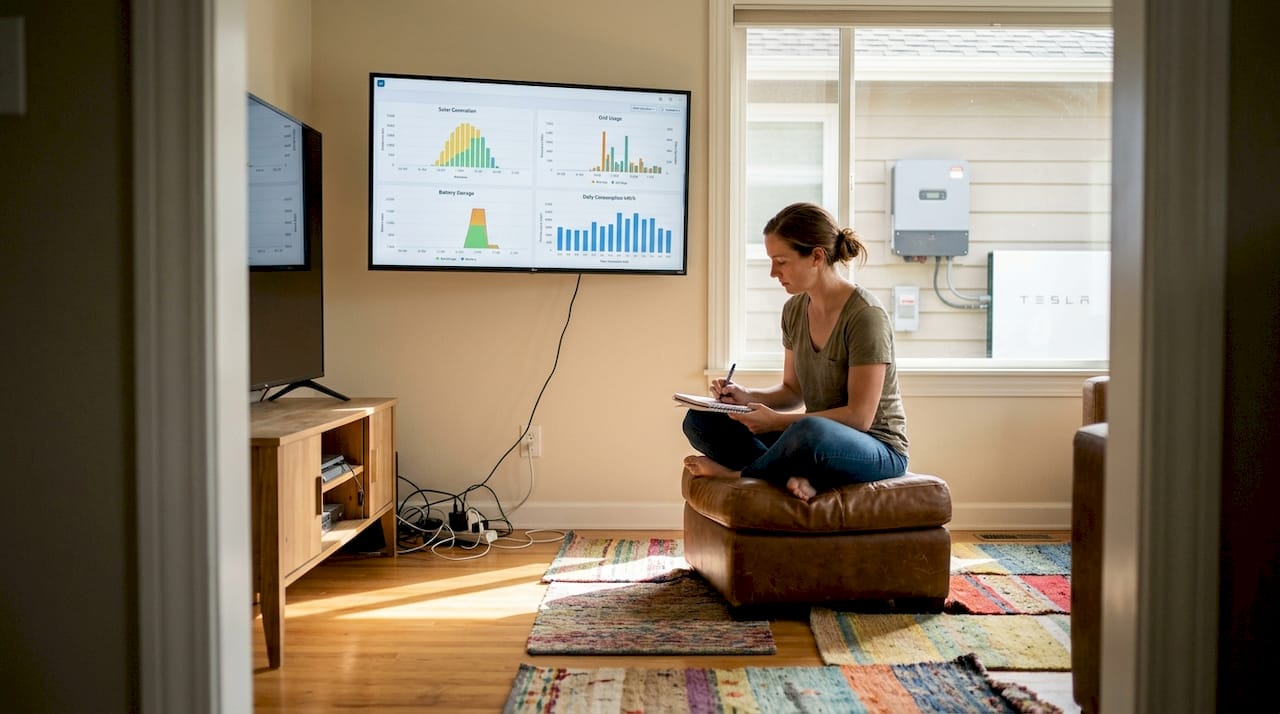
The strategic value of batteries emerges when considering future policy scenarios and energy independence goals. Many states have reduced export credit rates over time as solar adoption increases, shifting from retail rate compensation to lower wholesale or avoided-cost rates. Battery storage enables self-consumption of solar energy, storing unused daytime production for evening and overnight use. This approach reduces dependence on grid electricity and export credit policies, providing a hedge against potential future reductions in compensation rates.
Battery systems also enable time-of-use optimization for customers on rate plans with variable pricing. By storing solar energy during low-demand periods and deploying it during high-rate evening hours, batteries maximize savings beyond simple net metering offsets. Commercial customers facing demand charges benefit significantly since batteries can shave peak consumption spikes that trigger expensive penalties.
Pro Tip: Size your battery to match approximately 80% of your typical daily solar production for optimal system efficiency and cost-effectiveness. Oversizing adds unnecessary expense while undersizing leaves solar energy unused.
The table below compares bill impact scenarios for solar-only versus solar plus battery systems under current and potential future policy environments:
| Scenario | Solar Only | Solar + Battery | Key Difference |
|---|---|---|---|
| Current net metering (retail rate credits) | High savings from grid exports | Similar savings with energy independence | Battery adds resilience, minimal immediate bill impact |
| Future reduced export rates (wholesale compensation) | Reduced savings as export value drops | Maintained savings through self-consumption | Battery protects against policy changes |
| Time-of-use rate plans | Moderate savings with strategic export timing | Enhanced savings from peak-period battery discharge | Battery optimizes timing arbitrage |
| Commercial demand charges | Solar reduces energy costs only | Solar plus battery reduces energy and demand costs | Battery shaves expensive peak demand |
Batteries provide multiple advantages beyond immediate bill reduction:
- Energy independence from grid supply and policy uncertainty
- Time-of-use rate optimization for maximum savings
- Backup power during outages for resilience
- Demand charge reduction for commercial properties
- Protection against future export rate reductions
For homeowners exploring how solar panels reduce energy bills, batteries represent a strategic investment in long-term flexibility. The combination positions properties to adapt as utility policies evolve while delivering immediate resilience benefits. Businesses examining solar’s role in Florida operating costs find batteries particularly valuable for managing demand charges and ensuring operational continuity.
Choosing the right battery system for Florida homes and businesses
Selecting appropriate battery technology and capacity requires understanding Florida’s specific environmental challenges and typical usage patterns. Lithium iron phosphate batteries have emerged as the preferred chemistry for Florida installations due to superior performance characteristics in hot, humid conditions. LFP batteries offer heat resistance and safety advantages crucial during Florida’s intense summer temperatures and hurricane conditions. These units maintain stable operation at higher temperatures than alternative chemistries while presenting lower thermal runaway risks.
Proper sizing balances backup duration needs with system cost and solar production capacity. Most Florida homes require coverage for critical loads ranging from 3 to 5 kilowatts, including essential appliances and systems. A well-designed battery system should store enough energy to power these loads for 8 to 12 hours, matching typical outage durations. The battery capacity should align with daily solar production, with the system generating enough energy to fully recharge batteries while also meeting daytime consumption needs.
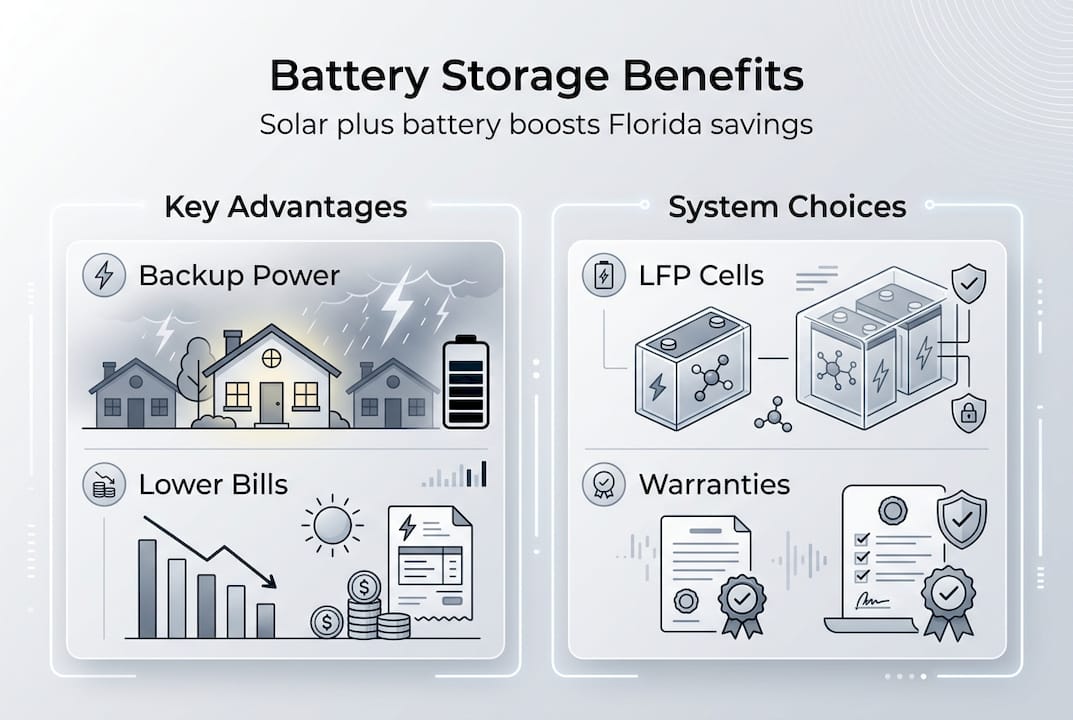
The comparison table below highlights key differences between battery chemistries available for Florida solar installations:
| Battery Chemistry | Advantages for Florida | Disadvantages | Best Use Case |
|---|---|---|---|
| Lithium iron phosphate (LFP) | Excellent heat tolerance, long cycle life, high safety, stable performance | Higher upfront cost than lead acid | Primary choice for Florida residential and commercial systems |
| Lithium nickel manganese cobalt (NMC) | High energy density, compact size | Lower heat tolerance, higher thermal runaway risk | Limited Florida applications, better for cooler climates |
| Lead acid | Lower initial cost, proven technology | Poor heat performance, shorter lifespan, maintenance needs | Budget applications with frequent replacement acceptance |
Pro Tip: Match battery capacity to your typical daily solar production and critical backup needs rather than trying to cover entire home consumption. This approach optimizes cost-effectiveness while ensuring essential systems remain powered during outages.
Key battery features to evaluate when selecting a system include:
- Usable capacity measured in kilowatt-hours for energy storage
- Depth of discharge indicating how much stored energy can be safely used
- Warranty terms covering both years and cycle count
- Safety certifications and thermal management systems
- Continuous and peak power output ratings
- Compatibility with existing or planned solar equipment
- Monitoring capabilities for system performance tracking
Florida property owners should prioritize systems with robust warranties covering at least 10 years or 4,000 cycles, whichever comes first. Quality manufacturers stand behind their products with comprehensive coverage that includes both equipment replacement and performance guarantees. The warranty should maintain at least 70% of original capacity at the end of the coverage period.
For homeowners researching solar battery options in Florida, LFP chemistry systems from established manufacturers provide the best balance of performance, safety, and longevity. Business owners can explore top home solar batteries 2026 to compare leading products and identify solutions matching their specific operational requirements.
Cost considerations and long-term savings with solar and battery systems
Evaluating battery storage economics requires looking beyond simple payback calculations to consider lifecycle costs and multiple value streams. Research demonstrates that hybrid solar plus battery microgrids reduce lifecycle costs by 19 to 35% compared to diesel generator alternatives over system lifetimes. This advantage stems from lower fuel costs, reduced maintenance requirements, and longer equipment life. While upfront investment remains substantial, the total cost of ownership favors battery systems for properties requiring reliable backup power.
Current adoption data reveals meaningful savings potential despite high initial costs. Approximately 60% of US homes with solar plus battery report energy bill reductions around 15% compared to solar-only installations. These savings accumulate through demand charge reduction, time-of-use optimization, and reduced grid dependence. Florida businesses facing high demand charges see particularly strong returns since batteries can shave expensive peak consumption spikes that trigger penalty rates.
Florida’s lack of state-level battery rebates means property owners rely primarily on federal incentives and utility programs to improve project economics. The federal investment tax credit applies to battery systems charged primarily by solar, reducing upfront costs by 30% for qualifying installations. Some Florida utilities offer pilot programs or special rates for customers with battery storage, though availability varies by service territory.
Hybrid microgrids with solar plus battery reduce lifecycle costs 19 to 35% versus diesel generators, and 60% of US homes with solar plus battery save 15% on energy bills through optimized consumption patterns.
Key cost factors influencing battery storage economics include:
- Battery equipment price per kilowatt-hour of capacity
- Installation labor and electrical integration expenses
- Ongoing maintenance and monitoring costs
- Expected payback period based on usage patterns
- Demand charge mitigation for commercial properties
- Avoided generator fuel and maintenance expenses
Financing options and incentives available in Florida to improve battery storage affordability:
- Federal investment tax credit covering 30% of qualified solar plus battery system costs
- Solar loans with competitive rates spreading costs over 10 to 25 year terms
- Property Assessed Clean Energy programs in participating counties
- Utility net metering programs maximizing solar export value
- Commercial accelerated depreciation for business installations
- Manufacturer rebates and promotional financing offers
Adoption rates in Florida concentrate in areas with frequent outages and among customers prioritizing energy independence over pure financial returns. Coastal communities vulnerable to hurricane impacts show higher battery attachment rates as residents value resilience alongside cost savings. Commercial properties with critical operations or expensive demand charges justify battery investments through operational continuity benefits and utility bill optimization.
Property owners exploring solar energy benefits in Florida should evaluate batteries as part of a comprehensive energy strategy rather than a standalone investment. The combination delivers synergistic value through backup power, bill optimization, and future policy protection. Those investigating solar financing options in Florida can structure loans to include battery costs, spreading the investment over time while capturing immediate resilience benefits.
Explore battery storage solutions with PES Solar in Florida
Transitioning from understanding battery storage benefits to implementing a practical solution requires expert guidance tailored to Florida’s unique conditions. PES Solar specializes in designing and installing integrated solar plus battery systems optimized for the state’s climate challenges and energy policies. Our team evaluates your property’s specific needs, from critical load requirements to solar production capacity, ensuring properly sized systems that deliver both resilience and savings.
Access comprehensive resources to simplify your solar plus battery journey. Our solar panel installation guide walks through the complete process from initial assessment to system activation. Browse our curated selection of solar battery options for Florida to compare leading products and identify solutions matching your budget and performance requirements.
Pro Tip: Consult with PES Solar about financing structures that maximize federal tax credits and minimize upfront costs. Strategic financing can dramatically improve project economics while preserving cash flow for other priorities.
Frequently asked questions about solar battery storage in Florida
What is the best battery size for a Florida home with solar?
The ideal battery size covers 3 to 5 kilowatts of critical loads and stores roughly 80% of your daily solar production for efficient use and resilience. Sizing depends on backup duration needs during typical outages and your essential energy consumption patterns. A 10 to 13 kilowatt-hour battery suits most Florida homes, providing 8 to 12 hours of backup for refrigeration, lighting, and critical systems.
Does battery storage increase my solar system payback in Florida?
Currently, batteries add minimal immediate bill savings due to full retail net metering credits for solar exports under existing Florida policies. However, batteries provide valuable future protection if export rates decrease and deliver immediate resilience benefits during frequent outages. The investment pays off through energy independence, demand charge reduction for businesses, and protection against policy changes that could reduce solar export compensation.
Are there any state rebates for solar battery storage in Florida in 2026?
Florida does not offer state-level rebates for solar battery storage systems as of 2026. Property owners can access the federal investment tax credit covering 30% of qualified system costs when batteries charge primarily from solar. Some utility companies offer pilot programs or special rates for battery-equipped customers, though availability varies by service territory.
What types of batteries are best suited for Florida’s climate?
Lithium iron phosphate batteries are strongly preferred for Florida installations due to superior heat tolerance and safety in the state’s hot, hurricane-prone climate. LFP chemistry maintains stable performance at high temperatures while presenting lower thermal runaway risks compared to other lithium technologies. These batteries offer longer lifespans and more reliable operation through Florida’s demanding environmental conditions, making them the standard choice for residential and commercial installations.
